

Top 5 Insurance Mistakes California Contractors Make (and How to Avoid Them)
Understanding the top 5 insurance mistakes California contractors make can help business owners identify coverage gaps before they become expensive problems.Running a contracting business in California means managing more than projects, crews, schedules, and customers. Insurance, bonding, payroll, subcontractors, equipment, and changing project requirements can all affect the risks your business carries.
One of the biggest problems is assuming that having “contractor insurance” automatically means every exposure is covered.
It does not.
A policy that worked when you were a one-person operation may no longer fit after you hire employees, increase payroll, purchase vehicles or equipment, work with subcontractors, or begin taking larger projects.
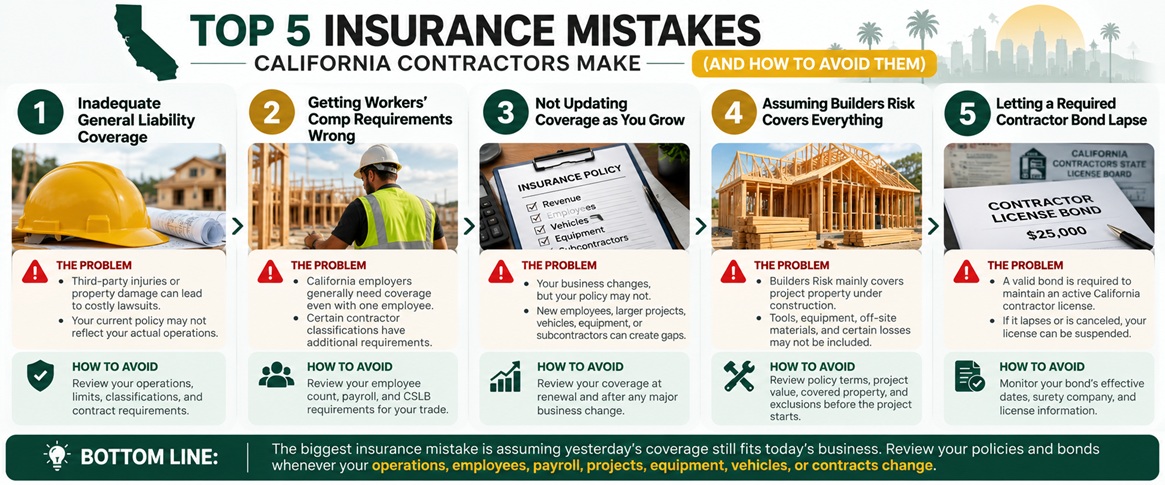
Below are five common insurance mistakes California contractors should watch for—and practical ways to reduce coverage gaps as their businesses change.The top 5 insurance mistakes California contractors should avoid often involve liability coverage, Workers’ Compensation, outdated policy information, Builders Risk assumptions, and contractor bonds.
Top 5 Insurance Mistakes California Contractors Should Avoid
Most insurance problems start with a simple oversight. Here are five common mistakes and what California contractors should review before they become costly problems.
| # | Common Mistake | Why It Matters | What to Review |
|---|---|---|---|
| 1 |
Inadequate General Liability Coverage | Outdated operations, limits, or classifications may not reflect the contractor’s current liability exposure. | Review General Liability → |
| 2 |
Getting Workers’ Comp Requirements Wrong | California employers generally need coverage with even one employee, and special CSLB rules apply to certain contractor classifications. | Review Workers’ Comp → |
| 3 |
Not Updating Coverage as You Grow | New employees, higher payroll, larger projects, vehicles, equipment, or subcontractors can change your risk. | Review revenue, payroll, operations, vehicles, equipment and subcontractor costs. |
| 4 |
Assuming Builders Risk Covers Everything | Project property, tools, equipment, off-site materials, and certain causes of loss may have different coverage requirements. | Review Builders Risk → |
| 5 |
Letting a Required Contractor Bond Lapse | Required contractor bond coverage must remain current to help maintain active California contractor license status. | Review Contractor Bonds → |
Review Your Coverage When:
You hire employees, increase payroll, add services, purchase vehicles or equipment, use more subcontractors, or take larger projects.
Before Signing a New Contract:
Check required limits, Workers’ Comp, Additional Insured requirements, Builders Risk, Auto coverage, and any required bonds.
The biggest insurance mistake is assuming yesterday’s coverage still fits today’s business. Review your policies and bonds whenever your
operations, employees, payroll, projects, equipment, vehicles, or contracts change.
1. Relying on the Wrong General Liability Coverage
General Liability is one of the first policies many contractors consider, but simply having a policy does not necessarily mean the coverage matches the business.
California contractors can face claims involving:
- Third-party bodily injury
- Damage to someone else’s property
- Jobsite accidents involving third parties
- Products and completed operations
- Legal defense associated with covered claims
The mistake is often not simply “having no insurance.”
It may be having coverage based on outdated or incomplete information about the contractor’s actual operations.
For example, a contractor may start by performing smaller residential projects and later move into larger remodels, commercial projects, or additional trades without reviewing the policy.
The contractor should make sure the insurer accurately understands the work being performed.
Is General Liability Required for California Contractors?
This needs an important clarification.
Commercial General Liability Insurance is not a blanket CSLB requirement for every California contractor. CSLB itself states that commercial general liability insurance is not generally required, although it can protect against certain property damage and liability exposures.
However, General Liability may still be required by:
- Project owners
- General contractors
- Commercial clients
- Property managers
- Lenders
- Leases
- Construction contracts
California LLC contractor licenses also have separate liability insurance requirements. CSLB currently states that LLC licenses must maintain liability insurance starting at $1 million for five or fewer personnel of record, increasing by $100,000 for each additional person up to $5 million. CSLB
How to Avoid This Mistake
Do not evaluate general contractor insurance based only on whether a policy exists.
Review:
- Current operations
- Trade and classifications
- Annual revenue
- Payroll
- Subcontractor costs
- Project types
- Coverage limits
- Deductibles
- Exclusions
- Completed-operations exposure
- Contract requirements
Your contractor liability insurance should be evaluated against what your business actually does.
2. Getting Workers’ Compensation Requirements Wrong
Workers’ Compensation is an area where California contractors need to be particularly careful.
California law generally requires employers to carry Workers’ Compensation Insurance even if they have only one employee. CSLB also has contractor-specific requirements affecting license status.
There is another important detail that a generic contractor insurance article can easily miss.
CSLB currently requires active contractors holding C-8 Concrete, C-20 HVAC, C-22 Asbestos Abatement, C-39 Roofing, or C-61/D-49 Tree Service classifications to maintain Workers’ Compensation coverage or valid self-insurance even when they do not have employees.
Contractors who qualify for an exemption must satisfy CSLB’s exemption requirements.
Why This Mistake Matters
Workers’ Compensation coverage must remain continuous when required.
CSLB states that failure to maintain required Workers’ Compensation coverage results in license suspension, and work performed while the license is suspended is considered unlicensed.
How to Avoid This Mistake
Review your Workers’ Compensation status whenever you:
- Hire your first employee
- Add new employees
- Change payroll significantly
- Add different job duties
- Change contractor classifications
- Use an RME
- Change business structure
Contractors can learn more about Workers’ Compensation Insurance and evaluate coverage based on their actual workforce and operations.One of the top insurance mistakes California contractors make is allowing their business to grow without updating the insurance information used to cover their operations.
3. Failing to Update Insurance as the Business Grows
A contractor’s business can change much faster than its insurance program.
Consider a contractor who originally reported:
- $250,000 annual revenue
- No employees
- Limited subcontractor use
- One work vehicle
- Small residential projects
Two years later, the same contractor may have:
- $1 million or more in revenue
- Several employees
- Multiple vehicles
- Higher payroll
- More subcontractors
- Larger contracts
- Expensive equipment
- Different project types
Yet the insurance program may still reflect the old business.
That mismatch can create problems.
Business Changes That Should Trigger an Insurance Review
Do not wait automatically for renewal if your business changes substantially.
Review your California contractor insurance when you:
Hire employees
Workers’ Compensation and payroll exposures can change.
Increase subcontractor use
Certificates of Insurance, subcontractor costs, contractual requirements, and policy terms should be reviewed.
Buy vehicles
Business vehicle exposures may require Commercial Auto coverage.
Purchase expensive tools or equipment
Your property and mobile-equipment exposures may change.
Take larger projects
Contract limits, insurance requirements, bonds, and project-specific policies may change.
Add a new trade or service
Your existing policy should not automatically be assumed to cover operations that were never contemplated when it was issued.
How to Avoid This Mistake
Treat insurance review as part of business growth.
At minimum, review your program at renewal and after material operational changes.
Do not focus only on premium.
Make sure the information being used to insure the company accurately reflects the company you operate today.
4. Misunderstanding Builders Risk Insurance
Builders Risk is another area where contractors can make assumptions about what a policy covers.
The California Department of Insurance describes Builders Risk as commercial property coverage for a new building or structure under construction or an existing structure undergoing additions, alterations, or repairs.California Department of Insurance
That makes it fundamentally different from General Liability.
General Liability addresses certain liability exposures.
Builders Risk focuses on covered property associated with a construction project.
The Mistake: Assuming Everything at the Jobsite Is Covered
Contractors should not automatically assume a Builders Risk policy covers:
- Every tool
- Every piece of equipment
- Every material regardless of location
- Existing structures
- Flood
- Earthquake
- Faulty workmanship
- Employee property
- Property in transit
- Property stored off-site
Coverage depends on the actual policy, endorsements, exclusions, limits, project structure, and covered causes of loss.
Tools and equipment that move between jobsites, for example, may require a different form of coverage rather than simply being assumed to fall under Builders Risk.
How to Avoid This Mistake
Before starting a project, determine:
- Who is responsible for obtaining Builders Risk?
- What property is insured?
- What is the project value?
- Are materials covered before installation?
- What about property in transit?
- What about off-site storage?
- Are existing structures involved?
- What exclusions apply?
- When does coverage begin and end?
Review Builders Risk Insurance before assuming another contractor’s or owner’s policy protects your project exposure.
5. Letting a California Contractor Bond Lapse
Insurance and bonds are different, but both can be important to a California contractor’s risk and licensing program.
CSLB currently requires the Contractor License Bond to be $25,000. The bond is maintained for the benefit of consumers who may be damaged by defective construction or other license-law violations and employees who have not received wages due to them.
A common mistake is assuming that once the bond has been purchased, nothing else needs to be monitored.
Contractors should keep track of:
- Surety company
- Bond number
- Effective date
- Business name
- License number
- Cancellation notices
- Replacement bond status
CSLB requires the business name and license number on the bond to correspond with its records.
Bond vs Insurance
A Contractor License Bond should not be confused with General Liability Insurance.
The bond serves a licensing and consumer-protection purpose.
General Liability addresses certain third-party liability exposures.
A contractor can therefore maintain the required bond and still have substantial uninsured liability exposure.
How to Avoid This Mistake
Monitor your bond independently from your insurance policies and contractor license expiration date.
If you need a new or replacement bond, review California Contractor Bonds.
If you want to understand what happens when someone makes a claim against the bond, read our Contractor Bond Claim guide.
Bonus Mistake: Assuming Subcontractors Transfer All the Risk
Using subcontractors does not automatically eliminate the general contractor’s exposure.
Before work begins, contractors should consider reviewing:
- Subcontractor license status
- Certificate of Insurance
- General Liability coverage
- Workers’ Compensation status
- Coverage limits
- Policy dates
- Written subcontract
- Additional insured requirements where applicable
- Scope of work
A Certificate of Insurance is useful evidence of insurance information, but it should not be treated as a guarantee that every claim will be covered.
The underlying policies and contractual relationships still matter.
This becomes particularly important as subcontractor costs and project sizes increase.
Insurance Mistakes Can Also Start in the Contract
Some coverage problems begin before a contractor even reaches the jobsite.
Construction contracts can require specific:
- General Liability limits
- Workers’ Compensation
- Commercial Auto
- Additional insured status
- Waivers
- Certificates of Insurance
- Builders Risk
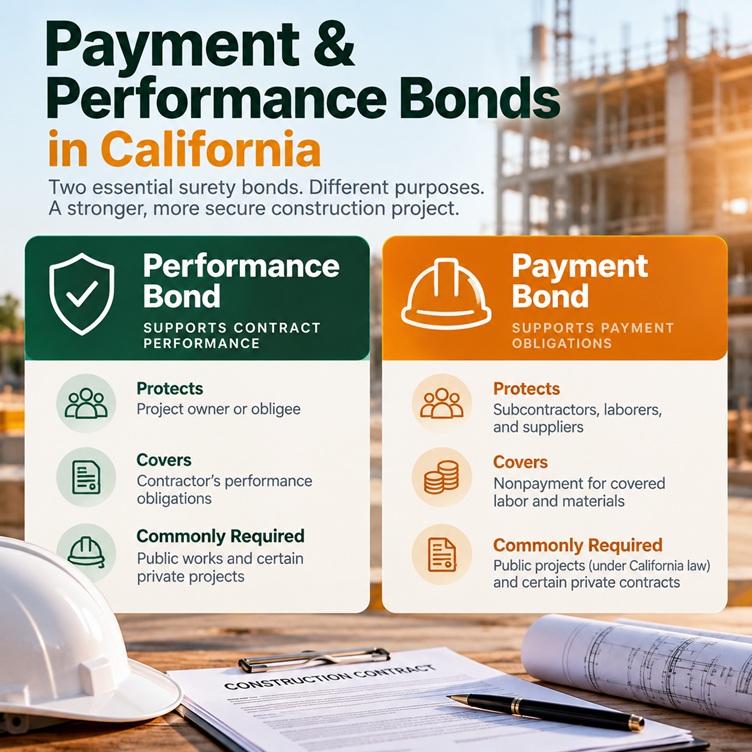
- Performance Bonds
- Payment Bonds
Signing a contract before reviewing those requirements can leave a contractor trying to obtain coverage or bonding after agreeing to terms.
Before signing a significant construction contract, identify the insurance and bond requirements and determine whether your current program can satisfy them.
For bonded projects, our Performance Bond California guide explains how project-specific performance bonding works.
A Better Annual Insurance Review for California Contractors
Instead of asking only, “Did my policy renew?” ask whether your insurance program still matches the business.
Review these areas:
Operations
Are you performing the same work as last year?
Revenue
Has annual revenue changed significantly?
Payroll
Have you hired employees or increased payroll?
Subcontractors
Are you using more subcontracted labor?
Vehicles
Have you purchased or added work vehicles?
Tools and Equipment
Has the value of equipment increased?
Projects
Are you taking larger or different types of jobs?
Contracts
Are clients requesting higher limits or additional coverage?
Claims
Have you had claims or circumstances that could affect underwriting?
Bonds
Are all required contractor and project-specific bonds current?
This type of review gives contractors a better picture of their actual exposure than simply comparing this year’s premium with last year’s. Reviewing these top 5 insurance mistakes in California is a useful starting point, but every contractor should also evaluate coverage based on their own trade, employees, projects, and contracts.
California Contractor Insurance Checklist
Before renewing or purchasing coverage, gather:
- Current annual revenue
- Current payroll
- Number of employees
- Employee job duties
- Subcontractor costs
- Types of construction performed
- Largest project size
- Typical project size
- Vehicle information
- Tools and equipment values
- Claims history
- Current contracts
- Required insurance limits
- Contractor license information
- Bond information
Providing accurate information can make it easier to evaluate the appropriate general liability insurance for contractors and other commercial coverage.
Avoid Insurance Gaps Before They Become Expensive Problems
The biggest insurance mistakes California contractors make are often not dramatic mistakes.
They are outdated information, assumptions about what a policy covers, missed Workers’ Compensation requirements, overlooked project exposures, or bonds and policies that no longer match the business.
As your construction company changes, your insurance and bonding program should be reviewed with it.
Green State Insurance helps California contractors evaluate contractor liability insurance, Workers’ Compensation, Builders Risk, and Contractor Bonds based on their operations and project requirements.
For additional contractor coverage options, explore Green State Insurance Services or call (949) 432-4805.
Frequently Asked Questions
Quick answers to common questions about contractor insurance, Workers’ Compensation, Builders Risk, and contractor bonds in California.
What are the top 5 insurance mistakes California contractors make?
The top 5 insurance mistakes California contractors make include relying on inadequate General Liability coverage, misunderstanding Workers’ Compensation requirements, failing to update coverage as the business grows, assuming Builders Risk covers every project exposure, and allowing a required contractor bond to lapse.
Is General Liability Insurance required for every California contractor?
No. Commercial General Liability Insurance is not a blanket CSLB requirement for every licensed California contractor. However, it may be required by clients, project owners, contracts, leases, or other agreements. California LLC contractor licenses also have specific liability insurance requirements.
Does a California contractor need Workers’ Compensation with one employee?
Yes. California employers are generally required to carry Workers’ Compensation Insurance even with one employee. Contractor-specific CSLB requirements may also apply depending on the license classification and circumstances.
Can a contractor without employees be exempt from Workers’ Compensation?
Some contractors without employees may qualify for an exemption, but important exceptions apply. Certain California contractor classifications are required to maintain Workers’ Compensation coverage or valid self-insurance even when they have no employees.
Does Builders Risk cover contractor tools?
Not necessarily. Builders Risk primarily addresses covered property associated with a construction or renovation project. Coverage for tools, mobile equipment, off-site materials, and property in transit depends on the specific policy and may require separate coverage.
How much is the California Contractor License Bond?
The current California Contractor License Bond requirement is $25,000. Contractors should also make sure the required bond remains continuously on file to maintain their license status.
Is a Contractor Bond the same as General Liability Insurance?
No. A contractor bond and General Liability Insurance serve different purposes. Maintaining the required license bond does not mean a contractor has liability insurance, and General Liability coverage does not replace the required contractor bond.
How often should contractors review their insurance?
Contractors should review coverage at renewal and whenever there is a significant change in operations, payroll, employees, subcontractors, vehicles, equipment, project size, or contractual insurance requirements.
Should subcontractors have their own insurance?
Insurance requirements depend on the subcontractor relationship, scope of work, applicable law, and contract. Contractors should verify relevant insurance and Workers’ Compensation information rather than assuming subcontracted work automatically transfers all risk.
Quick Tip:
Insurance requirements can change as your contracting business grows. Review your policies and bonds when you add employees, increase payroll, purchase vehicles or equipment, expand services, or take on larger projects.