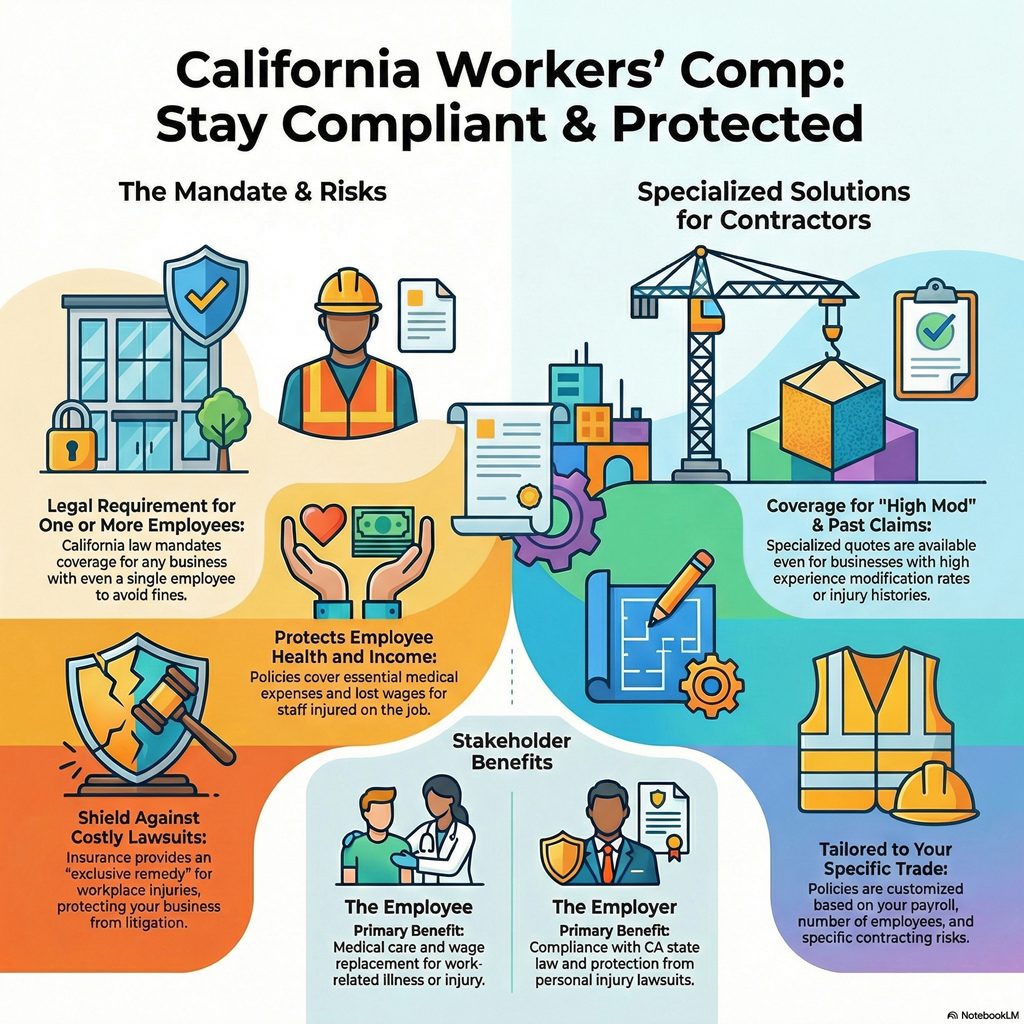
Employee Protection
Benefits for eligible work-related injuries and illnesses.
Green State Insurance helps general contractors, subcontractors, and construction businesses find workers’ compensation insurance in California. Whether you manage a construction crew, hire employees, or oversee multiple job sites, understanding your coverage requirements is essential to protecting your workers and maintaining compliance with California regulations.
Construction projects come with changing job sites, different trades, and real workplace risks. Green State Insurance helps California general contractors review workers’ compensation options based on their employees, operations, and project requirements.
Coverage and eligibility depend on your business and policy terms.

What matters for your business
Benefits for eligible work-related injuries and illnesses.
Review insurance obligations tied to California licensing.
Understand insurance verification and potential exposure.
Address coverage documentation requested for jobs.
Built for contractors managing employees, job sites, and changing project needs.
Understanding the process from injury to recovery
California Contractors: Special Requirements
California law mandates workers compensation insurance for ALL licensed contractors who have employees, including part-time workers and family members. Operating without coverage can result in immediate license suspension and criminal prosecution.
California generally requires employers to maintain workers’ compensation insurance when they have one or more employees. For general contractors, these requirements are especially important because construction operations may involve employees, subcontractors, and multiple job sites.
Under current California Contractors State License Board (CSLB) requirements, contractors with employees must provide proof of workers’ compensation coverage or approved self-insurance.
Certain contractor license classifications, including C-8 Concrete, C-20 HVAC, C-22 Asbestos Abatement, C-39 Roofing, and C-61/D-49 Tree Service, must maintain coverage or valid self-insurance even without employees.
Eligible contractors with no employees may qualify to file a workers’ compensation exemption, depending on their license classification and business circumstances.
General contractors should also verify subcontractor licensing and insurance documentation because subcontractor arrangements can create additional legal and insurance exposure.
For current requirements, visit the California CSLB Workers Compensation Requirements page.
Protection from employee lawsuits - workers typically cannot sue employers for workplace injuries covered by workers comp
Guaranteed benefits without proving fault, avoiding expensive legal battles and ensuring quick medical treatment
Workers compensation insurance covers 100% of medical costs for approved work-related injuries and illnesses. Employees never receive a medical bill for covered treatment.
Comprehensive coverage for work-related injury treatment
Financial support during recovery periods
Support for returning to work and normal life
Financial protection for dependents after fatal injuries
Self-employed individuals and true independent contractors are typically not covered
Injuries resulting from deliberate actions are not covered
Coverage excludes injuries unrelated to job duties
Government workers covered under separate federal programs
The cost of workers’ compensation insurance for general contractors in California depends on the type of construction work performed, employee payroll, applicable workers’ compensation classification codes, claims history, and other underwriting factors.
A general contractor managing office-based operations may have a different insurance cost structure than a contractor employing workers who perform roofing, framing, concrete work, or other higher-risk construction activities.
To obtain an accurate quote, contractors should be prepared to provide information about their business operations, employee count, estimated annual payroll, work classifications, and prior insurance history.
Green State Insurance helps contractors review their insurance needs and explore available workers’ compensation coverage options in California.
Get a General Contractor Workers Comp Quote
Strategic advantages that drive growth and sustainability
Understanding the difference and why you need both
Example Claim:
Employee falls from ladder and breaks arm. Workers comp covers all medical treatment and 2/3 of lost wages during recovery. Employee cannot sue for additional damages.
Example Claim:
Employee’s spouse sues for “loss of consortium” after workplace injury leaves employee permanently disabled. Employer’s liability covers defense costs and settlement.
Workers’ compensation insurance ensures your employees receive medical care and wage replacement if they’re injured or fall ill on the job. By carrying this coverage, you show commitment to their well-being while protecting your business from costly lawsuits.
Building across California? We’ve got your contracting risks covered. Request a free, no-obligation quote today for surety bonds, general liability, builders risk, bid & performance bonds, and workers’ compensation—everything a California contractor needs to stay compliant, competitive, and worry-free. Connect with our specialists now and lock in coverage you can build on.
Discover how contractors across California approach workers’ compensation insurance, employee protection, and business compliance with guidance from Green State Insurance.
California Contractor Coverage
Answers to common questions about workers' compensation insurance, California requirements, subcontractors, and coverage costs.
Generally, California general contractors with one or more employees must carry workers' compensation insurance. Contractors without employees may qualify for an exemption, depending on their license classification and applicable CSLB requirements.
Subcontractors are not automatically covered by a general contractor's policy. Coverage responsibilities depend on worker classification, licensing, insurance arrangements, and California law. Verify subcontractor coverage and discuss potential exposure with an insurance professional.
Premiums depend on payroll, job duties, classification codes, claims history, and other underwriting factors. A quote based on your actual operations is more useful than a generic estimate.
Be ready to share your business name, contractor license details, employee count, estimated payroll, type of construction work, and available claims history. Insurers may ask for additional documentation.
Some contractors without employees may qualify for a workers' compensation exemption, but specific license classifications have additional coverage requirements. Check the current CSLB rules before relying on an exemption.
Need coverage for your contracting business?
Request a Workers Comp Quote →Explore practical guides covering workplace injury claims, workers' compensation requirements, and insurance considerations for California construction professionals.
Understand how workers' compensation claims work in California, including injury reporting, claim forms, employer responsibilities, and the review process.
Read the Guide →Learn about workers' compensation considerations for California plumbing contractors, including employee injury exposures and coverage needs.
Read the Guide →Explore workers' compensation and insurance considerations for drywall businesses, including jobsite injury risks and contractor coverage.
Read the Guide →