


Workers Compensation Claim California: How the Claims Process Works
A workplace injury can create immediate questions for both employees and employers. Who needs to report the injury? What paperwork needs to be completed? Who handles medical treatment? And what happens after the claim reaches the insurance company?
Understanding the workers compensation claim California process can make those first steps easier to manage.
California’s workers’ compensation system is designed to provide benefits for employees who experience qualifying work-related injuries or illnesses. At the same time, employers have specific responsibilities after learning that an employee may have been injured at work.
For California businesses—especially contractors, construction companies, and employers with physically demanding operations—knowing how the claims process works is an important part of managing workplace risk.
Workers Compensation Claim California: What Happens Next?
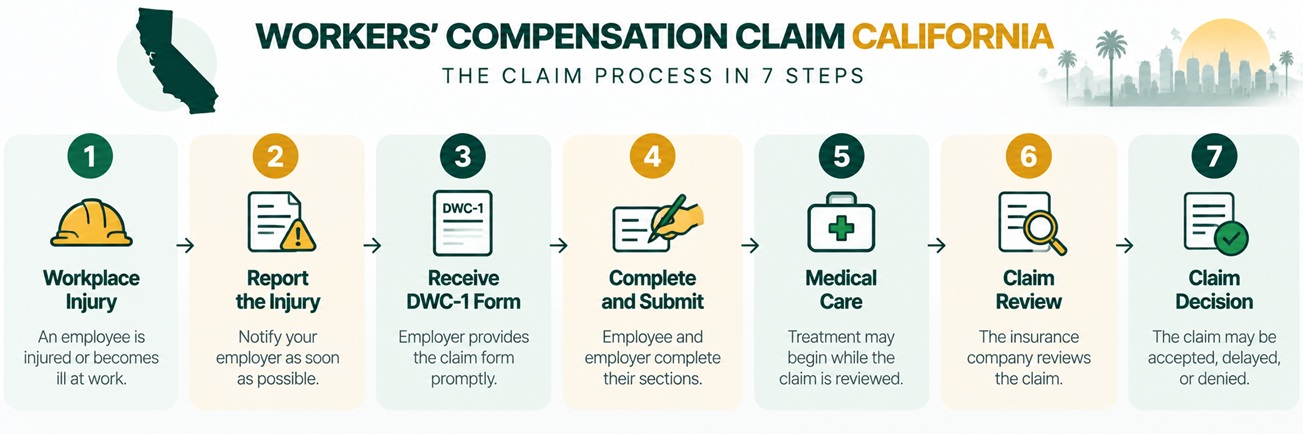
A workplace injury can move quickly from an incident to an insurance claim. Here is a simple overview of the California workers’ compensation claim process and what employees and employers should expect.
| Step | What Happens | What You Should Know | Employer Action |
|---|---|---|---|
| 1 | Workplace Injury | An employee is injured or develops an illness that may be related to work. | Address urgent medical needs and document when and how the injury was reported. |
| 2 | Injury Is Reported | Workplace injuries should be reported promptly rather than waiting for symptoms or problems to become more serious. | Follow the company’s established injury-reporting procedure. |
| 3 | DWC-1 Claim Form | The employer generally provides or mails the claim form within one working day after learning about the injury. | Provide the form promptly and maintain accurate records of the claim. |
| 4 | Claim Is Submitted | The employee completes their section, and the employer completes its section before the claim is forwarded to the appropriate claims administrator. | Send the required information to the Workers’ Compensation carrier or claims administrator. |
| 5 | Medical Care | Appropriate medical treatment may begin while the claim is being evaluated, subject to California workers’ compensation rules. | Follow the applicable medical and claims procedures provided by the carrier. |
| 6 | Claim Review | The claims administrator reviews the injury, medical information, employment details, and other relevant records. | Respond promptly to legitimate requests for claim-related information. |
| 7 | Claim Decision | The claim may be accepted, remain under investigation, or be denied depending on the circumstances. | Continue documenting the claim and coordinate with the claims administrator as needed. |
Report a workplace injury promptly, complete the required claim information accurately, keep copies of important documents, and follow the applicable medical and claim procedures.
Document the incident, provide the required claim form promptly, notify the appropriate insurance contact, preserve records, and cooperate with the claims process.
Make sure your employee information, payroll, classifications, and Workers’ Compensation coverage reflect your current business operations.
What Is a Workers Compensation Claim in California?
A workers’ compensation claim is the process through which an employee seeks benefits for a work-related injury or illness.
A claim might involve a sudden accident, such as a worker falling from a ladder, or a condition that develops over time because of repetitive job duties.
Depending on the circumstances, workers’ compensation benefits may include:
- Medical treatment
- Temporary disability benefits
- Permanent disability benefits
- Supplemental job displacement benefits
- Death benefits for qualifying dependents
Workers’ compensation is different from General Liability Insurance.
Workers’ Compensation generally addresses employee work-related injuries and illnesses, while general liability insurance for contractors is designed around certain third-party bodily injury, property damage, and other covered liability exposures.
For businesses with employees, understanding that distinction is important.
Common Workplace Injuries That May Lead to a Claim
A California workers compensation claim does not always begin with a dramatic jobsite accident.
Claims can arise from many types of workplace injuries and illnesses.
Strains and Sprains
Lifting materials, carrying equipment, repetitive movement, awkward positions, and physically demanding work can contribute to muscle, back, shoulder, or joint injuries.
These exposures are particularly relevant in construction, remodeling, warehousing, manufacturing, landscaping, and other physical occupations.
Slips, Trips, and Falls
Wet surfaces, uneven flooring, debris, ladders, scaffolding, stairs, and changing jobsite conditions can contribute to falls.
The resulting injuries can range from relatively minor strains to fractures or more serious injuries.
Cuts and Lacerations
Construction and trade businesses regularly use saws, blades, drills, power tools, sheet metal, glass, and other materials that can cause cuts.
Falling Objects
Tools, materials, equipment, or construction debris can create injury risks for employees working below.
Vehicle-Related Injuries
Employees who drive between jobsites, transport materials, or operate company vehicles may experience work-related vehicle accidents.
Repetitive Motion Injuries
Not every workplace injury happens at a specific moment.
Repeated lifting, gripping, typing, bending, or other job activities may contribute to conditions that develop gradually.
Occupational Illnesses
Some workers may also be exposed to dust, chemicals, fumes, noise, or other workplace conditions that can contribute to occupational illnesses.
The circumstances of each claim are different, which is why accurate injury reporting and documentation matter.
How to File a Workers Compensation Claim in California
The workers compensation claim California process can be understood in seven basic steps.
Step 1: Report the Injury
The employee should notify the employer or supervisor as soon as possible after a workplace injury.
If the condition developed gradually, it should be reported when the employee learns or believes that it may be related to work.
Prompt reporting can help avoid delays in medical care and the claim process.
California also has reporting deadlines. Waiting too long can potentially affect an employee’s rights, so workplace injuries should not be ignored or left undocumented.
Step 2: Receive the DWC-1 Claim Form
After learning about a work-related injury or illness, the employer generally must provide or mail the employee a Workers’ Compensation Claim Form, known as DWC-1, within one working day. CalDIR
This form formally begins an important part of the workers’ compensation claim process.
Step 3: Complete the Employee Section
The employee completes the employee portion of the DWC-1 form.
Information should be accurate and the form should be signed and dated.
The employee should keep a copy for their records and return the completed form to the employer promptly.
Good recordkeeping can become particularly important if questions arise later about:
- When the injury occurred
- How the injury happened
- When it was reported
- What body parts were affected
- When the claim form was submitted
Step 4: Employer Completes Its Section
After receiving the employee’s completed claim form, the employer completes the employer section and forwards the form to the appropriate insurance company or claims administrator.
The employee should also receive a copy of the completed form.
This is one reason employers need an established internal process for workplace injuries.
Managers and supervisors should know who to contact rather than trying to determine the entire claims process after an accident occurs.
Step 5: Medical Treatment and Claim Review Begin
Medical care is one of the central parts of workers’ compensation.
California DWC states that within one day after an employee files a claim form, the employer must authorize appropriate medical treatment while the claim is being considered. Up to $10,000 in treatment may be available during the period in which the employer or claims administrator is deciding whether to accept or reject the claim.
The exact medical process can depend on the employer’s insurance arrangement and applicable workers’ compensation rules.
Step 6: The Claims Administrator Reviews the Claim
After the claim reaches the insurance company or claims administrator, it is reviewed.
The administrator may evaluate:
- The reported accident
- Medical information
- Job duties
- Employment information
- Witness statements
- Injury circumstances
- Available workplace records
The insurance company generally has 14 days to send the employee a letter explaining the status of the claim.
A claim may be accepted, remain under investigation, or ultimately be denied depending on the facts and applicable rules.
Step 7: Claim Decision and Benefits
California DWC states that if a filed claim is not denied within 90 days after the claim form is given to the employer, the injury is generally presumed to be covered.
An accepted claim may provide benefits depending on the nature and severity of the injury.
That does not mean every employee receives every type of benefit.
The benefits depend on the circumstances of the individual claim.
What Benefits Can a California Workers Compensation Claim Provide?
California workers’ compensation provides several basic categories of benefits.
Medical Care
Medical benefits can pay for appropriate treatment needed to recover from a qualifying work-related injury or illness.
Temporary Disability Benefits
Temporary disability benefits may provide partial wage replacement when an employee cannot perform their usual work while recovering.
California DWC generally describes temporary disability as two-thirds of lost gross wages, subject to statutory minimum and maximum amounts.
Permanent Disability Benefits
If an employee does not fully recover and the injury results in lasting disability that affects earning capacity, permanent disability benefits may apply.
Supplemental Job Displacement Benefits
In qualifying situations, an employee who does not fully recover and does not return to work for the employer may qualify for assistance with retraining or skill enhancement.
Death Benefits
When a worker dies because of a qualifying work-related injury or illness, eligible dependents may qualify for death benefits.
Accepted, Delayed, and Denied Workers Comp Claims
Not every workers’ compensation claim follows exactly the same path.
Accepted Claim
An accepted claim means the claims administrator has accepted liability for the workplace injury or illness.
Applicable workers’ compensation benefits can then be provided according to the circumstances of the claim.
Claim Under Investigation
Sometimes the claims administrator needs additional time or information before deciding whether the claim should be accepted.
During this period, medical records, employment information, accident details, or other evidence may be reviewed.
Denied Claim
A claim can also be denied.
A denial does not necessarily mean the process ends immediately. California has procedures for disputes over workers’ compensation claims.
From the employer’s perspective, the key is to provide accurate information and allow the claims administrator to evaluate the claim.
What Should a California Employer Do After a Workplace Injury?
Employers play an important role in the workers compensation claim California process.
After learning about a workplace injury, a business should generally focus on several immediate priorities.
Address urgent medical needs.
Emergency situations should be treated as emergencies first.
Document the incident.
Record when, where, and how the injury was reported.
Provide the required claim form.
Do not unnecessarily delay the DWC-1 process.
Notify the appropriate insurance contact.
Follow the reporting procedures established by your Workers’ Compensation carrier or claims administrator.
Preserve relevant records.
Keep incident reports, witness information, photographs, payroll information, job descriptions, and other relevant documents.
Stay in communication.
Appropriate communication between the employer, employee, medical providers, and claims administrator can help prevent unnecessary confusion.
Workers Compensation Claim vs Workers Compensation Insurance
These terms are related, but they do not mean the same thing.
Workers’ Compensation Insurance is the insurance coverage maintained by an employer.
A Workers’ Compensation Claim occurs when a worker reports a qualifying work-related injury or illness and seeks benefits through the workers’ compensation system.
California employers are generally required to maintain Workers’ Compensation Insurance even if they have only one employee.
Businesses that need to review their coverage can learn more about Workers’ Compensation Insurance through Green State Insurance.
How Can Workers Compensation Claims Affect an Employer?
A claim is primarily about addressing the employee’s work-related injury, but claims can also become part of the employer’s broader insurance picture.
Depending on the business and its insurance program, claim history may be relevant to underwriting and future insurance costs.
Insurers may consider factors such as:
- Type of claims
- Frequency of claims
- Severity of claims
- Payroll
- Employee classifications
- Business operations
- Safety practices
- Historical losses
For some businesses, workers’ compensation experience can also influence experience modification calculations.
However, employers should not assume that every claim produces the same premium impact.
A single minor claim and a pattern of frequent or severe claims are not necessarily evaluated in the same way.
Why Workers Comp Claims Matter for California Contractors
Construction businesses can face significant workplace injury exposure.
Employees may:
- Work at heights
- Use ladders and scaffolding
- Operate power tools
- Lift heavy materials
- Work around electrical systems
- Drive between jobsites
- Work around heavy equipment
- Perform repetitive physical tasks
- Work in changing jobsite conditions
For contractors, Workers’ Compensation should therefore be treated as more than paperwork required after an accident.
It is part of the overall risk-management program.
A contractor may also need to coordinate Workers’ Compensation with contractor liability insurance, commercial auto coverage, project coverage, and applicable Contractor Bonds.
Common Workers Compensation Claim Mistakes Employers Should Avoid
Waiting Too Long to Report a Claim
Delays can create unnecessary complications.
Businesses should establish a clear procedure so supervisors know what to do when an injury is reported.
Incomplete Incident Documentation
Important details can become difficult to reconstruct weeks or months later.
Document the basic facts while information is still fresh.
Assuming a Minor Injury Will Disappear
An injury that initially appears minor may later require additional medical attention.
Employers should follow appropriate reporting procedures rather than making assumptions about medical severity.
Changing the Story After the Claim
Inconsistent documentation can create confusion.
Record factual information rather than speculation about fault or intent.
Failing to Update Payroll and Employee Information
Workers’ Compensation coverage depends heavily on accurate business information.
Changes in payroll, employee classifications, operations, and staffing should be reflected appropriately.
Treating Insurance as a Substitute for Safety
Insurance helps address financial consequences of covered losses.
It does not prevent injuries.
Workplace safety and insurance should work together.
How Employers Can Reduce Future Workers Compensation Problems
Not every workplace injury is preventable, but businesses can take practical steps to improve risk management.
Build a Clear Injury-Reporting Procedure
Employees and supervisors should know:
- Who should be notified
- How incidents should be documented
- Where employees should seek appropriate medical care
- Who contacts the insurance company
- Where claim documentation is stored
Review Employee Classifications
Make sure job duties and Workers’ Compensation classifications accurately reflect what employees actually do.
Keep Payroll Information Current
Significant payroll changes can affect Workers’ Compensation exposure.
Train Employees
Training should match the actual risks of the job.
For contractors, this may include:
- Ladder safety
- Equipment operation
- Lifting practices
- Personal protective equipment
- Vehicle safety
- Jobsite housekeeping
Review Claims Trends
One claim may be an isolated incident.
Repeated similar claims may indicate an underlying operational issue that deserves attention.
Workers Compensation Insurance Checklist for California Employers
Businesses should periodically review:
- Number of employees
- Employee job duties
- Workers’ Compensation classifications
- Current payroll
- Expected annual payroll
- New hires
- New services
- New locations
- Subcontractor relationships
- Previous claims
- Workplace safety procedures
- Injury-reporting procedures
- Return-to-work procedures
- Insurance policy information
For contractors, the review should also consider whether changes in license classification, workforce, or operations create additional insurance requirements.
Review Your Workers Compensation Coverage Before a Claim Happens
A workers compensation claim California employers face is easier to manage when the business already has clear reporting procedures, accurate employee and payroll information, and appropriate insurance coverage.
Employers should not wait until an employee is injured to determine who handles claims or whether their Workers’ Compensation information is current.
Green State Insurance helps California businesses and contractors review Workers’ Compensation Insurance based on their workforce, payroll, operations, and insurance needs.
Businesses can also explore Green State Insurance Services or call (949) 432-4805 to discuss coverage.
Frequently Asked Questions
Quick answers about the workers compensation claim California process, employer responsibilities, claim timelines, and insurance.
What is a workers compensation claim in California?
A workers’ compensation claim is the process used when an employee seeks benefits for a qualifying work-related injury or illness.
How soon should an employee report a workplace injury?
The injury should be reported as soon as possible. California DWC warns that failing to report an injury within 30 days can potentially jeopardize the right to workers’ compensation benefits.
How quickly must an employer provide a claim form?
The employer generally must provide or mail the DWC-1 claim form within one working day after learning about the injury or illness.
How long does a workers compensation claim take in California?
There is no single timeline for every claim. California establishes specific deadlines within the process, including the general 14-day status notification and the 90-day rule concerning acceptance or denial.
Does filing a workers compensation claim guarantee benefits?
No. Filing starts the claim process, but the claims administrator evaluates whether the claim and requested benefits qualify under California workers’ compensation rules.
Can a Workers’ Compensation claim be denied?
Yes. Claims can be denied when the claims administrator determines that the claim does not qualify. California provides procedures for disputing claim decisions.
Does California require Workers’ Compensation with one employee?
Generally, yes. California employers are required to carry Workers’ Compensation Insurance even when they have only one employee.
Can a workers compensation claim affect insurance premiums?
Claim history can be relevant to Workers’ Compensation pricing and underwriting, but the impact varies based on factors such as claim frequency, severity, payroll, classifications, and the employer’s overall loss experience.