LLC Insurance
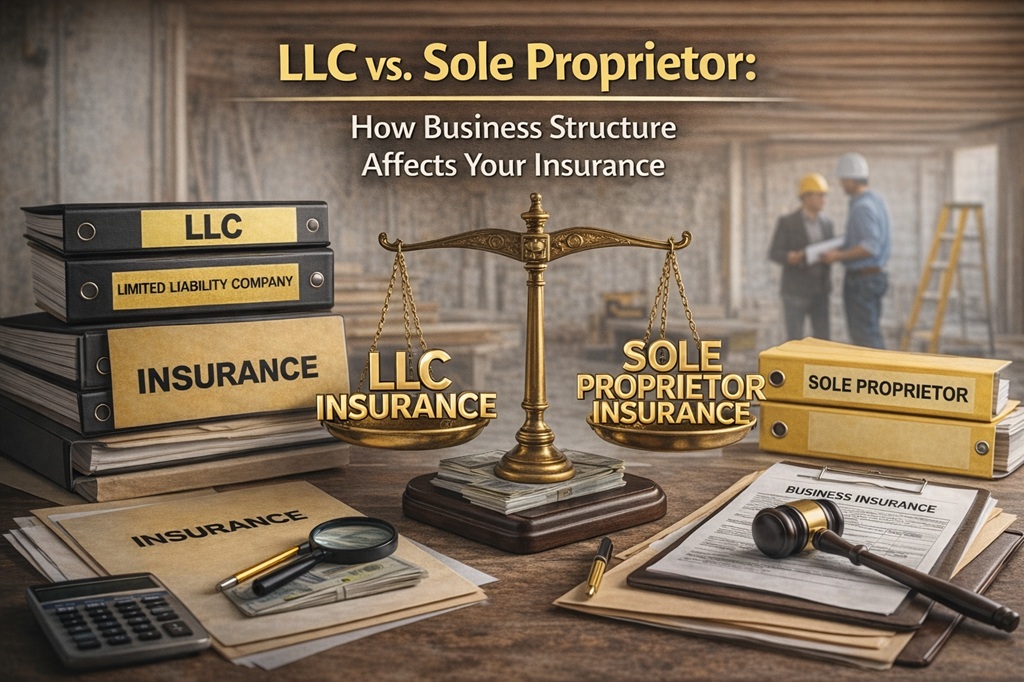
LLC vs. Sole Proprietor: How Business Structure Affects Your Insurance
Let’s start with a common misconception.
Choosing between an LLC and a Sole Proprietorship is not just a legal or tax decision. It directly affects how your insurance works, what it protects, and how exposed you are when something goes wrong.
Many contractors set up their business structure quickly—sometimes without much thought—just to get licensed and start working. Insurance often comes later. The problem is that once a claim happens, your business structure suddenly matters a lot more than you expected.
Sole Proprietor vs. LLC: the basic difference
A Sole Proprietorship is the simplest business structure. There’s no legal separation between you and the business. If the business is sued, you are sued. Your personal assets—bank accounts, home, savings—are all potentially exposed.
An LLC (Limited Liability Company), on the other hand, creates a legal separation between you and the business. Claims are generally directed at the company, not you personally. That separation doesn’t eliminate risk, but it changes how much of your personal life is on the line.
Insurance interacts very differently with these two structures.
How insurance works for Sole Proprietors
As a Sole Proprietor, your insurance policies usually list you personally as the insured. General Liability, for example, protects you while you’re working—but it does not create a shield around your personal assets beyond policy limits.
If a claim exceeds your coverage, or falls outside of it, the exposure can move directly to you. That’s why Sole Proprietors often underestimate risk: the policy exists, but the structure offers no backup protection.
For very small operations, this may be manageable—but the risk grows quickly as projects get bigger.
How insurance works for LLCs
With an LLC, insurance is written in the company’s name. Claims are typically handled at the business level, not the personal level. That alone changes how insurers evaluate risk, pricing, and coverage options.
LLCs often qualify more easily for bundled policies, higher limits, and cleaner contract compliance—especially when working with general contractors, property managers, or commercial clients. Many clients prefer, or even require, contractors to operate as an LLC before awarding work.
That doesn’t mean insurance becomes optional or less important. It means insurance works with the structure instead of trying to compensate for its absence.
Why this matters more in California
California is not forgiving when it comes to liability. Claims escalate fast, legal costs are high, and disputes don’t stay informal for long. Even if you’re properly licensed through the California Contractors State License Board, licensing does not protect your personal assets.
For Sole Proprietors in California, one uncovered or underinsured claim can have long-term consequences. For LLCs, the same claim is more likely to stay contained at the business level—assuming insurance is set up correctly.
Business structure doesn’t replace insurance. But in California, it absolutely affects how much damage a claim can do.
Common insurance mistakes tied to business structure
Most problems don’t come from choosing the “wrong” structure—they come from mismatching structure and insurance.
Common issues include:
-
Buying insurance as a Sole Proprietor while operating like an LLC
-
Forming an LLC but keeping policies under a personal name
-
Assuming an LLC alone provides protection without proper coverage
-
Carrying low limits because “the business is small”
-
Not updating insurance after changing business structure
Each of these can weaken coverage and create gaps that only show up after a claim is filed.
Frequently Asked Questions: LLC vs. Sole Proprietor & Insurance
Does forming an LLC reduce my insurance costs?
Not always. Sometimes premiums are similar. The real benefit is reduced personal exposure and better alignment with commercial requirements.
Do I still need General Liability if I have an LLC?
Yes. An LLC does not replace insurance. It only defines who the claim is filed against.
Can I switch from Sole Proprietor to LLC later?
Yes, but your insurance must be updated immediately. Old policies may not cover the new entity.
Do clients care about my business structure?
Many do—especially GCs, HOAs, and commercial clients. An LLC often signals professionalism and lower risk.
Is Sole Proprietor insurance “worse” than LLC insurance?
Not worse—but more personally exposed. The structure determines who takes the hit when coverage runs out.
Which structure makes sense for contractors?
If you’re doing occasional, low-risk work with small contracts, a Sole Proprietorship with proper insurance may be enough—for now. But as soon as projects grow, contracts get tighter, or other parties are involved, the balance shifts.
For many California contractors, an LLC paired with properly structured insurance offers a cleaner, safer, and more scalable setup. It doesn’t eliminate risk—but it controls it.
Insurance works best when it matches how your business actually operates. When structure and coverage are aligned, you’re not just insured—you’re protected in the way that matters.
If you’re trying to cut costs without cutting coverage, a Business Owners Policy (BOP) is often one of the smartest moves for small contractors. A BOP typically bundles core protections—like liability and certain business property coverage—into one policy, which can simplify paperwork and reduce premium overlap. To build a well-rounded insurance setup around a BOP, many contractors also pair it with essentials like
General Liability Insurance,
Workers’ Compensation Insurance,
Contractor Bond,
and project-specific protection such as
Builders Risk Insurance (California).
Together, this combination helps keep your business compliant, better protected, and less exposed to expensive surprises—while still keeping your insurance spend under control.