
Contractor Bond Claim in California: What You Need to Know
A Contractor Bond Claim can arise when a California contractor allegedly violates obligations covered by the contractor license bond.
For consumers, a bond claim may provide a potential path to seek compensation in certain qualifying circumstances. For contractors, receiving notice of a claim can create an issue that should be addressed promptly with the surety company.
But a Contractor Bond Claim is not the same as filing a complaint with the Contractors State License Board (CSLB), making an insurance claim, or filing a claim against a project-specific performance bond.
California requires an active contractor to maintain a $25,000 contractor license bond or qualifying alternative with CSLB. The bond is maintained for the benefit of consumers who may be damaged by defective construction or other license-law violations and employees who have not received wages due to them. CSLB
This guide explains who may make a claim, where a claim is filed, what documents may be useful, what happens after filing, and what California contractors should know when a claim is made against their bond.
Contractor Bond Claim in California: Quick Guide
Whether you are considering a claim or are a contractor who received one, these are the key points to understand first.
| Your Question | Quick Answer | What to Do |
|---|---|---|
| How much is the California contractor bond? | The current California Contractor License Bond requirement is $25,000. |
Verify the contractor and applicable bond. |
| Where do I file a bond claim? | Directly with the surety company that issued the applicable contractor bond. | Find the surety through the contractor’s CSLB bond history. |
| Does CSLB process the claim? | No. CSLB does not process claims against the surety company. | File the bond claim with the surety. A CSLB complaint is a separate process. |
| Who may have a potential claim? | Qualifying homeowners, persons damaged by certain license-law violations or fraud, and employees with unpaid wages may have potential claims. | Gather the contract, evidence, payment records, and documentation of damages. |
| Does filing guarantee payment? | No. The surety investigates the claim and determines how it will respond. | Submit clear supporting evidence and respond to requests from the surety. |
| What if I’m the contractor receiving the claim? | Do not ignore the notice. The surety may request your response and supporting project records. | Review the contract, change orders, payments, photos, communications, and project timeline. |
| Is this an insurance claim? | No. A Contractor License Bond and liability insurance serve different purposes. | Review Contractor Liability Insurance → |
| Is this a Performance Bond claim? | Not necessarily. A Contractor License Bond is different from a project-specific Performance Bond. | Review our Performance Bond California guide for project-specific bonding. |
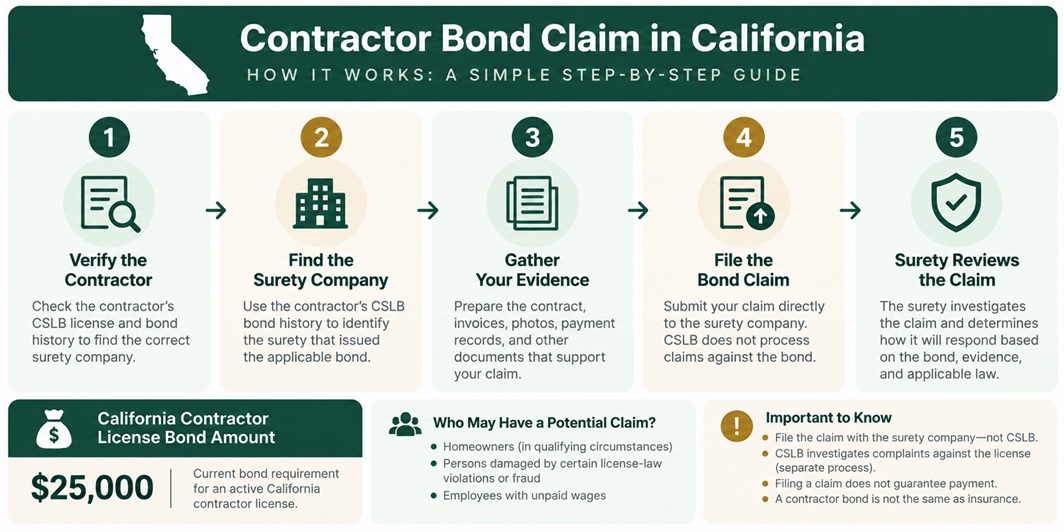
1. Verify Contractor
→
2. Find Surety
→
3. Gather Evidence
→
4. File Claim
→
5. Surety Reviews
Bottom Line:
A California Contractor Bond Claim is filed with the
surety company—not CSLB.
Filing a claim does not guarantee payment, and contractors who receive a claim should respond promptly and provide relevant project documentation.
What Is a Contractor Bond Claim?
A Contractor Bond Claim is a request for compensation made against a contractor’s surety bond based on an alleged covered violation or obligation.
California’s contractor license bond is not simply insurance purchased to protect the contractor.
It exists for the benefit of specified parties who may suffer qualifying damages associated with contractor license-law violations and certain other covered circumstances.
A bond generally involves three parties:
Principal — The licensed contractor required to maintain the bond.
Obligee — In the contractor-license context, the bond is filed with CSLB under California’s licensing requirements.
Surety — The company issuing the bond and investigating claims submitted against it.
Understanding this relationship is important because a claimant generally does not submit the bond claim to Green State or ask CSLB to pay it. The claim is made to the surety that issued the applicable bond.
Who Can File a Contractor Bond Claim in California?
Not every disagreement with a contractor automatically creates a valid bond claim.
According to CSLB, claims may potentially be made by several categories of parties under qualifying circumstances.
Homeowners
A homeowner who contracted for home improvements or construction of a single-family dwelling and was damaged because of a violation of contractor license law may potentially make a claim.
People Damaged by Certain Violations or Fraud
CSLB also identifies persons damaged as a result of a willful and deliberate violation of contractor license law or fraud by a licensee in the execution or performance of a construction contract.
Employees With Unpaid Wages
An employee damaged because a contractor failed to pay wages may also have potential rights against the bond.
CSLB’s current bond requirements specifically state that the bond is maintained for the benefit of employees who have not been paid wages due to them.
Eligibility depends on the particular facts and applicable law. The existence of a dispute by itself should not be interpreted as proof that the bond must pay the claim.
What Problems May Lead to a Contractor Bond Claim?
Potential bond claims can involve different circumstances.
Examples may include allegations involving:
- Defective construction
- Certain violations of contractor license law
- Fraud connected with a construction contract
- Willful and deliberate violations
- Unpaid employee wages
The facts of each situation matter.
For example, a homeowner being unhappy with an aesthetic choice is not necessarily the same as establishing a qualifying violation that creates liability under the bond.
The surety investigates the claim and determines how it will respond based on the applicable bond, documentation, law, and circumstances. CSLB separately investigates complaints filed against the contractor’s license.
How to Find the Contractor’s Surety Company
This is one of the most important practical steps in filing a Contractor Bond Claim.
The claim needs to reach the company that wrote the applicable bond.
CSLB instructs consumers to look up the contractor’s license and use the Contractor’s Bond History available from the contractor’s license detail page. This information can identify the surety company associated with the bond that was in place at the relevant time.
Pay attention to:
- Contractor license number
- Surety company
- Bond number
- Bond amount
- Effective date
- Cancellation date, if applicable
The bond in effect at the relevant time can matter.
Do not simply assume that the contractor’s current surety is necessarily the company associated with an older project.
How to File a Contractor Bond Claim in California
The exact procedure can vary by surety, but the process generally begins with identifying and contacting the correct bond company.
1. Verify the Contractor
Use CSLB’s contractor license records to confirm the contractor’s identity and license number.
2. Find the Applicable Bond
Review the contractor’s bond history to determine which surety provided the bond during the relevant period.
3. Contact the Surety Company
The consumer initiates the bond claim process directly with the surety.
CSLB specifically states that it does not process claims against surety companies.
Provide a clear description of what occurred, why you believe there is a claim, and the damages being alleged.
5. Provide Supporting Documents
Submit the information requested by the surety and maintain copies of what you send.
6. Respond to Additional Requests
The surety may request additional documentation while investigating the claim.
7. Track the Claim
Keep records of correspondence, claim numbers, documents, and important dates.
What Documents Should You Gather?
A well-organized claim is generally easier to understand and investigate.
Depending on the circumstances, relevant documentation may include:
- Construction contract
- Change orders
- Invoices
- Payment records
- Project photographs
- Emails
- Text messages
- Written notices
- Estimates for corrective work
- Inspection reports
- Contractor license information
- Bond information
- Documentation of alleged damages
- Wage records for an employee claim
- Other relevant project records
CSLB’s consumer guidance specifically recommends contacting the surety with a detailed written description of the problem, the contract, and other pertinent documents and information. CSLB
The documentation required by a particular surety may vary.
What Happens After a Contractor Bond Claim Is Filed?
Filing a claim does not automatically mean the claimant receives the bond amount.
The surety investigates the claim.
That process can include reviewing:
- The underlying contract
- Nature of the alleged violation
- Documentation from the claimant
- Contractor’s response
- Evidence of damages
- Applicable bond provisions
- Relevant legal requirements
The contractor may be asked to respond and provide documentation explaining their position.
The surety then determines how it will handle the claim based on its investigation.
This distinction is important:
A claim is an allegation submitted for review—not an automatic determination that the contractor violated the law or that the surety must pay.
Does CSLB Process Contractor Bond Claims?
No.
This is one of the most important points to understand.
CSLB states that consumers must submit surety bond claims to the surety company that wrote the bond. CSLB does not process those claims.
CSLB and the surety have different roles:
Surety Company → investigates the bond claim
CSLB → investigates complaints against the contractor’s license
Depending on the circumstances, a person may pursue a bond claim and a CSLB complaint, but they should not be treated as the same process.
Contractor Bond Claim vs CSLB Complaint
The distinction becomes clearer when the two are compared directly.
| Contractor Bond Claim | CSLB Complaint |
|---|---|
| Filed with the surety company | Filed with CSLB |
| Concerns the contractor bond | Concerns contractor licensing/conduct |
| Investigated by the surety | Investigated by CSLB |
| May involve potential compensation under the bond | May involve CSLB’s regulatory/disciplinary process |
| Subject to bond and legal requirements | Subject to CSLB complaint procedures |
CSLB expressly distinguishes these processes in its consumer guidance.
What Should a Contractor Do After Receiving a Bond Claim?
A contractor receiving notice of a bond claim should not ignore it.
Start by reviewing:
- Who made the claim
- Which project is involved
- What violation is alleged
- Amount of alleged damages
- Contract and change orders
- Payment history
- Project communications
- Photographs and inspection records
- Any corrective work performed
- Relevant timelines
Respond to legitimate requests from the surety and provide documentation supporting your position.
Keeping detailed project records before a dispute occurs can make this process much easier.
Contracts, signed change orders, payment records, photos, emails, notices, and completion documentation may all become important when a dispute arises.
Can a Bond Claim Affect a Contractor’s License?
A bond claim and license discipline are separate issues, but maintaining a valid bond is important to keeping an active California contractor license.
CSLB states that a contractor license bond is required for an actively renewed license. If CSLB receives a cancellation notice from the surety and a replacement or reinstatement is not received before the applicable cancellation takes effect, the contractor’s license can be suspended.
CSLB also notes that bond cancellation can occur for reasons including nonpayment of premium or when a surety pays some or all of the bond’s penal sum.
For contractors, this means a bond issue should not simply be ignored after the underlying dispute is addressed.
Maintaining continuous required bond coverage remains important.
What Happens if the Surety Pays a Contractor Bond Claim?
A surety bond works differently from ordinary liability insurance.
A payment by the surety should not automatically be viewed as the surety simply absorbing the contractor’s loss.
Surety arrangements commonly include indemnity obligations under which the contractor or other indemnitors may have obligations to reimburse the surety for certain losses and expenses, depending on the applicable agreement.
Contractors should review their bond and indemnity documents and communicate with their surety or bond professional if a claim occurs.
There is another practical licensing consideration.
CSLB states that once a contractor license bond has been depleted, the contractor must obtain a new bond for the license to remain in effect.
Contractor Bond Claim vs Insurance Claim
A Contractor Bond Claim and an insurance claim address different relationships and exposures.
Suppose a contractor allegedly violates an obligation covered by the California Contractor License Bond.
That may create a bond issue.
Now suppose the contractor accidentally damages a customer’s property while performing work.
That may involve a different type of exposure potentially addressed by general contractor insurance, depending on the circumstances and policy terms.
Likewise, employee workplace injuries may involve Workers’ Compensation Insurance rather than the contractor license bond.
A contractor license bond therefore should not be viewed as a substitute for contractor liability insurance.
CSLB itself distinguishes contractor bonds from commercial general liability insurance and notes that California does not generally require commercial general liability insurance simply as a condition applicable to all licensed contractors.
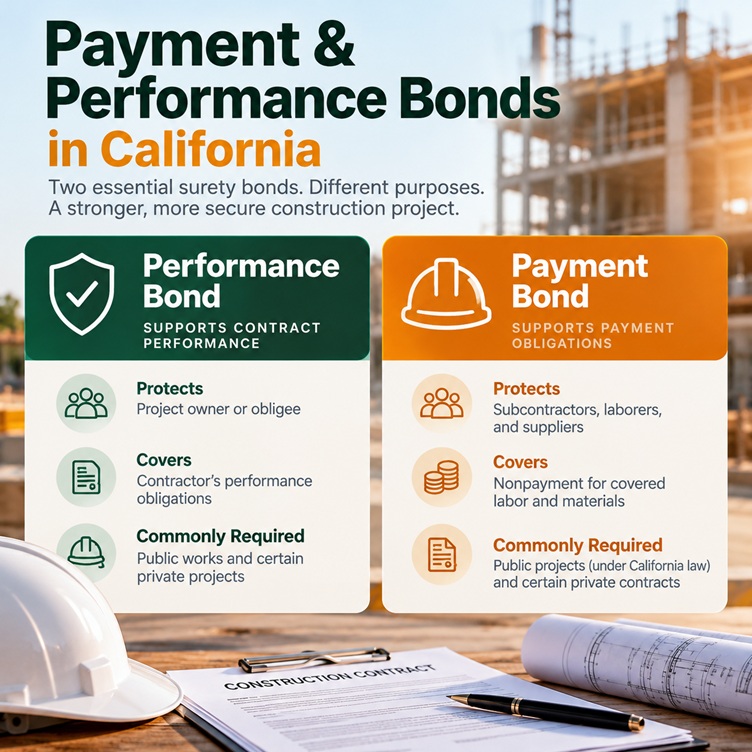
Contractor Bond Claim vs Performance Bond Claim
These claims can sound similar but involve different bonds.
A Contractor License Bond Claim involves the bond maintained in connection with the contractor’s California license.
A Performance Bond Claim generally involves a project-specific bond supporting the contractor’s performance under a particular bonded contract.
For example, a contractor may maintain the required $25,000 California Contractor License Bond while separately providing a much larger Performance Bond for a specific construction project.
A claim against one is not automatically a claim against the other.
For a detailed explanation of project-specific performance bonding, read our Performance Bond California guide.
And when a project requires multiple contract bonds, our Performance Bond vs Payment Bond guide explains the difference between performance and payment obligations.
Contractor License Bond vs Contractor Insurance
Contractors should avoid treating their $25,000 license bond as their complete risk-management program.
The license bond serves a specific licensing and consumer-protection purpose.
A construction business may separately need to evaluate:
- General Liability Insurance for certain third-party liability exposures
- Workers’ Compensation Insurance for applicable employee exposures
- Builders Risk Insurance for certain construction-project property exposures
- Commercial Auto for applicable vehicle exposures
- Project-specific bonds where required
The correct combination depends on the contractor’s operations, employees, contracts, projects, vehicles, and other exposures.
How Contractors Can Reduce Bond Claim Problems
Not every dispute can be prevented, but good business practices can reduce misunderstandings and improve documentation if a claim occurs.
Use Clear Written Contracts
Clearly define scope, payment terms, responsibilities, and project expectations.
Document Change Orders
Changes to price, materials, schedule, or scope should be documented appropriately rather than relying on informal conversations.
Maintain Project Records
Keep contracts, invoices, receipts, photographs, communications, notices, and completion records.
Address Problems Early
A small project disagreement can become significantly more difficult when communication stops.
Track Your Bond
Know your surety company, bond number, effective date, and renewal status.
CSLB specifically recommends that contractors keep accurate records regarding their agent, surety, bond number, effective dates, and terms.
Maintain Continuous Coverage
Do not assume your contractor license renewal and bond renewal occur at the same time. CSLB warns that the cycles may differ.
Contractor Bond Claim Checklist
If you are considering a bond claim, start by organizing the basic information.
Verify the Contractor
Confirm the contractor’s legal name and CSLB license number.
Check Bond History
Identify the surety company and bond that applied during the relevant period.
Review Your Contract
Gather the original contract and signed changes.
Document the Problem
Prepare a clear written timeline explaining what occurred.
Calculate the Alleged Damage
Organize invoices, estimates, wage records, or other evidence supporting the claimed amount.
Gather Supporting Evidence
Collect photographs, communications, inspection reports, payment records, and other relevant documents.
Contact the Surety
Request the company’s bond claim procedure and submit the required information.
Watch Applicable Deadlines
CSLB states that claims must be filed with the surety within specified time frames. Because timing depends on the type and circumstances of the claim, do not assume a generic deadline applies to every case. CSLB
Keep Copies
Maintain copies of everything submitted and all correspondence received.
Frequently Asked Questions About Contractor Bond Claims
What is a Contractor Bond Claim?
A Contractor Bond Claim is a claim made against a contractor’s surety bond based on an alleged obligation or violation covered by the bond and applicable law.
How much is the California Contractor License Bond?
The current California Contractor License Bond requirement is $25,000. The amount increased to $25,000 effective January 1, 2023. CSLB
Do I file a Contractor Bond Claim with CSLB?
No. CSLB states that a bond claim is filed directly with the surety company that wrote the contractor’s bond. CSLB
How do I find a contractor’s bond company?
Look up the contractor through CSLB and review the contractor’s bond history. The history can identify the surety, bond amount, and relevant effective dates. CSLB
Does filing a claim guarantee payment?
No. The surety investigates the claim. Filing a claim does not by itself establish that the claimant is entitled to payment.
Can an employee file a claim against a contractor’s bond?
California’s contractor license bond is maintained in part for employees who have not been paid wages due to them, subject to applicable requirements. CSLB
Is a Contractor Bond Claim the same as a CSLB complaint?
No. The surety investigates claims against the bond, while CSLB investigates complaints filed against the contractor’s license. CSLB
Is a Contractor Bond Claim the same as a Performance Bond Claim?
No. A Contractor License Bond is associated with California contractor licensing. A Performance Bond generally supports performance under a specific bonded contract.
Does a Contractor License Bond replace General Liability Insurance?
No. Bonds and General Liability Insurance address different risks and should not be treated as substitutes for each other.
What should a contractor do after receiving a bond claim?
Review the claim promptly, gather the contract and project records, respond to the surety’s requests, document your position, and continue monitoring the status of the bond and contractor license.
Need a California Contractor Bond?
A Contractor Bond Claim can have consequences for both the claimant and the contractor, but understanding the role of the surety, CSLB, and contractor license bond makes the process easier to navigate.
For California contractors, the larger lesson is to maintain continuous bond coverage, keep accurate project records, respond promptly to surety communications, and understand the difference between bonds and insurance.
If you need a California Contractor License Bond or need to review your current bonding requirements, visit Green State Contractor Bonds.
Contractors can also review general liability insurance for contractors, Workers’ Compensation Insurance, and Builders Risk Insurance as part of their broader protection.
For additional contractor insurance and bond options, visit Green State Insurance Services or call (949) 432-4805.

2 Responses
What if a contractor refuses to finish the job or fix defective work? Can I file a claim against their contractor license bond in California, and where should I start?
If your contractor abandoned the project or failed to complete the agreed work, you may be eligible to file a claim against their contractor license bond.
Here’s where to start:
1. Visit the [CSLB License Lookup](https://www.cslb.ca.gov/onlineservices/checklicenseii/CheckLicense.aspx) and search for the contractor by name or license number.
2. Open the contractor’s Bond History to identify the surety company covering the relevant period.
3. Gather your contract, payment receipts, photos, and communications with the contractor.
4. Contact the surety company directly and ask how to submit a contractor bond claim.
You can also [file a complaint with CSLB](https://www.cslb.ca.gov/consumers/filing_a_complaint/File_A_Complaint.aspx), but that is separate from filing a bond claim.
If you’re unsure where to begin, feel free to contact Green State Insurance. We can help explain the bond claim process and point you toward the appropriate next steps.