

When Is a Surety Bond Legally Required in California?
If someone has asked you to provide a surety bond, one of your first questions may be: When is a surety bond legally required in California?
A surety bond is legally required when a specific law, licensing requirement, or regulatory obligation requires a person or business to maintain one. However, not every California business is automatically required to carry a surety bond.
For contractors, the answer depends on why the bond is being requested. Some bonds are connected to California contractor licensing requirements, while others may be required by a construction contract, bid package, public project, or another specific obligation.
For example, California contractors must maintain a $25,000 Contractor’s Bond for an active contractor license. But that license bond does not automatically satisfy every other bonding requirement a contractor may encounter.
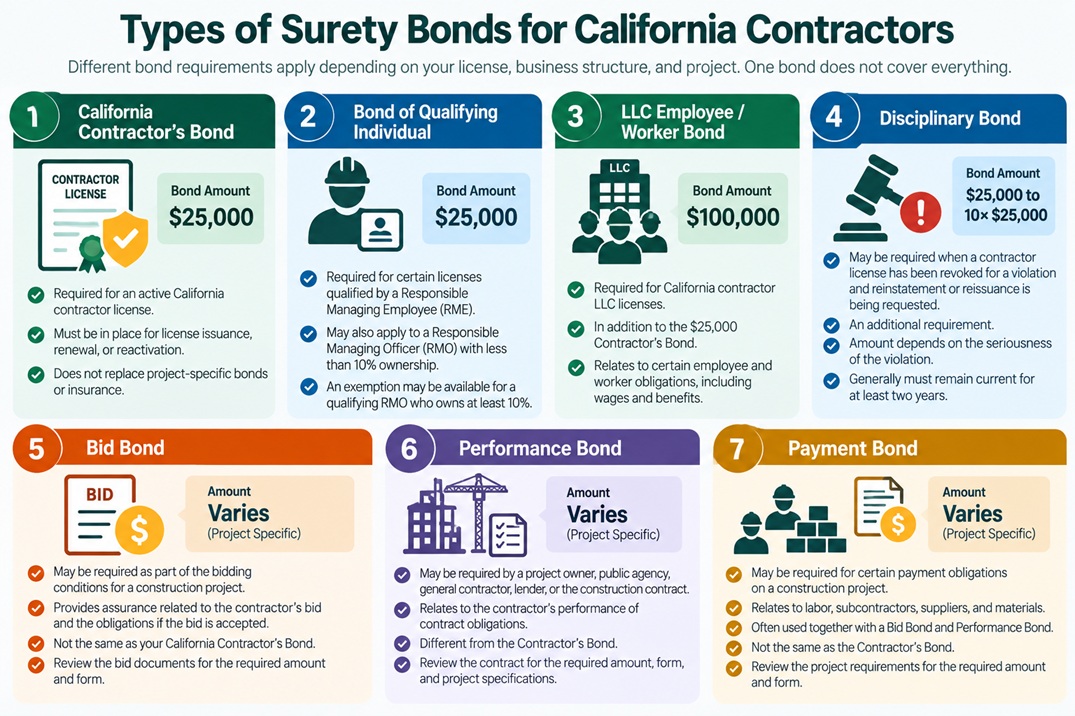
Depending on the contractor’s business structure, qualifying individual, licensing history, or project, additional bonds such as a Bond of Qualifying Individual, LLC Employee/Worker Bond, Bid Bond, Performance Bond, or Payment Bond may apply.
This guide explains when a surety bond is legally required, which bonding requirements may apply to California contractors, and how to determine whether you need a license bond, project-specific bond, or additional insurance coverage.
Is a Surety Bond Legally Required?
A surety bond is legally required when a law, licensing authority, or regulatory requirement requires a specific person or business to maintain one.
But there is no single rule requiring every California business to carry a surety bond.
The requirement depends on factors such as:
- Your profession or license
- The type of business you operate
- Your business structure
- The government agency regulating the activity
- Your role in a construction project
- The terms of a bid or contract
- Previous licensing or disciplinary actions
This distinction matters because a legally required license bond and a bond required under a construction contract are not necessarily the same thing.
For California contractors, CSLB is one of the primary agencies establishing licensing-related bonding requirements.
When Is a Surety Bond Legally Required for California Contractors?
Whether a surety bond is legally required for a construction project depends on the applicable law, bid requirements, and contract terms. Contractors should review the requirement before bidding or starting work. For an active California contractor license, a Contractor’s Bond is a key licensing requirement.
According to CSLB, a Contractor’s Bond must be in place before it can:
- Issue an active license
- Reactivate an inactive license
- Renew an active license
The required Contractor’s Bond amount is currently $25,000. CSLB
The bond must also meet specific CSLB requirements. For example, it must be written by a surety company licensed through the California Department of Insurance, and the business name and license number must correspond with CSLB records. CSLB
Need a California Contractor Bond?
Green State Insurance helps California contractors with their bonding needs.
Get a $25,000 California Contractor Bond
Call: (949) 432-4805
Surety Bond Required? Start With Why It’s Being Requested
A surety bond may satisfy a licensing or project requirement, but it does not automatically replace the insurance your business or construction contract may require. Start with your situation below.
| Your Situation | What You Should Review | Green State Service |
|---|---|---|
| I need to activate or renew my California contractor license. | Review the applicable California contractor bond requirement. The standard Contractor’s Bond is currently $25,000. | Contractor Bond → |
| A GC or project owner is asking for proof of insurance. | Review your liability coverage, policy limits, COI, and applicable contract insurance requirements. | General Liability → |
| I have employees or my workforce has changed. | Review Workers’ Compensation requirements, payroll, employee classifications, and current coverage. | Workers’ Comp → |
| I’m bidding on a project that requires a bond. | Review the bid documents carefully. A project-specific Bid Bond is different from your contractor license bond. | Bond Services → |
| I won a project that requires additional bonding. | The contract may require Performance or Payment Bonds in addition to your existing contractor license bond. | Bond Options → |
| I’m building or renovating a property. | A bond does not replace property coverage for buildings and materials exposed during construction. | Builders Risk → |
| I’m not sure whether I need a bond, insurance, or both. | Start with who is requesting the coverage or bond, then review your license, operations, employees, and project contract. | View Our Services → |
The key takeaway:
A required surety bond does not automatically mean all of your contractor insurance requirements are covered. Green State Insurance can help you review both your bonding and insurance needs.
1. California $25,000 Contractor’s Bond
For California contractors, the Contractor’s Bond is one of the most important examples of when a surety bond is legally required.
The standard California Contractor’s Bond amount is currently: $25,000
Understanding when a surety bond is legally required can help contractors avoid licensing problems and distinguish a license bond from project-specific bonding requirements.
This does not mean a contractor must pay $25,000 to purchase the bond. The bond amount and the premium paid to obtain the bond are different.
The Contractor’s Bond is connected to maintaining an active California contractor license and provides financial protection for certain parties who may be affected by violations covered under the bond.
It is also important to understand that a Contractor’s Bond is different from project-specific bonds such as:
- Bid Bonds
- Performance Bonds
- Payment Bonds
Those bonds can arise from separate bidding, project, or contractual requirements.
2. When Is a Bond of Qualifying Individual Required?
Some California contractor licenses may require a Bond of Qualifying Individual in addition to the standard Contractor’s Bond.
This requirement can apply when the license is qualified by a Responsible Managing Employee (RME).
It may also apply when a corporation is qualified by a Responsible Managing Officer (RMO) who owns less than 10% of the corporation’s voting stock. An exemption may be available for an RMO who owns at least 10%, provided the applicable requirements are satisfied.
The current Bond of Qualifying Individual amount is:
$25,000
This means a contractor should not automatically assume that obtaining the standard $25,000 Contractor’s Bond satisfies every licensing-related bonding requirement.
3. Are Surety Bonds Required for California LLC Contractors?
Contractors operating as LLCs have additional bonding requirements in California.Whether a surety bond is legally required depends on the contractor’s license, business structure, qualifying individual, and the specific project requirements.
In addition to the standard $25,000 Contractor’s Bond, an LLC contractor license generally requires a:
$100,000 LLC Employee/Worker Bond
This additional bond relates to certain obligations involving employees and workers, including qualifying wage and benefit obligations.
Because of this, the legal structure of a contracting business can affect the bonds it needs.
| Contractor Situation | Potential Bond Requirement |
|---|---|
| Active California contractor license | $25,000 Contractor’s Bond |
| Certain qualifying individuals | $25,000 Bond of Qualifying Individual |
| California contractor LLC | Additional $100,000 LLC Employee/Worker Bond |
| Certain licensing disciplinary situations | Disciplinary Bond |
| Project-specific requirement | Bid, Performance, or Payment Bond |
The exact bonding requirements should be reviewed based on the contractor’s license, business structure, qualifying individual, and project circumstances. Whether a surety bond is legally required can also depend on the contractor’s business structure, which is why LLC requirements should be reviewed separately.
4. When Is a Disciplinary Bond Legally Required?
A Disciplinary Bond is different from the standard Contractor’s Bond.
It may be required when a contractor license has been revoked for a violation of California contractor licensing law and the contractor is seeking to have the license reinstated or reissued.
Importantly, a Disciplinary Bond is an additional requirement.
It does not simply replace the other bonds required to maintain an active contractor license.
The required amount depends on the applicable disciplinary circumstances. The amount can be no less than $25,000 and may reach up to ten times the amount of the standard Contractor’s Bond.
A disciplinary bond generally must also remain current and on file for the required period, which may be at least two years.
5. Are Bid Bonds Legally Required?
A Bid Bond is different from a California Contractor’s Bond.
This distinction is important because not every Bid Bond is required simply because someone holds a California contractor license.
Instead, a Bid Bond may be required as a condition for bidding on a particular construction project.
It generally provides assurance related to the contractor’s bid and the obligations that may arise if the bid is accepted.
Therefore:
Having a $25,000 California Contractor’s Bond does not automatically satisfy a project’s Bid Bond requirement.
Before submitting a construction bid, contractors should review the bid documents carefully to determine whether a Bid Bond is required and what amount or form must be provided.
6. When Is a Performance Bond Required?
A Performance Bond relates to the contractor’s performance of obligations under a specific construction contract.
Depending on the project, a Performance Bond may be required by a project owner, public agency, general contractor, lender, or the construction contract itself.
The key distinction is:
A Contractor’s Bond and a Performance Bond serve different purposes.
Having the bond required for your California contractor license does not automatically mean you have satisfied a Performance Bond requirement for a particular project.
If a project has been awarded and the contract requires a Performance Bond, the contractor should review the required bond amount, form, and project specifications before beginning work.
7. When Is a Payment Bond Required?
A Payment Bond is another type of construction surety bond that may apply to a specific project.
It generally relates to certain payment obligations involving:
Labor → Subcontractors → Suppliers → Materials
Depending on the construction project and its requirements, a contractor may encounter several different bonds during the bidding and contracting process:
Bid Bond → Performance Bond → Payment Bond
These bonds are separate from the Contractor’s Bond maintained for California contractor licensing.
The important takeaway is that one surety bond does not automatically satisfy every bonding requirement. Contractors should identify who is requiring the bond, why it is required, the required amount, and whether it relates to licensing or a specific construction project.
If you are unsure whether a surety bond is legally required for your situation, start by identifying who is requesting the bond and whether the requirement comes from licensing rules or a specific construction contract. When a surety bond is legally required by a project or contract, contractors should confirm the exact bond type, amount, and required form before work begins.
Frequently Asked Questions About Surety Bond Requirements
Common questions California contractors ask about legally required bonds, project bonds, and contractor insurance.
Is a surety bond legally required in California?
It depends on the activity, license, business structure, or project. There is no single surety bond requirement for every California business. Certain contractor licenses and construction projects, however, can have specific bonding requirements.
When is a surety bond legally required for California contractors?
Bonding requirements can arise from contractor licensing, the qualifying individual, the contractor’s business structure, disciplinary circumstances, or the requirements of a specific construction project.
How much is the California Contractor’s Bond?
The standard California Contractor’s Bond amount is currently $25,000. This is the bond amount and should not be confused with the premium a contractor pays to obtain the bond.
Do I have to pay $25,000 to get a $25,000 Contractor’s Bond?
No. The $25,000 figure refers to the bond amount. The premium charged to obtain the bond is a separate amount and can depend on the type of bond and applicable underwriting requirements.
Is a Contractor’s Bond the same as a Bid Bond?
No. A California Contractor’s Bond is associated with contractor licensing. A Bid Bond may be required as part of the bidding conditions for a particular construction project.
Does my Contractor’s Bond cover Performance and Payment Bond requirements?
No. Contractor licensing bonds and project-specific Performance or Payment Bonds serve different purposes. If a construction contract requires additional bonding, your existing Contractor’s Bond does not automatically satisfy that requirement.
Do California LLC contractors have additional bond requirements?
California contractor LLCs have additional bonding requirements. In addition to the standard $25,000 Contractor’s Bond, an LLC contractor license generally requires a $100,000 LLC Employee/Worker Bond.
Does a surety bond replace General Liability insurance?
No. Surety bonds and General Liability insurance serve different purposes. A contractor may need both depending on licensing requirements, business operations, and the terms of a construction contract.
How do I know which surety bond I need?
Determining whether a surety bond is legally required starts with identifying who is requesting the bond. A licensing agency, project owner, public agency, or construction contract may impose different requirements. Start by identifying who is requesting the bond and why. A licensing requirement, qualifier requirement, bid package, awarded contract, or disciplinary requirement can each lead to a different type of bond.
What should I do if someone says I need a surety bond?
Ask for the written bond requirement, including the bond type, amount, obligee, and required form. This information can help determine whether you need a licensing bond, project bond, or another type of bond.
Not Sure Which Bond or Insurance You Need?
Green State Insurance can help review your California contractor bonding and insurance needs based on your license, business, and project requirements.