

Common Insurance Mistakes California Contractors Make
What Most Contractors Get Wrong About Insurance — and How to Fix It
Let’s be honest.
Most California contractors only think about insurance when they’re forced to. A license renewal. A new project. Someone asking for a certificate. That’s usually when insurance shows up on the radar.
The problem?
A lot of contractors are walking around with coverage gaps they don’t even know about. And those gaps always show up at the worst possible time — during a claim, an audit, or a jobsite accident.
Here are some of the most common insurance mistakes contractors make in California, explained in plain English — and how to fix them before they cost you real money.
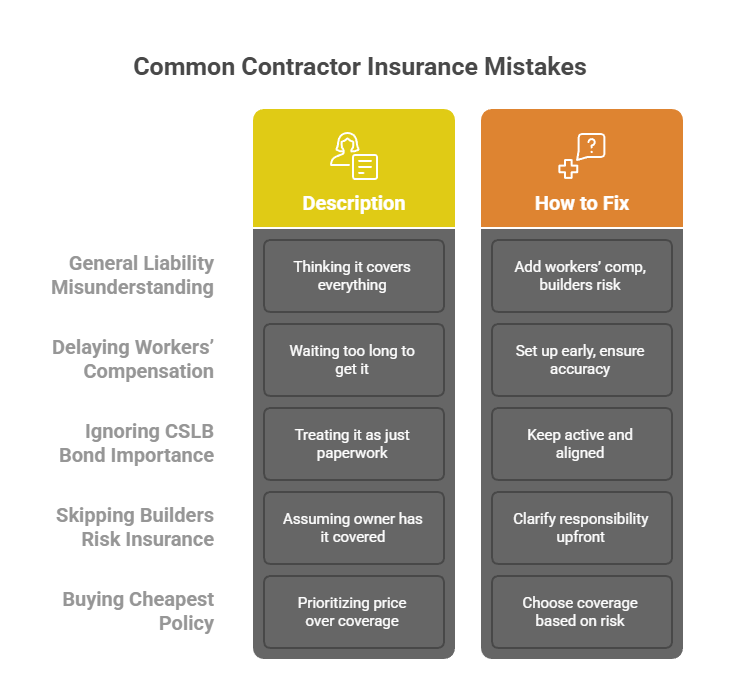
Mistake #1: Thinking General Liability Covers Everything
This is the big one.
General liability insurance is important, but it’s not “full coverage.” It mainly protects you if:
-
You damage a client’s property
-
A third party gets injured because of your work
What it does not cover:
-
Employee injuries
-
Stolen tools
-
Damage to unfinished work
-
Accidents involving your crew
How to fix it:
Think of general liability as the base layer. Most contractors also need workers’ compensation, and depending on the job, builders risk or additional coverage. One policy alone usually isn’t enough.
Mistake #2: Delaying or Misunderstanding Workers’ Compensation
In California, if you have even one employee, workers’ comp is required. Period.
Some contractors wait too long, or assume 1099 workers don’t count. That’s a dangerous assumption. One injury without workers’ comp can turn into a massive out-of-pocket expense — plus fines and penalties.
How to fix it:
Set up workers’ compensation early and make sure your payroll and job classifications are accurate. This helps avoid audits, fines, and surprise premium increases later.
Mistake #3: Treating the CSLB Bond Like Just Paperwork
The $25,000 CSLB contractor bond isn’t just a form to check off. It’s a signal.
Clients, general contractors, and project owners see it as proof that you operate responsibly and stand behind your work.
How to fix it:
Keep your bond active and aligned with your license. If your business grows or your work becomes higher risk, your insurance setup should grow with it.
Mistake #4: Skipping Builders Risk Insurance
Many contractors assume the property owner has builders risk covered. Sometimes that’s true. Sometimes it’s not.
When materials get stolen, a fire hits, or weather damages the project mid-build, responsibility becomes very unclear — very fast.
How to fix it:
Clarify responsibility upfront. If you’re responsible for materials, work-in-progress, or certain phases of construction, builders risk insurance can protect you from major losses.
Mistake #5: Buying the Cheapest Policy Without Understanding It
Price matters — but cheap insurance often means limited coverage, exclusions, or denied claims. A lot of contractors find out too late that their policy doesn’t actually match the work they do.
How to fix it:
Choose coverage based on your trade, your risk level, and the type of projects you take on. The right policy costs far less than fixing a bad mistake later.
Why the Right Insurance Helps Your Business Grow
Good insurance isn’t just about avoiding problems. It helps you:
-
Qualify for better jobs
-
Win more bids
-
Move faster when certificates are requested
-
Look more professional and reliable
In a competitive market like California, that matters.
Most insurance mistakes aren’t made because contractors don’t care. They happen because no one explained things clearly.
When you treat insurance as part of running a solid business — not just a requirement — it becomes protection, not a headache.
Frequently Asked Questions
Do California contractors really need more than general liability insurance?
Yes. General liability is important, but it doesn’t cover everything. Things like employee injuries, stolen tools, or damage to a project under construction usually require additional coverage such as workers’ compensation or builders risk insurance.
What’s the biggest insurance mistake contractors make in California?
Assuming they’re “fully covered” when they’re not. Many contractors only find out about coverage gaps after a claim gets denied or during a CSLB audit.
Do I need workers’ compensation if I only have one employee?
Yes. In California, workers’ compensation is required even if you have just one employee. Skipping it can lead to fines, stop-work orders, and serious financial risk.
Is the $25,000 CSLB contractor bond the same as insurance?
No. A contractor bond is not insurance. It protects the public, not you. You still need proper liability and workers’ comp insurance to protect your business.
Who is responsible for builders risk insurance — the contractor or the owner?
It depends on the contract. Many disputes happen because this isn’t clearly defined. If you’re responsible for materials or work-in-progress, builders risk insurance is often essential.
Can having the right insurance actually help me win more jobs?
Absolutely. Proper insurance makes you look professional, helps you qualify for more bids, and gives clients confidence that you’re reliable and compliant.
What happens if my insurance lapses for a short time?
Even a short lapse can cause big problems, including license issues, denied claims, and higher premiums later. Continuous coverage matters.