

Phone:

(949) 432-4805

Address:

19200 Von Karman Avenue Suite 400
Irvine, CA, 92612

California Contractor Surety Bond Services

Secure Your Projects with Reliable Contractors Bonds

Contractors Bond

Types of Contractors Bonds​

Explore our comprehensive bonding solutions tailored to your project needs

Bid Bonds

Guarantee you will enter the contract if awarded the project bid

Performance Bonds

Ensure contract completion according to agreed specifications

Payment Bonds

Guarantee subcontractors and suppliers are paid

License & Permit Bonds

Required to operate legally in your state or municipality

Retention Bonds

Alternative to retained project funds held by owner

Critical Understanding

Unlike insurance, contractors bonds are not designed to protect you as the contractor

  • Bonds protect the obligee (project owner, not the contractor)
  • You must repay all claims including legal fees and investigation costs
  • Claims damage your bonding capacity making future bonds difficult to obtain
Common Claim Causes

Understanding what triggers claims helps you prevent them

  • Failure to complete project according to contract specifications
  • Non-payment of subcontractors, suppliers, or laborers
  • Project abandonment or contractor bankruptcy
  • Violation of licensing laws or regulations
General Contractor Insurance in California
Surety Bonds (Contractor's Bond) Insurance in California

Meet Licensing Requirements

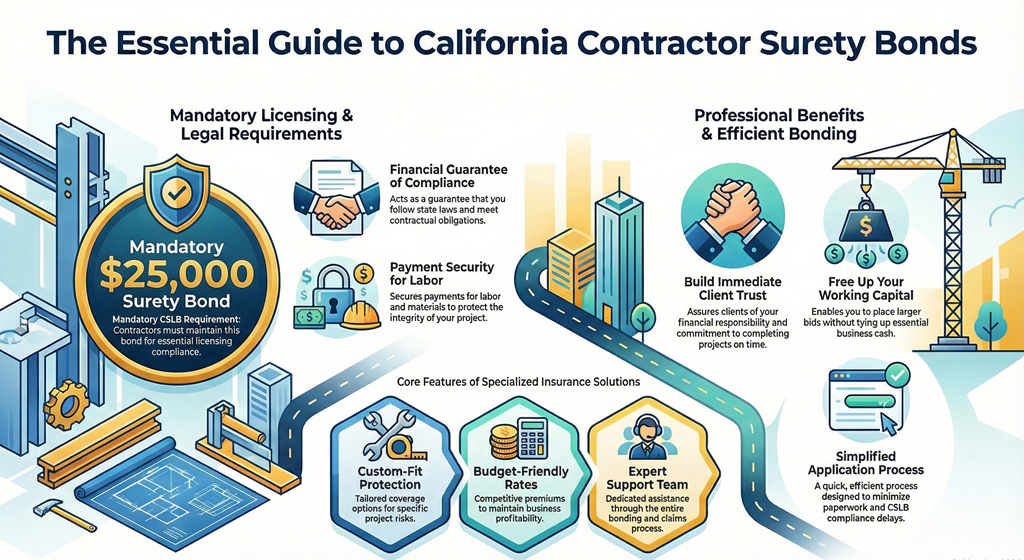
In California, contractors must obtain a $25,000 surety bond as part of the CSLB licensing process. This bond acts as a financial guarantee that you will follow state laws and meet contractual obligations.

Builds Client Confidence & Compliance:

Guarantees project completion per contract terms.

Frees Up Working Capital:

Enables larger bids without cash tie-ups.

Understanding Contractors Bonds

Build Trust with Clients

A contractors bond is a three-party agreement between the Principal (Contractor), Obligee (Project Owner/Government), and Surety (Bond Company).

It serves as a legal guarantee that contractual and licensing obligations will be fulfilled, providing financial protection to all parties involved in a construction project.

These bonds are typically required for most public works and government-funded projects, and they protect project owners, subcontractors, and suppliers from financial loss.

Who Requires It

Government agencies, municipalities, and large private project owners

Bond vs Insurance

Unlike insurance, bonds protect the project owner, and contractors must reimburse claims

How It Works

The surety guarantees the contractor will complete the work according to contract terms

Frequently Asked Questions

Get answers to common questions about contractors bonds

What happens if a claim is filed against my bond?
If a claim is filed, the surety company will investigate its validity. If the claim is legitimate, the surety pays the obligee up to the bond amount. However, you (the contractor) are legally obligated to reimburse the surety for the full amount paid, plus any investigation costs and legal fees. Claims can significantly impact your ability to obtain future bonds and may damage your business reputation.
 
While both provide financial protection, they serve different purposes. Insurance protects you (the policyholder) from covered losses. Contractors bonds protect the project owner or obligee from your failure to meet obligations. With insurance, you pay premiums and the insurer covers losses. With bonds, the surety expects full reimbursement for any claims paid. Additionally, insurance covers unforeseen events, while bonds guarantee contractual performance.
 
Yes, it’s possible to obtain a contractors bond with poor credit, though it’s more challenging and expensive. Contractors with credit scores below 650 may face higher premiums (typically 3-15% instead of 1-3%) and may need to provide additional collateral or a co-signer. Some specialty surety companies focus on high-risk applicants. To improve your chances, demonstrate strong financials, work history, and business management skills. Consider working with a bond specialist who has relationships with multiple sureties.
 
Bond duration varies by type. License and permit bonds typically last 1-2 years and must be renewed annually or biennially to maintain your license. Contract bonds (bid, performance, payment) last for the duration of the specific project plus any warranty period, which can range from a few months to several years. Most bonds require annual premium payments even if the bond term is longer. You’ll receive renewal notices before expiration.
 
Bond premiums typically range from 1-3% of the total bond amount annually for contractors with good credit and strong financials. For example, a $100,000 bond would cost $1,000-$3,000 per year. Factors affecting cost include your credit score, financial strength, business experience, project complexity, and bond amount. Contractors with challenged credit may pay 3-15% or higher. License bonds under $25,000 often have minimum premiums of $100-$200. Higher bond amounts and specialized projects undergo more rigorous underwriting and may have higher rates.
 
General Contractor Insurance in California

General Contractor Insurance in California
Contact Us

What matters most get your free insurance quote today!

Building across California? We’ve got your contracting risks covered. Request a free, no-obligation quote today for surety bonds, general liability, builders risk, bid & performance bonds, and workers’ compensation—everything a California contractor needs to stay compliant, competitive, and worry-free. Connect with our specialists now and lock in coverage you can build on.