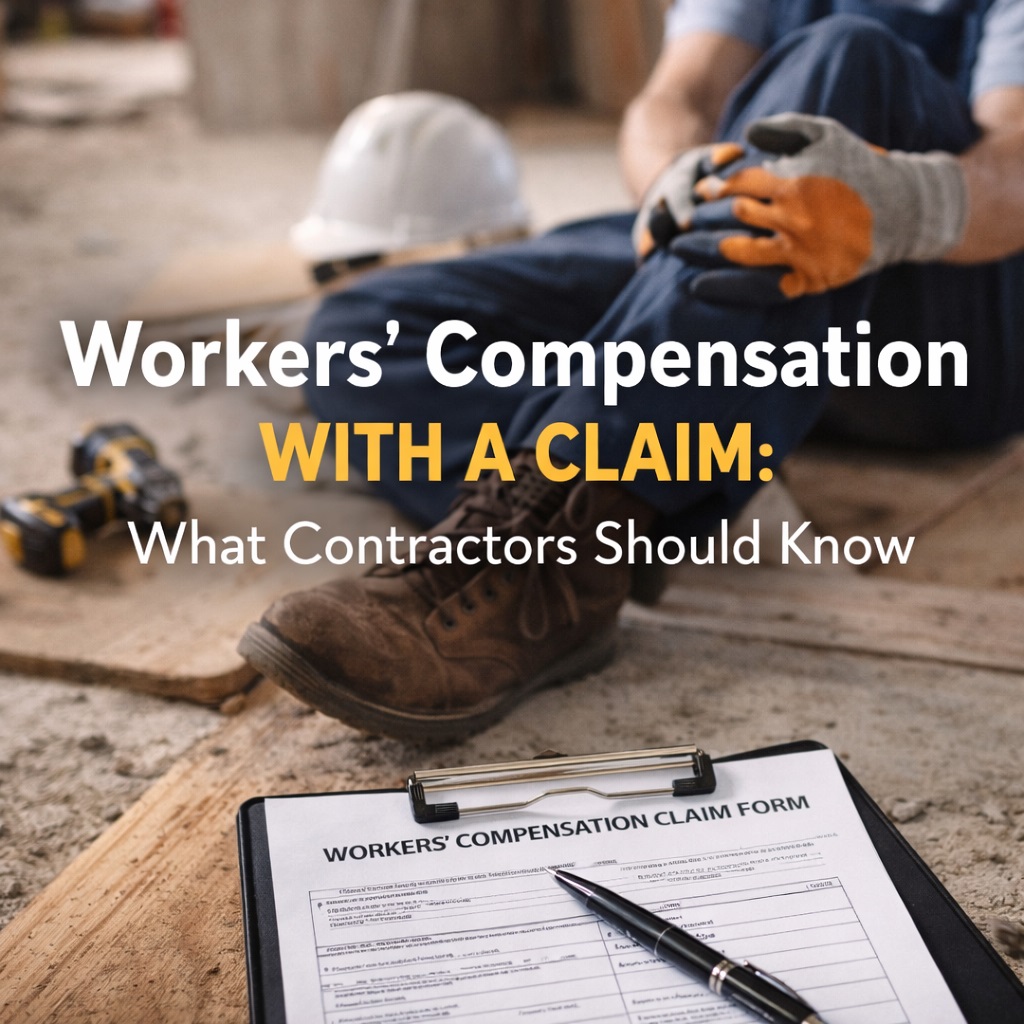

Workers’ Compensation with a Claim: What It Really Means (and What Contractors Can Do About It)
If you’ve ever been told your business has “Workers’ Compensation with a claim”, it can sound scary. A lot of contractors hear that phrase and immediately think their insurance is ruined forever.
That’s not true.
Having a workers’ comp claim doesn’t mean your business is uninsurable. It means insurers are paying closer attention. What happens next depends on how that claim is understood, explained, and managed.
This article breaks it down in plain language — what “workers’ compensation with a claim” actually means, why it affects your insurance, and what you can realistically do to control costs and protect your business.
What Does “Workers’ Compensation with a Claim” Mean?
It simply means this:
your business has had at least one reported workers’ comp injury where the insurance company paid benefits.
That could be:
- A worker who got injured on the job
- Medical bills paid by workers’ comp
- Time off work covered by insurance
- Or a more serious injury involving surgery or long-term recovery
To an insurance company, a claim is not just an accident — it’s data.
It tells them something about risk, work conditions, and how a business operates.
What Contractors Can Do About It
Having a workers’ compensation claim doesn’t mean your business is stuck paying high premiums forever. What really matters is how you respond after the claim happens. This is where many contractors either regain control — or make things worse.
First, take the time to actually review your claim history, not just the total dollar amount. Insurance carriers look closely at details like whether the claim was medical-only or involved lost time, how long the employee was out of work, and whether the claim is closed or still open. Two businesses can have the same claim cost and receive completely different quotes based on these details alone.
Next, make sure your job classifications are accurate. Misclassification is extremely common in construction. If employees who perform light or limited duties are coded as high-risk trades, your experience modification and premium will suffer. Correcting classification errors can have a real, measurable impact on your rate.
Clear communication with the insurance carrier also makes a difference. Carriers want to understand why a claim happened and what has changed since then. Showing that you’ve adjusted jobsite procedures, improved training, or added safety measures tells underwriters this wasn’t a pattern — it was an event that’s being addressed.
Choosing the right insurance carrier is just as important. Not all carriers are built for businesses with claim history or higher experience mods. Some specialize in clean accounts only, while others are designed to handle higher-risk contractors and understand construction realities. Working with the right carrier can mean the difference between being declined and getting a workable quote.
Finally, even a basic safety and loss control plan goes a long way. Regular safety talks, proper use of protective equipment, documenting near-misses, and having a return-to-work program all signal that your business is actively reducing risk. Over time, this can help stabilize premiums and lower your experience modification.
A claim doesn’t define your business. Poor follow-up does. Contractors who stay proactive, organized, and transparent are the ones who recover faster — and keep their insurance costs under control.
Why Insurance Companies Care So Much About Claims
Insurance carriers don’t just ask if you had a claim. They ask:
- What kind of injury was it?
- Was it medical-only or lost-time?
- How long was the employee off work?
- Is the claim closed or still open?
- Was it a one-time incident or part of a pattern?
Two businesses can both have a $40,000 claim — and get completely different quotes.
Why?
Because one may have been a minor injury with a quick return to work, and the other may show poor safety controls and long-term disability.
To insurers, claims help predict whether another claim is likely.
Not All Claims Are Equal
This is something many contractors don’t realize.
Lower-impact claims
- Medical-only claims
- Short recovery time
- No long-term disability
- One isolated incident
These usually have limited impact on pricing over time.
High-impact claims
- Lost-time claims
- Surgery or long recovery
- Multiple claims over a short period
- Open or poorly documented claims
These raise red flags and push premiums higher.
So when people say, “I had a claim and now my insurance is expensive,” the real issue is usually how that claim looks on paper.
Experience Mod (X-Mod): Where Claims Really Hit
Workers’ comp claims affect your Experience Modification Rate (X-Mod).
In simple terms:
- X-Mod below 1.00 = lower premiums
- X-Mod above 1.00 = higher premiums
Claims increase your X-Mod because insurers see your business as more likely to have future losses.
But here’s the key point:
A high mod is not permanent.
With proper management, it can come down over time.
Common Mistake: Ignoring Job Classification Errors
One of the most common — and expensive — problems is misclassification.
For example:
- An employee doing light or mixed duties
- But classified under a high-risk construction code
- Or payroll reported under the wrong category
This makes claims look worse than they really are and inflates premiums fast.
Correct classification doesn’t hide risk — it accurately represents it, which insurers respect.
Why Explanation Matters More Than Most Contractors Think
Insurance is data-driven, but humans still make underwriting decisions.
If a carrier only sees:
“Business with prior claim”
They assume the worst.
But when they see:
- Why the injury happened
- What changed afterward
- What safety measures were added
- How the business prevents repeat incidents
The risk profile changes.
A properly written explanation can be the difference between:
- A declined quote
- Or a workable, fairly priced policy
Choosing the Right Insurance Carrier Matters
Not all workers’ comp carriers are built for businesses with claim history.
Some only want:
- Clean loss records
- Low-risk operations
- Perfect mods
Others specialize in:
- Construction trades
- High-risk businesses
- Prior claims and elevated mods
If you go to the wrong carrier, you’ll get rejected or overcharged.
If you go to the right one, your claim history is evaluated, not punished.
Loss Control: How You Show Insurers You’re Serious
Insurance companies want to know one thing:
“Is this business preventing future claims?”
Even simple measures help:
- Regular safety meetings
- Proper PPE enforcement
- Incident reporting (even small ones)
- Return-to-work programs
- Clear jobsite procedures
You don’t need a complicated system — just proof that safety is intentional, not reactive.
Can You Get Workers’ Comp with a Claim History?
Yes — absolutely.
But expect:
- Fewer carrier options
- Higher pricing at first
- More underwriting questions
What matters is how the claim is presented and how the business is positioned going forward.
A claim doesn’t end your insurability.
Poor management of that claim does.
Final Thoughts
Workers’ compensation with a claim doesn’t mean your business is broken.
It means insurers are watching more closely.
Contractors who understand their claims, correct classification issues, work with the right carriers, and show real risk management almost always regain control over their premiums.
The goal isn’t perfection.
It’s stability, transparency, and progress.
Handled correctly, even businesses with prior claims can stay insured, competitive, and profitable.
If you want, I can also:
- Turn this into an FAQ page
- Adapt it for a landing page
- Optimize it further for SEO keywords
- Or simplify it even more for contractors with no insurance background
If you’re dealing with workers’ compensation challenges — such as a prior claim, a higher experience mod, or increasing premiums — having the right coverage setup is just as important as the claim itself. At Green State Insurance, we help California contractors review and optimize their
Workers’ Compensation Insurance, make sure it aligns properly with
General Liability Insurance, and add protection like
Builders Risk Insurance when a project requires it.
For contractors who prefer speed and simplicity, we also offer
online contractor insurance, so you can request quotes, submit information, and get guidance without slowing down your business. The goal isn’t just to get insured — it’s to make sure your coverage actually supports your work when it matters most.