


If you run a contracting business in California, insurance is more than another monthly expense. The right coverage can determine whether you qualify for a project, meet a general contractor’s requirements, protect your equipment and vehicles, or absorb the financial impact of an accident or claim.
But how much does contractor insurance actually cost in 2026?
There is no single price that applies to every contractor. A self-employed painter working on small residential projects has a very different risk profile from a roofing contractor with 10 employees, multiple trucks, expensive equipment, and large commercial contracts.
Your contractor insurance cost can depend on your trade, payroll, revenue, number of employees, claims history, vehicles, subcontractor use, project size, coverage limits, and the types of insurance your contracts require.
This guide breaks down the major costs California contractors should understand in 2026 and explains what can make your premiums go up or down.
How Much Does Contractor Insurance Cost in California in 2026?
Contractor insurance can range from a relatively modest monthly expense for a solo, lower-risk contractor to several thousand dollars per month for a construction company with employees, vehicles, higher-risk operations, and multiple insurance requirements.
Current market data illustrates just how wide the range can be.
For example, Insureon reports that California general contractors buying coverage through its platform average approximately $144 per month for general liability insurance, $590 per month for workers’ compensation, and $270 per month for commercial auto insurance. These figures are benchmarks based on Insureon customers, not guaranteed rates for every contractor.
Your actual quote may be lower or substantially higher depending on your business.
Average Monthly Contractor Insurance Cost
A contractor may need only one or two policies, while another may need a complete insurance package that includes:
- General Liability Insurance
- Workers’ Compensation
- Commercial Auto Insurance
- Tools and Equipment Coverage
- Builders Risk Insurance
- Contractor License Bond
- Bid Bonds
- Performance Bonds
- Payment Bonds
- Umbrella or Excess Liability Coverage
That is why comparing contractor insurance prices only by monthly premium can be misleading. Two contractors paying different premiums may also have very different policy limits, deductibles, payroll levels, operations, and contract requirements.
Average Annual Contractor Insurance Cost
Annual contractor insurance expenses are usually driven by the combination of policies your business needs.
A solo contractor without employees or company vehicles may have a relatively simple insurance program. A growing general contractor with employees, subcontractors, trucks, active construction projects, and bonding requirements can have a much more substantial annual insurance budget.
Instead of asking only, “What does contractor insurance cost?”, a better question is:
Not Sure What Contractor Coverage You Need?
Explore insurance and surety options for California contractors, or speak with Green State Insurance about your business, projects, and coverage requirements.
What coverage does my business actually need, and what variables are affecting the price?
That distinction can prevent you from buying a cheap policy that does not satisfy your contracts—or paying for coverage your business does not need.
Why Contractor Insurance Prices Vary So Much
Insurance carriers evaluate risk.
The more likely an insurer believes a claim is to occur—or the more expensive that claim could become—the more that risk can affect your premium.
A flooring contractor working inside occupied homes does not present the same insurance exposure as a roofer working at height. Similarly, a contractor with $150,000 in payroll does not present the same workers’ compensation exposure as a contractor with $2 million in payroll.
The final price is built around the actual characteristics of the business.
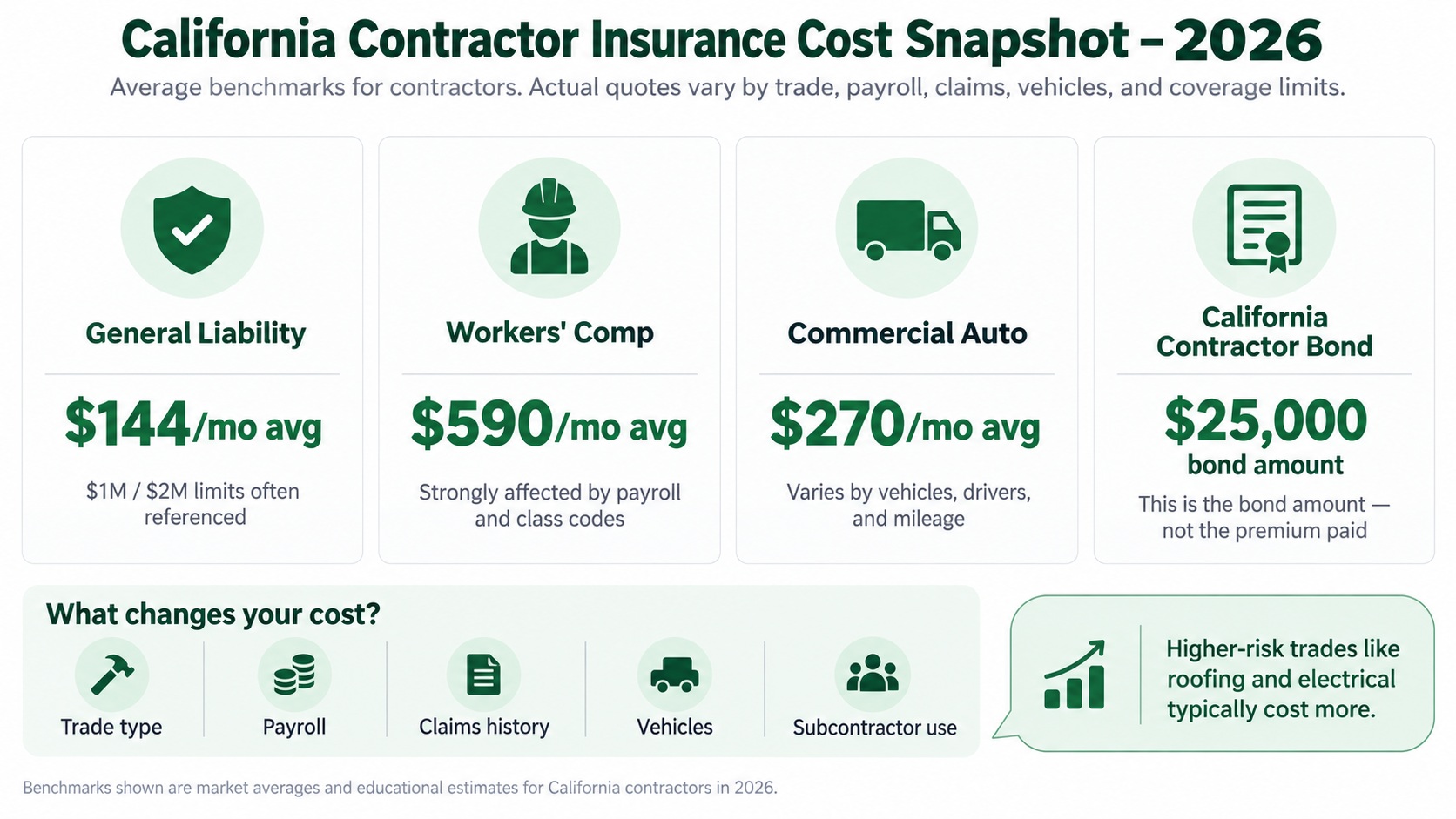
Contractor Insurance Cost by Coverage Type
Understanding each policy separately makes it much easier to understand your total contractor insurance cost.
General Liability Insurance Cost
General Liability Insurance is one of the most common coverages carried by contractors.
It can help protect a contracting business when a third party alleges bodily injury or property damage connected to the company’s operations.
Insureon currently reports an average general liability premium of approximately $162 per month for general contractors across its customer base, typically around a $1 million per-occurrence and $2 million aggregate limit in the example policy profile it publishes. California general contractors in its state comparison averaged about $144 per month.
That does not mean every contractor should expect a $144 quote.
General liability pricing may be affected by:
- Type of construction work
- Residential versus commercial work
- Annual revenue
- Payroll
- Number of employees
- Use of subcontractors
- Prior claims
- Coverage limits
- Deductibles
- Additional insured requirements
- Contract size
- Locations where work is performed
Roofing, structural work, demolition, and other higher-hazard operations may cost considerably more than lower-risk interior work.
Workers’ Compensation Insurance Cost
Workers’ Compensation Insurance can become one of the largest insurance expenses for a growing contractor.
Unlike a simple flat monthly subscription, workers’ compensation pricing is heavily influenced by payroll and employee classification.
California requires employers, including construction employers, to maintain workers’ compensation insurance even when they have only one employee. CSLB also requires workers’ compensation coverage for active contractors in certain classifications—including C-8 Concrete, C-20 HVAC, C-22 Asbestos Abatement, C-39 Roofing, and C-61/D-49 Tree Service—even when they do not have employees.
Factors that can affect workers’ compensation pricing include:
- Total payroll
- Employee job classifications
- Type of construction work
- Claims history
- Experience modification
- Safety record
- Employee duties
- Location
- Carrier underwriting guidelines
A roofing employee, for example, normally presents a different workplace injury risk from an office employee working for the same company.
That is why asking for the “workers’ comp price per employee” rarely tells the whole story.
Commercial Auto Insurance Cost
Contractors often depend on pickups, vans, utility vehicles, and larger trucks to transport employees, materials, tools, and equipment.
When vehicles are owned or used by the business, commercial auto insurance may become another major part of the insurance budget.
Insureon’s current data shows California general contractors in its customer base paying an average of approximately $270 per month for commercial auto coverage. Actual pricing can vary significantly.
Commercial auto pricing may depend on:
- Number of vehicles
- Vehicle types
- Vehicle values
- Driver ages and driving histories
- Annual mileage
- Business use
- Coverage limits
- Claims history
- Garaging location
Adding several vehicles or drivers can change the cost substantially.
Not Sure What Contractor Coverage You Need?
Explore insurance and surety options for California contractors, or speak with Green State Insurance about your business, projects, and coverage requirements.
Tools and Equipment / Inland Marine Insurance Cost
Contractors frequently move expensive tools and equipment between job sites.
Standard property insurance may not always provide the protection needed for equipment while it is being transported or used away from the primary business location.
Tools and equipment coverage, often structured as inland marine coverage, can help protect items such as:
- Power tools
- Generators
- Compressors
- Mobile equipment
- Specialized trade equipment
- Tools stored in work vehicles or at temporary job sites
Pricing depends heavily on the value and type of equipment being insured, the coverage limits, deductible, storage practices, and theft exposure.
A contractor with $10,000 in tools will generally present a different exposure from a contractor transporting $250,000 worth of specialized equipment.
Builders Risk Insurance Cost
Builders Risk Insurance protects construction projects while the work is underway.
Unlike general liability, builders risk pricing is closely connected to the project itself.
Factors may include:
- Total completed project value
- Type of construction
- New construction versus renovation
- Project duration
- Building materials
- Location
- Fire protection
- Theft exposure
- Weather exposure
- Deductible
- Coverage extensions
A small residential renovation and a multi-million-dollar ground-up construction project should not be expected to receive similar builders risk pricing.
For contractors working on multiple projects, it is especially important to confirm whether coverage applies to a specific project or is structured differently across multiple jobs.
Contractor License Bond Cost
California contractors must distinguish between the bond amount and the premium paid to obtain the bond.
CSLB requires a $25,000 Contractor’s Bond for an active contractor license. The $25,000 figure is the bond amount—it does not mean the contractor pays $25,000 to purchase the bond.
The actual cost of a California Contractor License Bond can depend on underwriting factors such as:
- Credit profile
- Bond history
- Business background
- Surety underwriting
- Other financial considerations
Certain licenses may require additional bonds.
For example, California LLC contractor licenses have an additional $100,000 employee/worker surety bond requirement in addition to the standard $25,000 contractor bond.
Bid, Performance and Payment Bond Costs
Larger construction projects may require more than a contractor license bond.
Public projects and many commercial contracts may require:
Bid Bonds – help demonstrate that a contractor intends to honor its bid and provide required bonds if awarded the project.
Performance Bonds – provide financial protection related to completion of the contractor’s contractual obligations.
Payment Bonds – help protect certain subcontractors, laborers, and suppliers if they are not paid as required.
Pricing for these surety bonds is generally based on factors such as:
- Bond amount
- Contract value
- Contractor experience
- Financial strength
- Credit
- Work history
- Project size
- Surety underwriting
Contractors bidding larger jobs should ideally address bonding capacity before the bidding deadline rather than waiting until a contract has already been awarded.
The key point is simple: there is no reliable contractor insurance price without understanding the business behind the quote.
Contractor Insurance Cost by Trade
One of the biggest factors affecting contractor insurance cost is the type of work performed.
General Contractor Insurance Cost
General contractors may coordinate multiple trades, manage subcontractors, supervise job sites, and take responsibility for larger projects.
Insurance companies may evaluate:
- Percentage of work subcontracted
- Type of projects
- Residential versus commercial construction
- Contract value
- Payroll
- Revenue
- Subcontractor insurance practices
- Prior losses
A general contractor managing a bathroom remodel has a different exposure from one building large commercial structures.
Roofing Contractor Insurance Cost
Roofing is commonly treated as a higher-hazard construction trade because employees work at height and claims can involve serious injuries or property damage.
Workers’ compensation can be particularly significant for roofing companies.
California also requires active C-39 Roofing contractors to maintain workers’ compensation coverage even if they currently have no employees.
Insureon’s current construction industry data also illustrates the difference in liability pricing between trades, with roofers showing higher general liability premiums than many lower-risk contracting businesses in its customer dataset.
Electrical Contractor Insurance Cost
Electrical work can involve:
- Fire exposure
- Property damage
- Injury risks
- Work inside occupied properties
- High-value commercial projects
- Contractual insurance requirements
An electrical contractor working on large commercial installations may therefore have different insurance requirements from a small residential service contractor.
Plumbing Contractor Insurance Cost
Water damage can create expensive claims.
A plumbing error inside a completed building may damage flooring, drywall, cabinets, electrical systems, or neighboring units.
Carriers may consider the type of plumbing performed, project size, revenue, employee count, claims history, and percentage of new construction versus repair work.
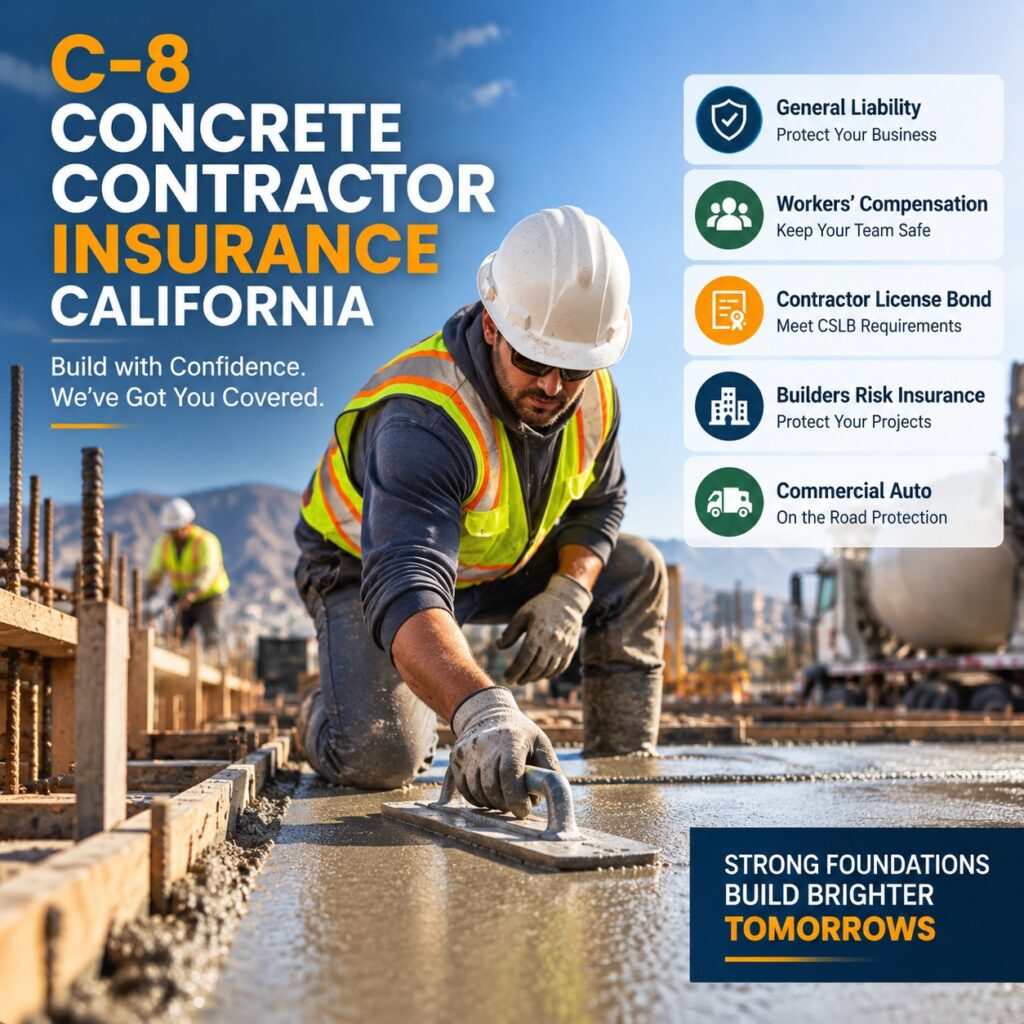
Concrete Contractor Insurance Cost
Concrete contractors may face workplace injury, heavy equipment, vehicle, and job-site risks.
California’s C-8 Concrete classification is also one of the classifications specifically required by CSLB to maintain workers’ compensation coverage regardless of whether the contractor currently has employees.
HVAC Contractor Insurance Cost
HVAC contractors may work on roofs, electrical systems, gas lines, large equipment, and occupied structures.
California C-20 contractors are another classification subject to CSLB’s specific workers’ compensation requirement regardless of employee status.
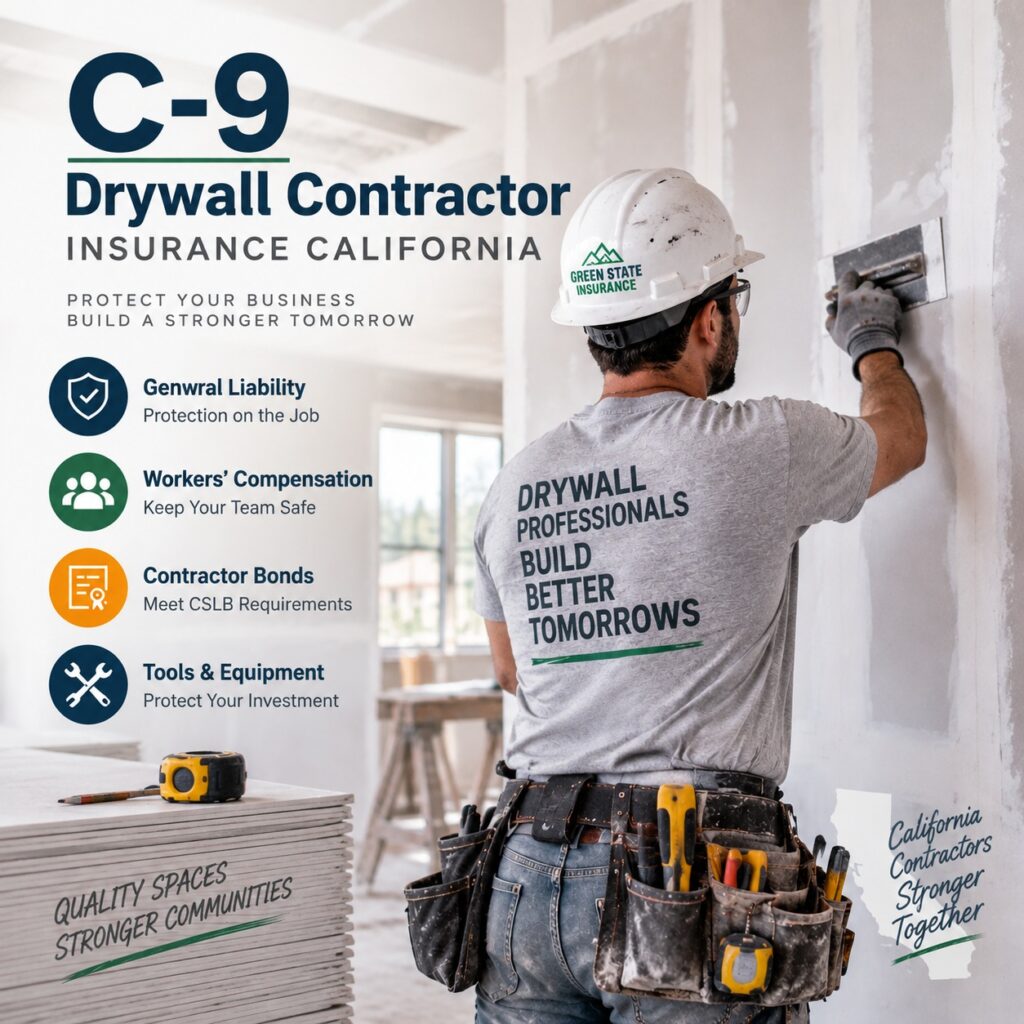
Painting, Drywall and Flooring Contractor Insurance Cost
Interior finish trades can sometimes present lower liability and workers’ compensation exposure than heavy structural or roofing work, but “lower risk” does not mean “no risk.”
Claims can still arise from:
- Falls
- Property damage
- Overspray
- Water or chemical damage
- Damaged flooring
- Tool theft
- Employee injuries
- Vehicle accidents
The exact operations performed still matter when requesting coverage.
Not Sure What Contractor Coverage You Need?
Explore insurance and surety options for California contractors, or speak with Green State Insurance about your business, projects, and coverage requirements.
What Factors Affect Contractor Insurance Cost?
Understanding the variables insurers look at gives you more control over the quoting process.
Contractor Classification and Type of Work
Your trade is one of the first factors an insurer evaluates.
Roofing, structural work, demolition, concrete, electrical, plumbing, and other specialized trades can carry different loss patterns.
Describe your operations accurately. A cheaper policy based on an inaccurate business classification can create major problems later.
Annual Payroll
Payroll is especially important for workers’ compensation.
As your workforce grows, your workers’ compensation exposure normally grows with it.
Accurate payroll estimates matter because significant differences between estimated and actual payroll can result in adjustments during an insurance audit.
Annual Revenue
Revenue helps insurers understand the scale of your business.
A contractor generating $200,000 per year in revenue typically has a different project volume and exposure from a company generating $10 million.
Do not intentionally understate revenue just to reduce a quote. Accurate information helps create a policy that reflects the actual business.
Number of Employees
More employees can increase exposure across several policies.
Employee duties matter as well.
A project manager, office administrator, electrician, roofer, driver, and laborer do not necessarily create the same insurance risk.
Claims History and Loss Runs
Past claims are an important underwriting factor.
A contractor with repeated liability, vehicle, or workers’ compensation losses may receive different pricing or underwriting terms from a business with a clean record.
Before renewal, review your loss runs for accuracy and understand any claims that appear on them.
Use of Subcontractors
Subcontractors deserve special attention.
Insurance companies may want to know:
- How much work you subcontract
- What trades your subcontractors perform
- Whether subcontractors maintain their own insurance
- Whether you collect Certificates of Insurance
- Whether contracts contain appropriate insurance requirements
- Whether your business is added as an additional insured when required
Poor subcontractor documentation can create unnecessary exposure.
Coverage Limits and Deductibles
Higher policy limits can increase premiums, although the relationship is not always proportional.
A $1 million liability policy will not necessarily cost exactly half as much as a $2 million policy.
Deductibles also influence pricing.
A higher deductible may reduce part of the premium, but the business needs enough cash available to comfortably absorb that deductible when a claim occurs.
Project Size and Contract Requirements
A contractor working on small residential projects may face different insurance requirements from a contractor bidding:
- Public works
- Apartment developments
- Commercial buildings
- Large residential developments
- Industrial projects
Contracts may require specific limits, endorsements, additional insured status, waiver of subrogation, primary and noncontributory wording, bonding, or umbrella coverage.
Review insurance requirements before signing the contract.
Business Location
Location can affect insurance pricing because loss patterns, medical costs, litigation environments, theft exposure, construction activity, and state regulations vary.
California contractors also operate within California-specific licensing, bonding, and workers’ compensation requirements.
Years in Business and Insurance History
New businesses may have less historical information available to insurers.
An established contractor with continuous coverage, documented safety practices, and favorable loss history may present a different underwriting profile from a company purchasing coverage for the first time.
Not Sure What Contractor Coverage You Need?
Explore insurance and surety options for California contractors, or speak with Green State Insurance about your business, projects, and coverage requirements.
How Workers’ Compensation Insurance Cost Is Calculated
Workers’ compensation deserves additional attention because it can become one of the largest expenses in a contractor’s insurance program.
Workers’ Compensation Classification Codes
Employees are generally assigned classifications based on the type of work they perform.
A construction laborer and an office employee should not automatically be treated as the same exposure.
Correct classifications matter because different types of work have different injury risks.
CSLB also requires contractors submitting workers’ compensation information to report up to the top three classification codes associated with the highest estimated payroll on the policy.
Payroll and Rate Calculation
Payroll is a major component of workers’ compensation pricing.
As payroll increases, the premium exposure usually changes accordingly.
That is why contractors should maintain accurate records throughout the year instead of waiting until the annual insurance audit.
Experience Modification Rate
For businesses that qualify for an experience modification rating, prior loss experience may affect workers’ compensation pricing.
Strong loss control and safety practices can therefore have financial value beyond preventing injuries.
Why High-Risk Trades Can Pay More
The probability and potential severity of employee injuries vary significantly between trades.
Working on roofs, handling heavy equipment, performing structural construction, working around electricity, and operating machinery can create greater injury exposure than lower-hazard office or administrative work.
California Contractor Insurance Requirements That Can Affect Cost
Not every insurance requirement comes directly from the state.
Some come from CSLB, while others come from customers, general contractors, property owners, lenders, municipalities, or construction contracts.
Is General Liability Insurance Required in California?
California does not impose a universal CSLB general liability requirement on every type of contractor license.
However, that does not mean contractors can safely operate without it. Customers, general contractors, landlords, government entities, and project contracts frequently require liability coverage. In fact, many California contractor insurance requirements can also be influenced by client contracts, commercial leases, and project-specific conditions.
California LLC contractor licenses are different. CSLB requires liability insurance of at least $1 million for LLC licenses with five or fewer personnel of record, increasing based on additional personnel up to the statutory maximum.
California Workers’ Compensation Requirements
California employers must maintain workers’ compensation coverage even when they employ only one person.
Contractors without employees may qualify for an exemption in certain situations, but CSLB specifically excludes several classifications from that exemption, including C-8, C-20, C-22, C-39, and D-49.
Coverage must also remain continuous when required. CSLB states that failure to maintain required workers’ compensation coverage can result in license suspension.
$25,000 California Contractor License Bond
An active California contractor license generally requires a $25,000 Contractor’s Bond on file with CSLB.
Remember:
$25,000 is the bond amount, not necessarily the amount you pay for the bond.
The premium charged by a surety can be considerably lower and depends on underwriting.
Additional Requirements for LLC Contractors
California LLC contractor licenses have additional requirements.
CSLB identifies an additional $100,000 employee/worker surety bond requirement for LLC licenses, along with liability insurance requirements.
Depending on how the license is qualified, a separate Bond of Qualifying Individual may also be required.
Insurance Requirements From General Contractors and Project Owners
Even when state law does not require a specific policy or limit, your contract may.
Before accepting a project, look carefully at the insurance section.
A contract may require:
- $1 million or $2 million liability limits
- Commercial auto coverage
- Workers’ compensation
- Employer’s liability
- Umbrella coverage
- Additional insured endorsements
- Waiver of subrogation
- Primary and noncontributory wording
- Builders risk
- Professional liability
- Performance and payment bonds
These requirements can change the real cost of taking on the project.
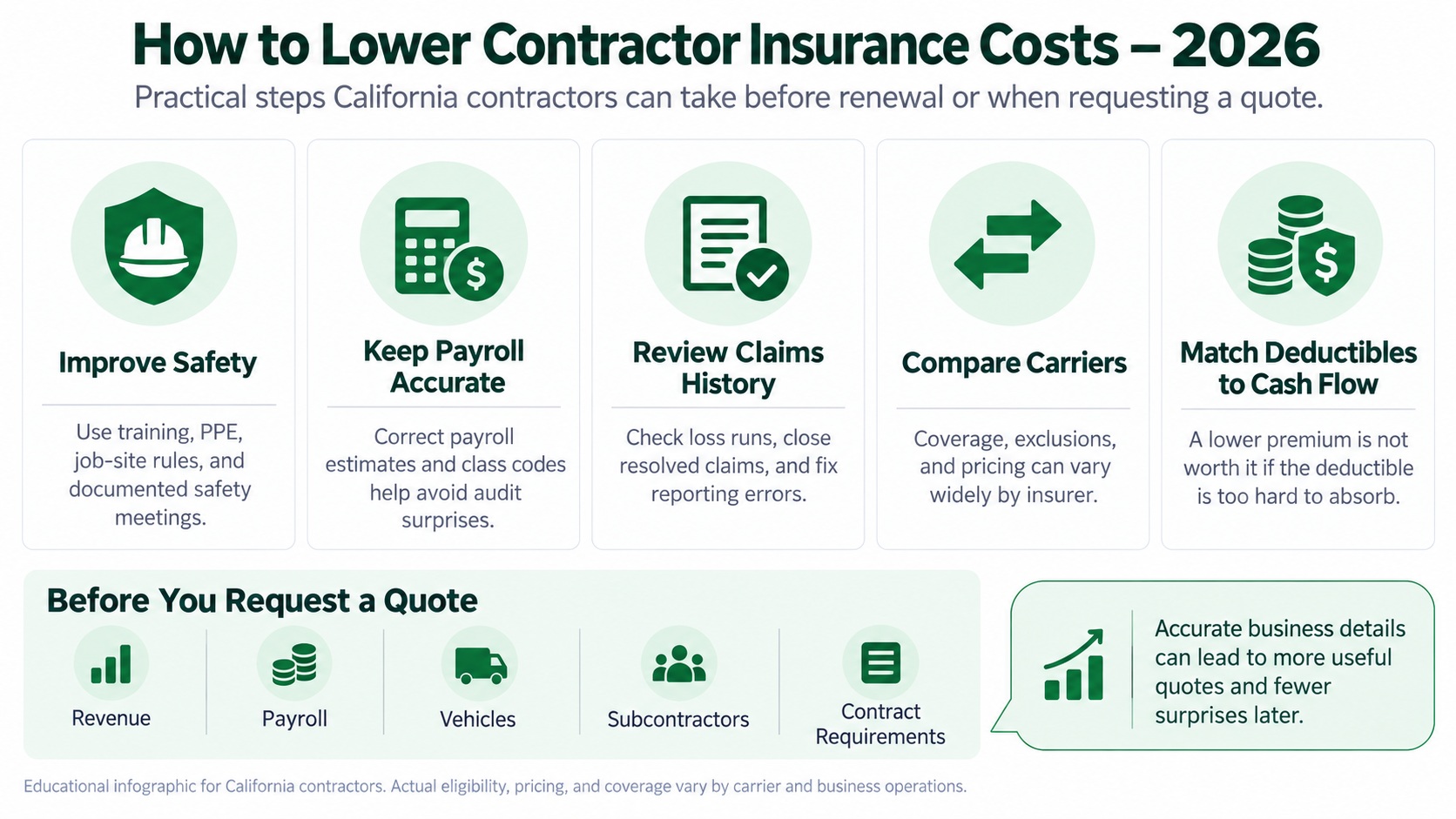
How to Lower Contractor Insurance Costs
The goal should not be to buy the cheapest possible policy.
The goal is to avoid paying unnecessarily while maintaining coverage that fits your operations and contracts.
Maintain a Strong Safety Program
Safety programs can help reduce injuries and claims.
Depending on the trade, that may include:
- Employee training
- Fall protection procedures
- PPE requirements
- Equipment inspections
- Driver safety policies
- Job-site documentation
- Incident reporting
- Regular safety meetings
Reducing losses can improve your insurance position over time.
Keep Payroll and Classification Records Accurate
Do not guess at payroll if better information is available.
Review payroll periodically, especially after:
- Hiring employees
- Laying off employees
- Changing employee duties
- Adding a new trade
- Expanding into a new type of work
Accurate classifications can also help avoid unpleasant surprises at audit.
Review Loss Runs Before Renewal
Request and review your loss history.
Look for:
- Incorrect claims
- Open claims that may be closable
- Incorrect reserves
- Duplicate records
- Old claims requiring clarification
If an insurer sees a loss, be prepared to explain what happened and what your company changed afterward.
Compare Multiple Insurance Carriers
Different carriers have different appetites for construction risks.
One insurer may be competitive for electricians while another prefers general contractors, plumbers, or interior trades.
Comparing multiple markets can sometimes produce better pricing or coverage.
Price should not be the only factor.
Review:
- Exclusions
- Endorsements
- Deductibles
- Coverage limits
- Additional insured wording
- Carrier requirements
Bundle Policies When It Makes Financial Sense
Buying several policies from one carrier can sometimes simplify administration and produce savings.
But bundling is not automatically the cheapest solution.
In some cases, using different carriers for different lines of coverage can make more sense.
Compare the total insurance program, not just one policy.
Review Deductibles and Policy Limits
Increasing a deductible may reduce premium, but it also increases the amount your business must absorb when a claim happens.
Choose a deductible based on cash flow and realistic risk tolerance—not simply because it produces the lowest quote.
Eliminate Unnecessary Coverage Overlap
Review your policies for duplicate or overlapping coverage.
At the same time, make sure eliminating overlap does not create a gap between policies.
This is especially important when your company has:
- General liability
- Commercial auto
- Inland marine
- Builders risk
- Umbrella coverage
- Professional liability
Review Insurance Before Major Contract Changes
A new project can change your exposure dramatically.
Talk to your insurance professional before:
- Starting a much larger project
- Entering a new trade
- Hiring a large number of employees
- Purchasing expensive equipment
- Adding vehicles
- Expanding into commercial work
- Taking government contracts
- Beginning work in another state
Finding out after signing the contract that your insurance program does not meet the requirements can become expensive.
Contractor Insurance Cost Examples
The following scenarios are examples designed to show why contractor insurance costs vary. They are not insurance quotes.
Solo Painting Contractor
A self-employed painter working primarily on residential interiors may need:
- General liability
- Tools and equipment coverage
- Contractor bond
- Commercial auto coverage if using a business vehicle
The relatively lower-hazard nature of the work may also result in a different insurance profile from roofing or structural construction.
Electrical Contractor With Three Employees
An electrical contractor with employees may need:
- General liability
- Workers’ compensation
- Commercial auto
- Tools and equipment coverage
- Contractor bond
- Umbrella coverage for certain contracts
Vehicle and driver information will also influence commercial auto pricing.
General Contractor Using Subcontractors
A general contractor may have relatively few direct employees but manage substantial subcontracted work.
The insurer may want to understand:
- Annual subcontractor cost
- Types of trades used
- Subcontractor insurance requirements
- Certificate collection procedures
- Written subcontractor agreements
- Additional insured requirements
Roofing Contractor With Employees and Vehicles
A roofing company with field employees, several trucks, tools, and commercial projects may need a significantly larger insurance budget.
The program could include:
- General liability
- Workers’ compensation
- Commercial auto
- Inland marine
- Umbrella coverage
- Contractor bond
- Project-specific bonding
How to Get an Accurate Contractor Insurance Quote
The fastest way to get a useful contractor insurance quote is to provide accurate information from the beginning.
Incomplete applications can delay underwriting or produce pricing that changes once the insurer receives the missing information.
Information You’ll Need
Prepare details about:
- Business name and structure
- CSLB license and classification
- Years in business
- Description of operations
- Annual revenue
- Annual payroll
- Number of employees
- Subcontractor costs
- Types of projects
- Largest project
- Typical project size
- Prior insurance
- Claims history
Payroll and Revenue Records
Use realistic projections.
If your company is growing quickly, tell the agent or carrier rather than relying on numbers that no longer reflect the business.
Loss Runs and Claims History
If you have prior insurance, carriers may request loss runs showing your claims history.
Obtaining them early can make the quoting process smoother.
Vehicle and Driver Information
For commercial auto coverage, prepare:
- Vehicle identification numbers
- Vehicle types
- Vehicle values
- Driver information
- Driving history
- Business use
- Garaging information
Contract and Certificate Requirements
If a client or general contractor has already provided insurance requirements, send them with your quote request.
That can help determine whether you need:
- Higher limits
- Additional insured endorsements
- Waiver of subrogation
- Primary and noncontributory language
- Umbrella coverage
- Bonding
It is much easier to build the correct coverage before the job begins.
Get a Contractor Insurance Quote That Fits Your Business
There is no reason to guess what contractor insurance should cost based on another company’s premium.
Your trade, payroll, employees, vehicles, projects, claims history, insurance requirements, and growth plans all affect the final price.
Green State Insurance works with California contractors seeking coverage for general liability, workers’ compensation, builders risk, commercial auto, contractor license bonds, and construction surety bonds.
Whether you are starting a new contracting business, renewing an existing policy, hiring employees, bidding a larger project, or reviewing rising insurance costs, the first step is understanding what coverage you actually need.
Request a contractor insurance quote and compare coverage based on your real operations—not a generic online estimate.
Insurance costs, eligibility, policy terms, limits, exclusions, and availability vary by carrier and applicant. Pricing examples in this guide are for general educational purposes and should not be interpreted as a guaranteed quote. California licensing and insurance requirements can change, so contractors should confirm current requirements applicable to their specific license and operations.
Frequently Asked Questions About Contractor Insurance Cost
Common questions California contractors ask about insurance pricing, coverage requirements, and policy limits.
Not Sure What Contractor Coverage You Need?
Explore insurance and surety options for California contractors, or speak with Green State Insurance about your business, projects, and coverage requirements.

One Response