
E&O Insurance: What Errors and Omissions Coverage Means for Your Business
A professional mistake does not have to involve physical injury or property damage to become expensive.
If your business provides advice, consulting, recommendations, designs, technical services, or other professional expertise, a client could claim that an error, omission, missed deadline, or failure in your services caused them financial loss.
E&O Insurance, also known as Errors and Omissions Insurance, is designed to address certain professional liability claims like these.
Depending on the policy, E&O Insurance may help with covered claims involving professional negligence, mistakes, omissions, inadequate services, and related legal defense costs.
This guide explains what E&O Insurance covers, who may need it, how it differs from General Liability Insurance, what affects the cost, and what businesses should review before choosing coverage.
E&O Insurance at a Glance
Not every business risk is covered by the same policy. Use this quick guide to understand where E&O Insurance fits and which coverage may apply to different exposures.
| Your Concern | Coverage to Review | Why It Matters |
|---|---|---|
| A client claims your advice caused financial loss | E&O Insurance | May address certain claims involving professional advice or negligence. |
| You make an error or omission while providing a service | E&O Insurance | May help with certain covered professional mistakes and related claims. |
| A customer is injured or their property is damaged | General Liability Insurance |
E&O is not a replacement for third-party bodily injury and property damage coverage. |
| An employee is injured while working | Workers’ Compensation Insurance |
Workplace injuries are a separate exposure from professional liability. |
| A contractor provides design, consulting or technical advice | E&O + general contractor insurance |
Professional and jobsite exposures may require different types of coverage. |
| You are unsure which policies your business needs | Business Insurance Services |
Review coverage based on your services, contracts, employees and business operations. |
E&O Insurance focuses on certain claims arising from professional services, errors and omissions. It does not replace General Liability, Workers’ Compensation or other coverage your business may need.
What Is E&O Insurance?
E&O Insurance is a form of Professional Liability Insurance designed for businesses and professionals that provide services, expertise, advice, or recommendations to clients.
The key difference is the type of loss involved.
Consider two examples.
A client visits your office, slips on the floor, and is injured. That is generally a premises liability exposure and may fall under appropriate General Liability Insurance.
Now consider a client who claims your professional recommendation contained a serious error and caused their business to lose money.
That is a professional liability exposure and may be the type of claim addressed by E&O Insurance.
This distinction is important because one insurance policy should not automatically be expected to cover every type of business risk.
What Does E&O Insurance Cover?
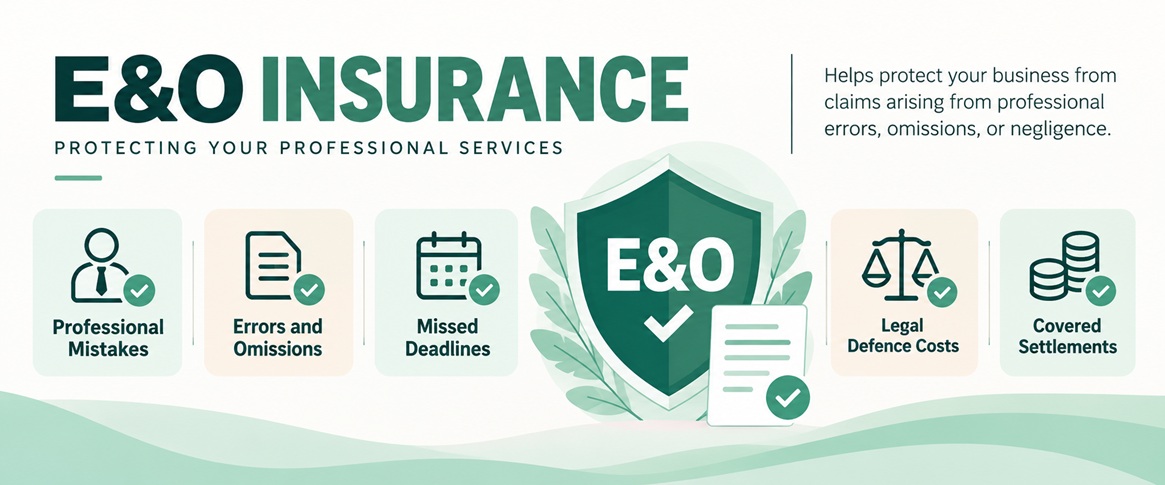
Coverage varies by policy and profession, but E&O Insurance may address certain claims involving errors or failures in the professional services a business provides.
Professional Mistakes
Incorrect calculations, overlooked details, inaccurate recommendations, or documentation errors may lead to a client claim.
Professional Negligence
May address certain claims alleging that your business failed to provide the expected level of professional service or care.
Errors & Omissions
Missing information or failure to complete an agreed professional responsibility may result in a claim.
Incorrect Advice
Claims may arise when professional advice or recommendations allegedly cause a client financial loss.
Failure to Deliver Services
Claims may arise when professional services are allegedly incomplete, inadequate, or not delivered as expected.
Missed Deadlines
A professional error that causes an important deadline to be missed may result in a financial-loss claim.
Legal Defense Costs
Depending on the policy, E&O Insurance may help with eligible attorney fees, court costs, settlements, or judgments arising from a covered professional liability claim.
SIMPLE EXAMPLE
A Simple E&O Insurance Example
Imagine a business consultant is hired to analyze a client’s operations and recommend ways to reduce expenses. The consultant makes an error in the analysis, and the client later claims the mistake caused a significant financial loss.
Because the alleged loss resulted from a professional service, an applicable E&O policy may respond to certain covered defense costs or damages. A customer slipping at the consultant’s office, however, represents a different type of liability exposure.
What Does E&O Insurance Usually Not Cover?
E&O Insurance is not an all-purpose business insurance policy. Exact exclusions vary, but several major exposures generally require different coverage.
Bodily Injury & Property Damage
These exposures are generally associated with
general liability insurance
rather than the core purpose of E&O coverage.
Employee Work-Related Injuries
E&O does not replace
Workers’ Compensation insurance
for employee workplace injuries.
Vehicle Accidents
Businesses that own, lease, or use vehicles for work may need appropriate Commercial Auto coverage.
Your Business Property
Offices, equipment, computers, inventory, and other business property may require separate property coverage.
Intentional or Fraudulent Acts
E&O policies commonly contain exclusions involving intentional, fraudulent, criminal, or dishonest conduct.
Employment-Related Claims
Claims involving discrimination, harassment, or wrongful termination are different from professional-service claims and may require separate coverage.
Coverage and exclusions vary by insurer and policy. Review the actual policy terms, limits, exclusions, and covered professional services before relying on E&O Insurance for a specific exposure.
Who Needs E&O Insurance?
E&O Insurance is particularly relevant when clients rely on a business’s professional judgment, expertise, recommendations, or specialized services.
Businesses that may consider E&O coverage include:
- Consultants
- Insurance professionals
- Real estate professionals
- Accountants and bookkeepers
- Technology and IT businesses
- Engineers
- Architects and designers
- Marketing professionals
- Financial service businesses
- Business service providers
- Other professional service companies
Rather than relying only on a list of occupations, ask a more useful question:
Could a client claim that an error, omission, professional recommendation, or failure in my service caused them financial harm?
If the answer is yes, E&O Insurance may be worth reviewing.
According to the California Department of Insurance, Professional Liability Insurance covers liability resulting from performing a profession and can include Errors & Omissions (E&O) Insurance. California Department of Insurance
E&O Insurance for Contractors
Contractors can face both physical and professional risks. Traditional general contractor insurance may help address certain jobsite liability exposures, but it should not automatically be expected to cover claims arising from professional advice, design work, or consulting services.
Professional exposures may become more important when a contractor provides:
- Design services
- Project management
- Technical recommendations
- Specifications
- Consulting
- Design-build services
For these businesses, E&O coverage may need to be reviewed alongside contractor liability insurance and other applicable commercial coverage.
For example, general liability insurance for contractors may address certain covered third-party bodily injury or property damage claims, while E&O Insurance focuses on certain claims arising from professional services.
California construction businesses should therefore evaluate their professional exposure as part of their broader California contractor insurance program rather than assuming one policy addresses every risk.
E&O Insurance vs. Professional Liability Insurance
E&O Insurance and Professional Liability Insurance are commonly terms used for the same general category of coverage.
The preferred terminology often depends on the profession or insurance market.
For example, one industry may commonly call the coverage Errors and Omissions Insurance, while another refers to essentially the same category as Professional Liability Insurance.
Instead of focusing only on the policy name, review what the actual policy says.
Important details include:
- Covered professional services
- Policy limits
- Deductible
- Exclusions
- Claims reporting requirements
- Retroactive date
- Prior-acts coverage
- Policy period
The wording of the policy matters more than the label alone.
E&O Insurance vs. General Liability Insurance
This is one of the most important distinctions for business owners to understand.
| Risk | E&O Insurance | General Liability |
|---|---|---|
| Professional error | May address covered claims | Generally not its primary purpose |
| Incorrect professional advice | May address covered claims | Generally not its primary purpose |
| Professional negligence | May address covered claims | Generally not its primary purpose |
| Failure to provide professional services | May address covered claims | Generally not its primary purpose |
| Third-party bodily injury | Generally outside its primary purpose | May address covered claims |
| Third-party property damage | Generally outside its primary purpose | May address covered claims |
For example:
If an accountant makes an alleged professional error that causes a client financial loss, that may create an E&O exposure.
If the same client’s laptop is accidentally damaged at the accountant’s office, the situation involves a different type of liability exposure.
Businesses that face both types of risks may need to review both E&O and general liability insurance rather than assuming one replaces the other.
Is E&O Insurance Required in California?
There is no single E&O Insurance requirement that applies to every California business.
Whether coverage is required can depend on:
- Profession
- License
- Business entity
- Regulatory requirements
- Client contracts
- Industry requirements
Some regulated professions or business entities can have specific financial responsibility or Professional Liability requirements.
Even when E&O Insurance is not required by law, a client contract may require it before work begins.
For example, a contract could specify:
- Professional Liability coverage
- Minimum policy limits
- Continuous coverage
- Particular insurance documentation
Before determining whether E&O is required, review the requirements that actually apply to your business, profession, and contracts.
Understanding Claims-Made E&O Insurance
Many E&O and Professional Liability policies are written on a claims-made basis.
This makes the timing of coverage especially important.
With claims-made coverage, several dates and policy provisions can affect whether a claim is eligible for coverage.
Policy Period
The policy must generally be active when required by the policy’s claims-made and reporting provisions.
Retroactive Date
A retroactive date can determine how far back eligible professional services may be considered.
A claim reported today could involve work performed months or years earlier, making this date important.
Continuous Coverage
Allowing claims-made coverage to lapse can create potential gaps involving previous professional services.
Businesses changing insurers or policies should carefully review continuity and prior-acts provisions before replacing existing coverage.
Extended Reporting Period
Some policies may offer an Extended Reporting Period that provides additional time to report certain claims after coverage ends.
It does not necessarily extend the period during which new professional services are performed. The exact protection depends on the policy.
Claims-made provisions can be technical, so businesses should review them carefully rather than comparing E&O policies only by price.
How Much Does E&O Insurance Cost?
There is no universal price for E&O Insurance.
Two businesses in different professions—or even two businesses in the same profession—can receive very different premiums.
Factors that may affect cost include:
- Industry or profession
- Type of professional services
- Annual revenue
- Business size
- Number of professionals or employees
- Coverage limits
- Deductible
- Claims history
- Years in business
- Location
- Contract requirements
- Underwriting factors
A small consulting business with relatively limited professional exposure will not necessarily have the same pricing as a larger company handling complex or high-value client projects.
For this reason, a business-specific quote is generally more useful than relying on a generic average.
What Information Is Needed for an E&O Insurance Quote?
Preparing accurate information can make the quote process more efficient and help insurers understand the professional exposure.
1. Describe Your Professional Services
Clearly explain what your business does.
Do not rely only on a broad label such as “consultant” or “contractor.” Describe the actual services provided to clients.
2. Prepare Revenue Information
Be prepared to provide current or projected annual revenue when requested.
3. Identify Your Client Types
Consider whether you primarily serve consumers, small businesses, large companies, government entities, or other organizations.
4. Review Your Contracts
Check whether clients require Professional Liability Insurance and whether contracts specify particular limits.
5. Prepare Your Claims History
Previous professional liability claims or known circumstances may be relevant to underwriting.
6. Review Existing E&O Coverage
If you already have coverage, review:
- Current limits
- Deductible
- Effective and expiration dates
- Retroactive date
- Prior-acts coverage
- Claims history
7. Identify Required Limits
Do not select limits only because they are the cheapest option.
Review contractual requirements and the potential financial severity of professional liability claims.
Common E&O Insurance Mistakes to Avoid
Several mistakes can reduce the usefulness of an E&O policy or create unexpected coverage issues.
Assuming General Liability Covers Professional Errors
General Liability and E&O address different categories of risk.
A business with both physical and professional exposures may need both.
Buying Based Only on Price
Premium matters, but it should not be the only factor.
Compare coverage limits, deductible, exclusions, covered professional services, and claims-made provisions.
Describing Your Services Too Broadly
Your professional services should be accurately represented during the application process.
The actual work your business performs matters.
Ignoring the Retroactive Date
For claims-made policies, the retroactive date can be an important part of coverage.
Allowing Coverage to Lapse
A lapse in claims-made coverage may create problems involving professional services performed in the past.
Assuming Every E&O Policy Is the Same
Policy language varies.
Two policies with the same limits may have different definitions, exclusions, deductibles, retroactive dates, and reporting provisions.
E&O Insurance Checklist
Before purchasing or renewing E&O Insurance, review the details that can affect your coverage. Having this information ready can also make it easier to compare policy options and identify potential gaps.
Professional Services
List the services your business actually provides. Be specific about consulting, advice, design, technical work, or other professional responsibilities.
Potential Exposure
Consider how an error, omission, incorrect recommendation, missed deadline, or failure to perform a professional service could cause a client financial loss.
Client Contracts
Check whether your contracts require E&O or Professional Liability Insurance, including specific coverage limits or other insurance requirements.
Coverage Limits & Deductible
Review the limits your business needs and the deductible you would be responsible for if a covered claim occurs.
Covered Professional Services
Confirm that the professional services your business actually performs are appropriately addressed by the policy.
Policy Exclusions
Review what the policy does not cover. Pay particular attention to exclusions that could affect your normal business activities.
Claims-Made & Retroactive Date
If the policy is claims-made, check the retroactive date, reporting requirements, and whether continuous coverage is important for prior professional services.
Claims History
Prepare information about previous claims and any known circumstances that may need to be disclosed during the application or renewal process.
Before You Choose a Policy: Compare more than the premium. Review the covered services, limits, deductible, exclusions, retroactive date, and claims-reporting requirements to determine whether the policy fits the actual professional risks of your business.
How E&O Fits Into a Business Insurance Program
E&O Insurance should be viewed as one part of a broader risk-management strategy.
A business may have several exposures at the same time.
Professional services
→ E&O / Professional Liability
Customer injuries or third-party property damage
→ General Liability Insurance
Employee work-related injuries
→ Workers’ Compensation Insurance
Business-owned or operated vehicles
→ Appropriate Commercial Auto coverage
Buildings and business property
→ Appropriate Commercial Property coverage
For construction businesses, the insurance program may also involve California contractor insurance and other project-specific coverage depending on operations and contract requirements.
The right combination depends on what the business actually does.
Review Your E&O Insurance Needs
A professional liability claim can arise even when there has been no physical injury or property damage.
If clients rely on your business for professional advice, expertise, recommendations, designs, or services, E&O Insurance may be an important part of your insurance program.
Before choosing coverage, review your professional services, contracts, limits, claims history, retroactive date, and policy exclusions.
Green State Insurance can help California businesses review E&O and other commercial insurance options based on their actual operations and coverage needs.
Explore business insurance services from Green State Insurance.
Businesses with third-party liability exposures can also review General Liability Insurance.
Businesses with employees can review Workers’ Compensation Insurance.
Construction businesses can review their contractor liability insurance needs alongside any applicable professional liability exposures.
Green State Insurance: (949) 432-4805
Frequently Asked Questions About E&O Insurance
Common questions about E&O Insurance, professional liability coverage, policy requirements, costs, and claims.
What does E&O Insurance mean?
E&O stands for Errors and Omissions Insurance. It is a type of Professional Liability Insurance designed to address certain claims arising from professional errors, omissions, negligence, or inadequate professional services.
What does E&O Insurance cover?
Depending on the policy, E&O may help with certain claims involving professional mistakes, negligence, incorrect advice, omissions, missed responsibilities, or failure to provide professional services. Eligible legal defense costs and covered damages may also be included.
Is E&O Insurance the same as Professional Liability Insurance?
The terms are commonly used for the same general category of coverage, although terminology varies by profession and insurance market.
Is E&O Insurance the same as General Liability Insurance?
No. E&O primarily addresses professional-service exposures. General Liability generally addresses different risks, including certain third-party bodily injury and property damage claims.
Who should consider E&O Insurance?
Businesses that provide professional services, advice, consulting, recommendations, designs, or specialized expertise may want to review E&O coverage.
Is E&O Insurance required in California?
There is no universal requirement for every California business. Requirements can depend on the profession, license, entity type, regulations, or client contracts.
How much does E&O Insurance cost?
Cost depends on factors such as profession, services, revenue, business size, claims history, limits, deductible, and underwriting factors.
What is a claims-made E&O policy?
A claims-made policy generally bases coverage on when a claim is made and reported, subject to the policy’s terms, policy period, retroactive date, and reporting requirements.
Does E&O Insurance cover mistakes made before the policy started?
It depends on the policy, including its retroactive date and prior-acts provisions. Businesses replacing existing coverage should review this carefully.
Does E&O Insurance cover legal fees?
E&O policies may provide defense coverage for eligible professional liability claims, subject to the policy’s limits, deductible, exclusions, and other terms.