
Hiring a Contractor Tips: 10 Things to Check Before You Hire
Hiring a contractor is about more than finding someone who can complete the work at the right price. Whether you are planning a home renovation, repair, addition, or larger construction project, you should understand who you are hiring, what work they are responsible for, what insurance and bonding they carry, and what happens if something goes wrong.
The most useful hiring a contractor tips focus on verification before the project begins. A professional website, a competitive estimate, or the words “licensed and insured” may sound reassuring, but important details should still be checked before you sign a contract.
Use the following checklist to evaluate a contractor, compare your options, and better understand the insurance and bonding information that may matter for your project.
Before Hiring a Contractor, Know What to Check
A contractor may be licensed, bonded, or insured—but those terms do not mean the same thing. Start with the concern you have and review the protection that may apply before work begins.
| Your Concern | What You Should Check | Why It Matters | Related Green State Service |
|---|---|---|---|
| What if the contractor damages my property? | General Liability insurance | May address certain third-party property damage or bodily injury claims, subject to the policy. | General Liability → |
| What if a worker gets injured on the job? | Workers’ Compensation | Review whether employees performing the work are covered for work-related injuries or illnesses. | Workers’ Compensation → |
| The contractor says they are “bonded.” What does that mean? | Contractor’s Bond | A licensing bond and contractor insurance serve different purposes. Being bonded does not automatically mean being insured. | Contractor Bond → |
| What protects the building or materials during construction? | Builders Risk | Depending on the project and policy, Builders Risk may cover certain physical loss or damage during construction. | Builders Risk → |
| I’m not sure what coverage should be verified. | Review the contractor and project requirements | Insurance needs can vary based on the contractor’s trade, workforce, operations, and specific project requirements. | View All Services → |
Licensed, bonded, and insured describe different things. Before hiring a contractor, verify the contractor’s credentials and review the insurance and bonding information relevant to the work being performed.
1. Verify Exactly Who You Are Hiring
Start with the basics: identify the actual business or contractor that will be responsible for the project.
The business name appearing on the estimate and contract should be consistent with the contractor information you verify. This becomes particularly important when a salesperson, subcontractor, project manager, or another company is involved in the initial conversation.
You should know who is entering into the agreement, who will supervise the project, and who is responsible for completing the work.
For California projects that fall within contractor licensing requirements, verify the contractor’s current license rather than relying solely on a license number displayed in advertising or on an estimate. California’s licensing rules generally apply when a project requires a building permit, uses employee labor, or reaches the state’s applicable labor-and-material threshold. CSLB
A basic identity and license check is one of the simplest hiring a contractor tips, but it can prevent significant confusion later.
2. Understand the Difference Between Licensed, Bonded, and Insured
You may see contractors advertise themselves as:
Licensed. Bonded. Insured.
These terms are often grouped together, but they describe different things.
Licensed refers to the contractor holding the applicable contractor license.
Bonded means an applicable surety bond is in place. For California licensed contractors, the Contractor’s Bond is part of the licensing framework.
Insured generally refers to insurance policies the business carries, such as General Liability, Workers’ Compensation, Commercial Auto, or other applicable commercial coverage.
Think of it this way:
License ≠ Bond ≠ Insurance
Having one does not automatically prove that the contractor has the others.
This distinction is especially important for property owners because a Contractor’s Bond should not be mistaken for General Liability insurance, and General Liability should not be mistaken for Workers’ Compensation.
3. Check the Contractor’s Bond
California licensed contractors are required to maintain a Contractor’s Bond as part of maintaining an active license. The current required amount is $25,000. CSLB
But the dollar amount is only part of what homeowners should understand.
A Contractor’s Bond is a surety bond, not the same product as a commercial insurance policy. It is connected to California contractor licensing and has defined conditions under which claims may apply.
Therefore, seeing the word “bonded” should not lead you to assume that the contractor also carries General Liability or Workers’ Compensation insurance.
Contractors who need a new bond, renewal, or help understanding their California bonding options can review Green State Insurance’s Contractor Bond services.
Contractor Bond:
https://www.greenstateins.com/contractors-bond/
4. Ask About General Liability Insurance
One of the most important hiring a contractor tips is to ask about General Liability insurance before construction begins.
Construction work creates potential liability exposures. Depending on the circumstances and terms of the policy, General Liability insurance may address certain third-party bodily injury or property damage claims arising from the contractor’s operations.
For example, imagine that work is being performed inside a home and contractor operations accidentally cause damage to other property. That situation is different from a licensing or bonding issue and may raise questions about the contractor’s liability coverage.
Ask the contractor for current insurance information and review:
- Insurance carrier
- Policy effective dates
- Coverage limits
- Certificate of Insurance (COI)
- Any insurance requirements contained in your project contract
Do not simply ask:
“Are you insured?”
A better question is:
“Can you provide current proof of your General Liability insurance?”
California does not universally require commercial general liability insurance for every contractor, making verification particularly important rather than assuming that a contractor license automatically means CGL coverage exists. CSLB
Green State Insurance helps California contractors review coverage based on their trade, operations, revenue, payroll, subcontractor exposure, project requirements, and other underwriting factors.
General Liability Insurance:
https://www.greenstateins.com/general-liability/
5. Ask About Workers’ Compensation
General Liability and Workers’ Compensation serve different purposes.
If the contractor has employees who will perform work on the project, Workers’ Compensation is another important coverage to verify.
Workers’ Compensation generally addresses work-related employee injuries and illnesses according to applicable policy terms and California law. California contractors with employees are generally required to carry Workers’ Compensation insurance, with additional requirements applying to certain contractor classifications. CSLB
Before the project begins, ask:
Who will actually perform the work?
The answer may include the contractor’s employees, subcontractors, or a combination of both.
Understanding the workforce is useful because the contractor’s insurance arrangements and contractual responsibilities may differ depending on how the work is performed.
Green State Insurance provides Workers’ Compensation options for California contractors across a range of construction trades.
Workers’ Compensation:
https://www.greenstateins.com/workers-compensation/
6. Check References and Similar Projects
Insurance and bonding tell you about important business protections, but they do not tell you whether a contractor is the right fit for your particular project.
Ask for examples of similar work.
If you are hiring someone for a major kitchen renovation, references from similar remodeling projects may be more informative than examples of unrelated construction work.
When speaking with previous customers, consider asking:
Was the project completed close to the expected schedule?
Were changes and additional costs clearly communicated?
Did the contractor respond when problems occurred?
Was the final scope consistent with what was promised?
Would you hire this contractor again?
Online reviews can provide additional context, but they should not be your only source of information.
A combination of references, completed projects, contractor documentation, and a detailed estimate provides a much more complete picture.
7. Compare the Scope, Not Just the Price
Suppose you receive three estimates:
Contractor A — $24,500
Contractor B — $31,000
Contractor C — $37,500
That does not automatically mean Contractor A is the best value or Contractor C is overpriced.
First determine whether all three contractors are actually quoting the same project.
One proposal may include demolition, debris removal, premium materials, permits, and finish work, while another may exclude several of those items.
Compare:
- Scope of work
- Materials
- Labor
- Exclusions
- Estimated schedule
- Permit responsibilities
- Payment schedule
- Warranty information
- Change-order process
The goal is to compare like with like.
California’s contractor regulator also recommends obtaining at least three written bids based on the same plans, specifications, and scope rather than automatically selecting the lowest bid. CSLB
8. Put Important Project Details in Writing
A handshake can start a conversation. It should not be the only record of a construction project.
Your written agreement should make the project easier to understand for both sides.
At a minimum, review how the contract addresses the scope of work, materials, project price, payment schedule, approximate timeline, permits, and responsibilities.
Also pay attention to what the contract doesn’t include.
If a contractor verbally promises to install a particular product, complete additional work, upgrade a material, or make another significant change, make sure the agreement reflects what you actually expect.
Document Change Orders
Changes are common during construction.
You may discover hidden damage after demolition, decide to upgrade materials, add work, or remove something from the original scope.
Those changes can affect both price and schedule.
Instead of relying on a verbal conversation, document important changes through a written change order.
A simple rule to remember:
If the scope changes, the documentation should change too.
9. Understand Permits and Responsibilities Before Work Begins
Do not wait until construction has started to ask who is responsible for permits.
Depending on the project and jurisdiction, permits and inspections may be required. The contractor and property owner should understand who will obtain necessary permits and coordinate applicable inspections.
Before signing, ask:
Does this project require permits?
Who is responsible for obtaining them?
Are permit costs included in the estimate?
Who coordinates inspections?
Will permit-related delays affect the project schedule?
The answers should be reflected in the project’s written documentation where appropriate.
This is particularly important when comparing estimates because one contractor’s proposal may include responsibilities that another contractor has excluded.
10. Understand the Payment Schedule
Another essential part of hiring a contractor tips is understanding how money will move throughout the project.
Do not look only at the final price.
Review the deposit, progress payments, milestones, final payment, and any conditions associated with those payments.
A clear payment schedule should help you understand:
How much is due?
When is it due?
What stage of work corresponds to the payment?
What happens if the project scope changes?
Keep copies of invoices, receipts, payment confirmations, change orders, and other important financial records.
Avoid making significant payments without understanding what the payment represents.
The Insurance Check Most Homeowners Miss
Many homeowners spend considerable time comparing flooring, countertops, fixtures, paint colors, and project prices but spend very little time reviewing the contractor’s insurance.
That can be a mistake.
Before work begins, there are three separate questions worth asking:
Does the contractor have General Liability insurance?
This may be relevant to certain third-party bodily injury and property damage exposures arising from the contractor’s operations.
Does the contractor have Workers’ Compensation?
This becomes particularly important when the contractor has employees performing work.
Does the contractor have the required Contractor’s Bond?
For California licensed contractors, the Contractor’s Bond is part of the licensing requirements. The current required amount is $25,000. CSLB
These are separate protections.
A contractor could have a bond without a particular insurance policy, or carry one type of insurance without another.
That is why the better question is not simply:
“Is the contractor insured?”
Instead ask:
“What insurance and bonding does this contractor currently have, and what does my project require?”
Contractor Bond vs General Liability Insurance
This distinction deserves special attention because bonds and insurance are frequently confused.
A California Contractor’s Bond is a surety product associated with contractor licensing requirements.
General Liability insurance is a commercial insurance product designed to address certain liability exposures subject to the policy’s coverage terms, conditions, exclusions, and limits.
They do not serve the same purpose.
| Contractor’s Bond | General Liability |
|---|---|
| Surety product | Insurance product |
| Connected to contractor licensing | Connected to business liability exposure |
| California active-license requirement | Not universally required for every California contractor |
| $25,000 current required bond amount | Limits vary by policy |
| Does not replace GL insurance | Does not replace licensing bond |
For contractors who need both, Green State Insurance provides access to:
Contractor Bond:
https://www.greenstateins.com/contractors-bond/
General Liability:
https://www.greenstateins.com/general-liability/
What Is a Certificate of Insurance?
A Certificate of Insurance, commonly called a COI, is a document used to provide information about insurance coverage.
When hiring a contractor, requesting a current COI can help you review information such as the insurance carrier, policy type, effective dates, and limits shown on the certificate.
However, a COI should not automatically be interpreted as expanding or changing the underlying insurance policy.
For larger projects, the construction contract may contain specific insurance requirements. Contractors should review those requirements before work begins instead of assuming that an existing policy automatically satisfies every contract.
This is also why contractors may need to review insurance requirements when taking on larger commercial or construction projects.
Red Flags When Hiring a Contractor
Not every unusual situation means there is a problem. However, several warning signs should lead you to ask more questions before proceeding.
Be cautious when:
- Contractor information is difficult to verify.
- The business name changes between documents.
- The contractor avoids providing written estimates.
- Insurance information cannot be provided or verified.
- Important promises remain verbal.
- The scope of work is vague.
- Payment terms are unclear.
- A bid is dramatically different from comparable proposals without an understandable reason.
- The contractor cannot provide relevant references.
- You are pressured to sign before you understand the agreement.
One red flag does not automatically mean you should reject a contractor. It means you should verify before you commit.
Questions to Ask Before Hiring a Contractor
A good contractor interview does not need to be complicated.
Ask questions that help you understand the business, the project, and the protections surrounding the work:
- What is the exact business name I will be contracting with?
- What is your contractor license number?
- Who will supervise my project?
- Will employees or subcontractors perform the work?
- Can you provide current General Liability insurance information?
- Can you provide Workers’ Compensation information where applicable?
- Is your Contractor’s Bond current?
- Can you provide references from similar projects?
- What is included and excluded from this estimate?
- Who is responsible for permits and inspections?
- What is the expected project schedule?
- How are change orders handled?
- What is the payment schedule?
- What happens if additional work is discovered?
- What documentation will I receive before work begins?
You do not necessarily need a perfect answer to every question immediately.
What matters is whether the contractor can provide clear, consistent, and verifiable information before you make a significant commitment.
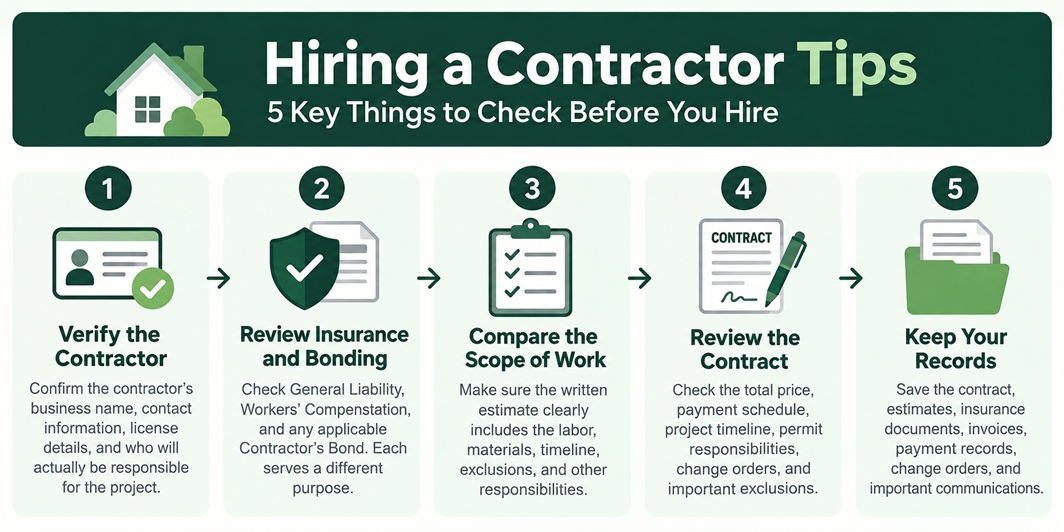
Before You Sign: A 5-Step Contractor Final Check
Before signing a construction contract, take a few minutes to complete one final review. Among the most practical hiring a contractor tips is to verify the contractor, project scope, insurance and bonding information, and contract terms before work begins—not after a problem occurs.
Step 1 — Verify the Contractor and License
Confirm the contractor’s legal business name, contact information, license details, and the person or company that will actually be responsible for the project. Make sure the information on your estimate and contract is consistent with the contractor you intend to hire.
Step 2 — Verify Insurance and Bonding
Don’t stop at the words “licensed, bonded, and insured.” Review what is actually in place. Depending on the contractor and project, this may include a Contractor’s Bond, General Liability insurance, and Workers’ Compensation.
Remember that a contractor’s license, bond, General Liability policy, and Workers’ Compensation coverage serve different purposes. Having one does not automatically mean the others are in place.
Step 3 — Compare the Scope With the Estimate
Review exactly what the contractor has agreed to provide. Check the labor, materials, demolition, cleanup, exclusions, project schedule, and other responsibilities included in the estimate.
If you received multiple bids, make sure you are comparing substantially the same scope of work rather than choosing a contractor based only on the lowest price.
Step 4 — Review the Contract Before Signing
Read the complete agreement and make sure it reflects what you discussed. Pay particular attention to the total price, payment schedule, project timeline, permit responsibilities, change-order process, materials, and any important exclusions.
If an important promise was made verbally but does not appear in the agreement, address it before signing.
Step 5 — Create a Project Record
Keep copies of the signed contract, estimates, insurance information, bond details, permits, invoices, receipts, payment records, change orders, and important communications in one place.
If the scope, price, or schedule changes during construction, document those changes instead of relying only on conversations.
Final Check: Before work begins, you should be able to answer five questions: Who am I hiring? What exactly are they doing? What insurance and bonding have I verified? What does the contract require? What records do I have?
Hiring a Contractor Starts With Verification
The most important hiring a contractor tips are not complicated: know who you are hiring, verify important information, understand the project scope, review insurance and bonding, put important agreements in writing, and keep good records.
Price and availability matter, but they should not be the only factors in your decision. Before construction begins, make sure you understand who is responsible for the work, what is included in the project, and what protections are in place.
Before work begins, you should be able to answer:
For contractors on the other side of that conversation, being prepared to provide current insurance and bonding information can make it easier to address homeowner, general contractor, lender, or project requirements.
Green State Insurance helps California contractors review General Liability, Workers’ Compensation, Contractor Bonds, Builders Risk, and other commercial insurance and bonding options based on their operations and project requirements.
Frequently Asked Questions About Hiring a Contractor
Get quick answers to common questions about contractor licensing, insurance, bonding, estimates, and what to review before hiring.
What should I check before hiring a contractor?
Start with the contractor’s identity and license, then review relevant bonding and insurance information. You should also check references, compare detailed written estimates, understand the scope of work, review the contract, clarify permits, and understand the payment schedule before construction begins.
Should I ask a contractor for proof of insurance?
Yes. Asking for current insurance information is a practical part of evaluating a contractor. For General Liability, you can request a Certificate of Insurance and review the insurance carrier, policy effective dates, and limits shown on the document. Workers’ Compensation information should also be reviewed when applicable.
Is a contractor bond the same as insurance?
No. A Contractor’s Bond is a surety product, while General Liability and Workers’ Compensation are insurance products. They serve different purposes and should be reviewed separately.
How much is the California Contractor’s Bond?
The current California Contractor’s Bond requirement is $25,000 for an active contractor license.
Does every California contractor have General Liability insurance?
No. Commercial General Liability insurance is not universally required for every California contractor. This is one reason homeowners should verify coverage rather than assuming that an active contractor license means General Liability insurance is in place.
What insurance should a contractor have?
The answer depends on the contractor’s operations, employees, vehicles, trade, contracts, and project requirements. General Liability and Workers’ Compensation are two common coverages to review, while contractors may also need Commercial Auto, Builders Risk, tools and equipment coverage, or other policies depending on their operations.
Should I choose the contractor with the lowest estimate?
Not automatically. Compare what each contractor actually includes in the proposal. A lower estimate may reflect a legitimate price difference, but it may also involve different materials, exclusions, responsibilities, or scope. Compare written bids based on substantially the same work.
What are the biggest red flags when hiring a contractor?
Common warning signs include information that cannot be verified, vague estimates, unclear payment terms, reluctance to provide insurance information, inconsistent business information, important promises that are not documented, and pressure to sign before you understand the agreement.
What is the difference between licensed, bonded, and insured?
Licensed refers to the contractor’s professional licensing status.
Bonded refers to an applicable surety bond.
Insured refers to insurance policies carried by the business.
A contractor may need more than one of these, and one should not automatically be treated as proof of another.