C-7 Low Voltage Systems Contractor Insurance in California
Low voltage contractor insurance helps California C-7 contractors protect their businesses against common risks such as third-party property damage, jobsite injuries, employee claims, vehicle accidents, and losses involving tools and equipment.
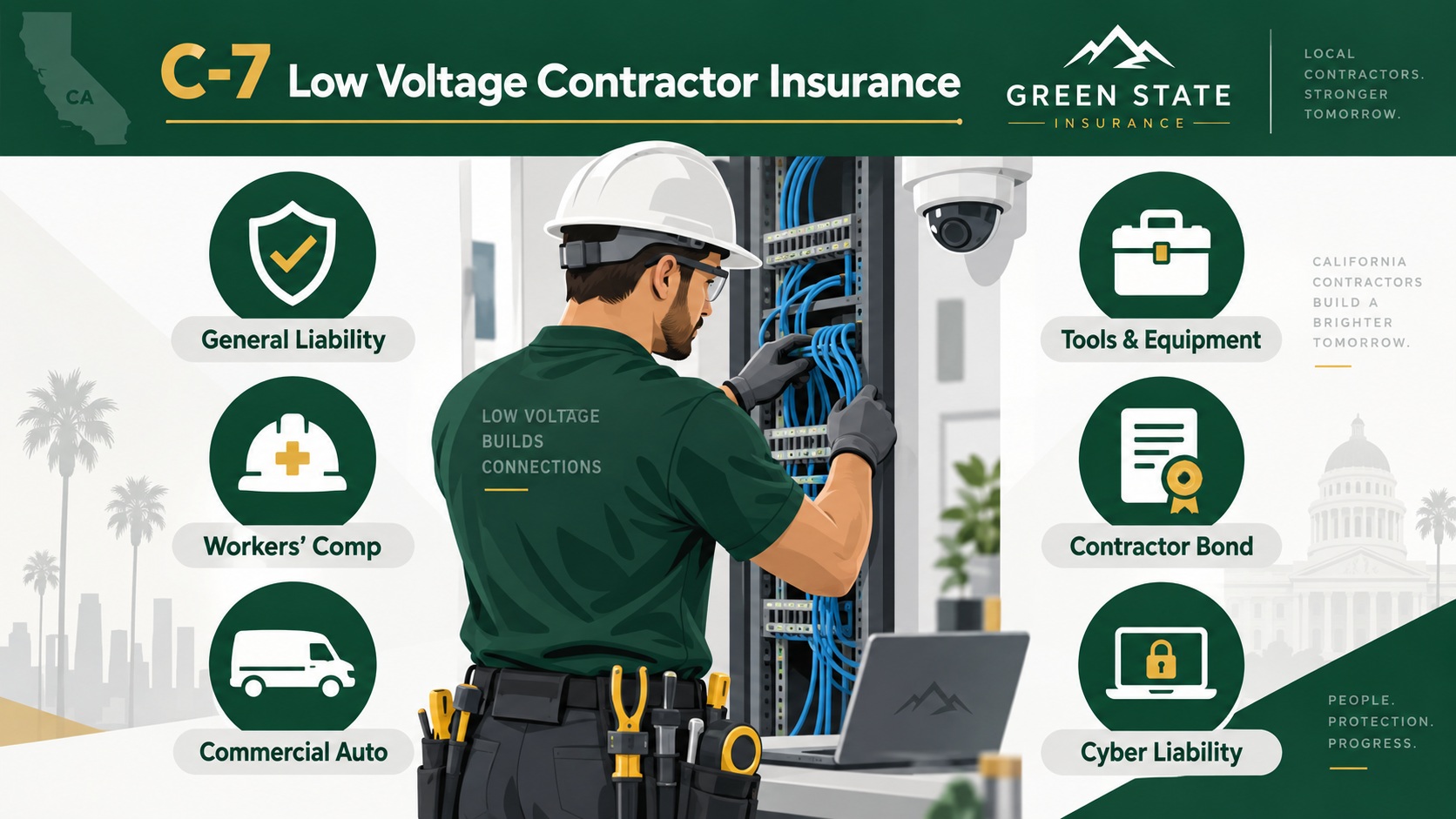
For many C-7 contractors, an insurance package may include general liability insurance, workers’ compensation, commercial auto, tools and equipment coverage, and contractor bonds, depending on the company’s structure, employees, contracts, vehicles, and type of work.
C-7 Low Voltage Systems Contractor Insurance at a Glance
C-7 contractors may need different insurance and bond protections depending on their employees, contracts, vehicles, project size, and type of low-voltage work.
| Coverage | What It Can Help Protect | C-7 Contractor Consideration | Learn More |
|---|---|---|---|
| General Liability Insurance | Third-party bodily injury and property damage claims. | Important for contractors working inside customer properties, commercial buildings, and construction sites. | View Coverage |
| Workers’ Compensation | Work-related employee injuries and illnesses. | Required for California C-7 contractors with employees. | View Coverage |
| Contractor License Bond | Helps satisfy California CSLB contractor licensing requirements. | A $25,000 Contractor’s Bond is required to maintain an active California contractor license. | View Bond |
| Builders Risk Insurance | Covered construction work, materials, and property during a project. | May be relevant when C-7 work is part of a larger construction or renovation project. | View Coverage |
| Bid Bond | Helps support bid obligations for qualifying construction projects. | May be requested when bidding on public works or certain larger commercial projects. | View Bond |
Insurance needs vary based on business structure, employees, contracts, vehicles, project size, and the specific low-voltage systems being installed or serviced.
What Is Low Voltage Contractor Insurance?
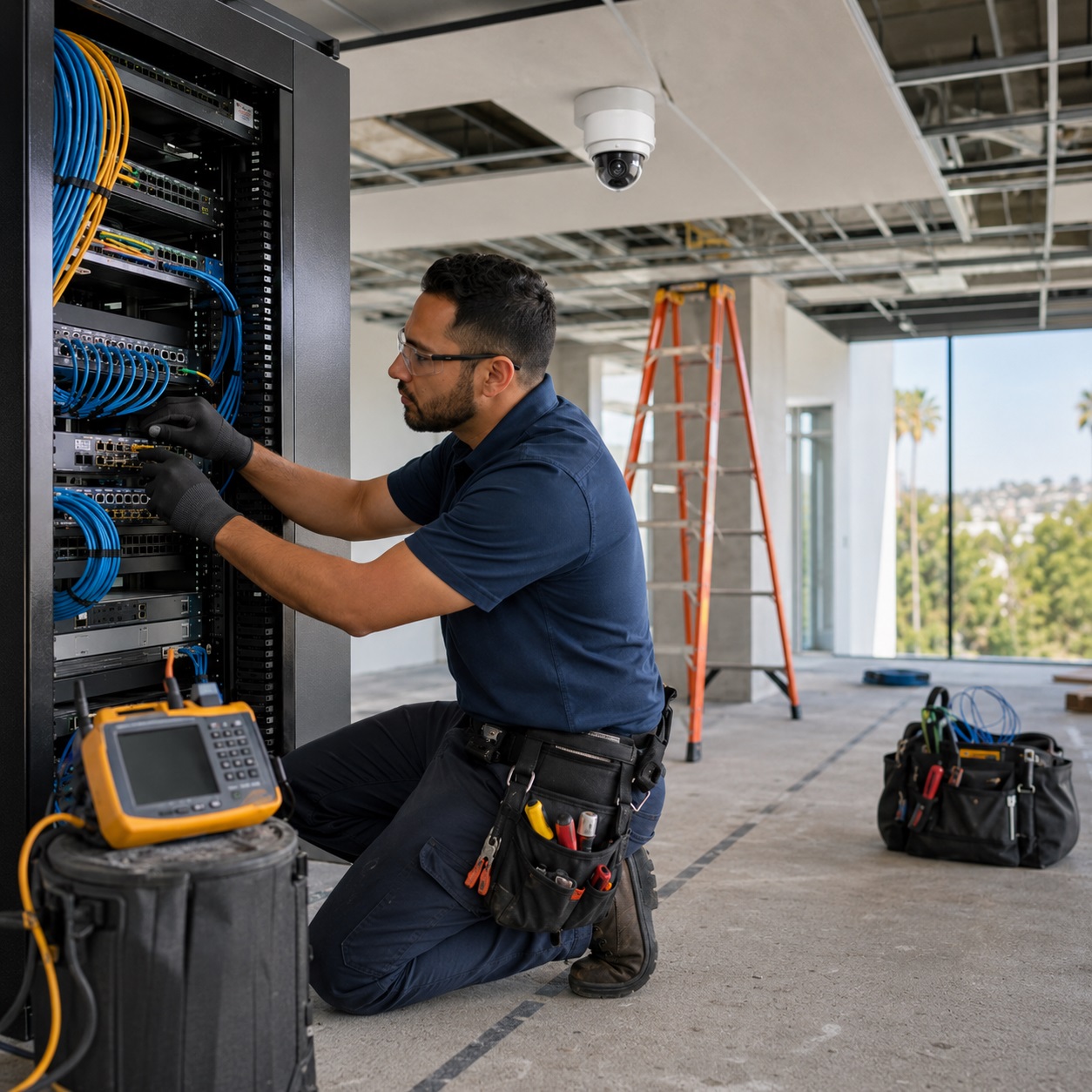
The California Contractors State License Board, or CSLB, defines a C-7 Low Voltage Systems Contractor as a contractor that installs, services, and maintains communication and low-voltage systems that are energy-limited and do not exceed 91 volts.
C-7 work can include systems such as:
- Telephone and communication systems
- Data and structured cabling
- Sound systems
- Cable television systems
- Closed-circuit video and CCTV systems
- Satellite dish antennas
- Instrumentation systems
- Temperature controls
- Low-voltage landscape lighting
Depending on your employees, contracts, projects and business operations, a C-7 low voltage contractor may also need the following coverage and bond services:
One important distinction is that low-voltage fire alarm systems are specifically excluded from the C-7 classification under the CSLB definition.
That distinction matters when determining the scope of work your company performs and the insurance exposures that should be described when requesting coverage.
What Insurance Does a C-7 Low Voltage Systems Contractor Need?
There is no single insurance policy that fits every C-7 business.
A one-person low-voltage contractor installing data cable may have very different insurance needs from a company with ten technicians, several vans, expensive testing equipment, and contracts for large commercial buildings.
A typical insurance review for a C-7 Low Voltage Systems Contractor may include:
| Coverage | What It Can Help Protect |
|---|---|
| General Liability | Third-party bodily injury and property damage claims |
| Workers’ Compensation | Work-related employee injuries and illnesses |
| Commercial Auto | Vehicles used for business operations |
| Tools & Equipment | Tools, testers, cabling equipment, and mobile property |
| Contractor Bond | CSLB licensing requirement |
| Umbrella / Excess Liability | Additional liability limits |
| Cyber Liability | Certain technology and data-related exposures |
The right combination depends on how the contractor actually operates.
General Liability Insurance for C-7 Low Voltage Contractors
General liability insurance is one of the most important coverages for low-voltage contractors because technicians frequently work at customer properties and construction sites.
Consider a few realistic situations.
A technician damages a finished wall while pulling communication cable.
Equipment being installed causes damage to property belonging to the customer.
A customer or visitor trips over materials being used during an installation.
A contractor is accused of causing property damage while working inside a commercial building.
General liability insurance may respond to covered claims involving third-party bodily injury or property damage, subject to the policy’s terms, exclusions, deductibles, and limits.
California does not generally require commercial general liability insurance for every licensed contractor solely because the contractor holds a CSLB license. However, CSLB notes that general liability coverage protects against property-damage exposures, and customers or contracts may require contractors to carry it.
There is an important exception for contractor businesses licensed as an LLC.
California requires CSLB-licensed LLC contractors with five or fewer personnel of record to maintain at least $1 million in liability insurance. The required amount increases by $100,000 for each additional person of record, up to $5 million.
So when determining the appropriate liability coverage for a C-7 contractor, both the type of work and the business entity matter.
Workers’ Compensation for C-7 Contractors
If a California C-7 contractor has employees, workers’ compensation insurance is required under California law. California employers are required to maintain workers’ compensation coverage even when they have only one employee.
For a low-voltage business, employee injuries might involve:
- Falls from ladders
- Cuts while working with cable or equipment
- Strains from pulling wire or moving equipment
- Injuries while working above ceilings
- Jobsite accidents
- Vehicle-related injuries during work activities
Workers’ compensation can provide benefits for covered work-related injuries and illnesses, including medical treatment and disability benefits.
Does a C-7 Contractor Without Employees Need Workers’ Comp?
As of 2026, C-7 is not one of the CSLB classifications that automatically requires workers’ compensation coverage regardless of whether the contractor has employees.
CSLB currently identifies classifications including C-8 Concrete and C-20 HVAC among those that cannot use the standard no-employee workers’ compensation exemption. C-7 is not included on that list. An otherwise eligible C-7 contractor with no employees may therefore be able to file an exemption with CSLB.
Contractors should still review their actual workforce carefully. Calling someone an independent contractor does not automatically determine their employment status under California law.
California has specific rules for determining whether workers are employees or independent contractors.
CSLB materials also indicate that the broader workers’ compensation requirement for all contractor licensees is scheduled to take effect January 1, 2028.
California Contractor Bond for C-7 Contractors
Insurance and contractor bonds are not the same thing.
To maintain an active California contractor license, CSLB requires a Contractor’s Bond in the amount of $25,000. The bond must meet CSLB requirements and be issued by an authorized surety company.
This requirement applies to C-7 contractors just as it does to other active California contractor classifications.
The contractor bond is designed for the benefit of consumers and certain other parties who may suffer damages because of specified violations of contractor licensing law. It should not be treated as a replacement for general liability insurance.
Depending on the company structure and qualifying individual, additional bonding requirements may also apply.
Commercial Auto Insurance for Low Voltage Contractors
Many C-7 contractors rely on vans, pickup trucks, or other vehicles to transport technicians, ladders, cable, tools, testing equipment, and installation materials.
When vehicles are owned or used by the business, commercial auto coverage should be reviewed separately from general liability insurance.
A contractor may need coverage for:
- Company-owned vans and trucks
- Liability arising from covered business vehicle accidents
- Physical damage to insured vehicles
- Employees driving company vehicles
- Certain hired or non-owned vehicle exposures
The right structure depends on who owns the vehicles, who drives them, and how they are used.
Tools and Equipment Coverage
Low-voltage contractors may carry thousands of dollars in portable equipment from one jobsite to another.
That may include:
- Cable testers
- Certification equipment
- Network testing tools
- Power tools
- Ladders
- Specialty installation equipment
- Hand tools
- Cameras and electronic equipment
General liability insurance is primarily designed for liability claims. It should not automatically be assumed to cover every loss involving a contractor’s own portable tools and equipment.
Tools and equipment or inland marine coverage may be appropriate when a C-7 company regularly moves valuable equipment between its office, vehicles, and jobsites.
California Workers’ Compensation Requirement
“California employers are required by law to have workers’ compensation insurance, even if they have only one employee.”
This requirement is especially important for C-7 low voltage contractors that employ technicians, installers, or other workers.
Do C-7 Contractors Need Cyber Liability Insurance?
Not every low-voltage contractor needs cyber insurance, but it is worth reviewing when the company’s work involves networks, connected devices, security systems, data infrastructure, or access to customer technology.
The exposure becomes especially relevant when a contractor:
- Accesses a client network
- Configures connected equipment
- Stores customer information
- Uses cloud-based management systems
- Works with network-connected cameras or devices
- Handles passwords or system credentials
Cyber coverage is separate from standard contractor general liability insurance and should be evaluated based on the actual technology services provided.
How Much Does C-7 Low Voltage Systems Contractor Insurance Cost?
There is no single price for C-7 Low Voltage Systems Contractor Insurance.
Insurance companies may evaluate factors such as:
- Annual revenue
- Payroll
- Number of employees
- Type of low-voltage work performed
- Residential versus commercial projects
- Subcontractor costs
- Claims history
- Policy limits
- Vehicles
- Tools and equipment
- Project size
- Geographic area of operation
- Business experience
For example, a small owner-operated C-7 business doing residential data cabling will not necessarily be rated the same way as a contractor with multiple crews working on large commercial communication systems.
The most accurate quote comes from providing the insurer with a clear description of the actual work being performed.
Insurance Requirements Can Also Come From Your Contracts
CSLB requirements are only part of the picture.
A general contractor, property manager, building owner, municipality, or commercial customer may require specific insurance before allowing a C-7 contractor onto a project.
A contract may request items such as:
- Specific general liability limits
- Workers’ compensation coverage
- Commercial auto insurance
- Additional insured status
- Waiver of subrogation
- Primary and non-contributory wording
- A Certificate of Insurance
- Umbrella or excess liability limits
This is why a contractor should review insurance requirements before signing a contract or starting work, rather than waiting until a certificate is requested.
C-7 Insurance Checklist
Before requesting a C-7 contractor insurance quote, it helps to have the following information ready:
- CSLB license number
- Business entity type
- Description of operations
- Annual gross revenue
- Annual payroll
- Number of employees
- Subcontractor costs
- Residential and commercial work percentages
- Largest project size
- Vehicle information
- Claims history
- Current insurance limits
- Contract or certificate requirements
The more accurately the business operations are described, the easier it is to identify coverage that fits the actual exposure.
C-7 Low Voltage Systems Contractor Insurance FAQ
What is a C-7 Low Voltage Systems Contractor?
A C-7 Low Voltage Systems Contractor is a California CSLB specialty contractor authorized to install, service, and maintain qualifying communication and low-voltage systems that are energy-limited and do not exceed 91 volts.
Does C-7 include fire alarm installation?
No. CSLB specifically states that low-voltage fire alarm systems are not included within the C-7 Low Voltage Systems classification.
Does a C-7 contractor need general liability insurance in California?
California does not generally require commercial general liability insurance from every contractor simply because the contractor has a CSLB license. However, contracts and customers may require it, and CSLB-licensed LLC contractors have separate liability insurance requirements.
Does a C-7 contractor need workers’ compensation insurance?
A C-7 contractor with employees must carry workers’ compensation coverage under California law. An otherwise eligible C-7 contractor with no employees may currently be able to file a workers’ compensation exemption with CSLB.
Does a C-7 contractor need a contractor bond?
Yes. An active California contractor license requires a $25,000 Contractor’s Bond that meets CSLB requirements.
What insurance should a low-voltage contractor consider?
Depending on the business, common coverages to review include general liability, workers’ compensation, commercial auto, tools and equipment coverage, umbrella liability, and certain cyber-related coverage.
Is contractor insurance the same as a contractor bond?
No. Contractor insurance protects against covered risks defined by the insurance policy. A CSLB contractor bond serves a different legal and licensing purpose and is required for an active California contractor license.
Get C-7 Low Voltage Systems Contractor Insurance in California
A low-voltage contractor should not have to piece together coverage without understanding how each policy fits the business.
Whether your C-7 company installs communication cabling, CCTV systems, sound systems, network infrastructure, controls, or other qualifying low-voltage systems, your insurance should reflect the work you actually perform.
Green State Insurance can help California contractors review coverage options for general liability, workers’ compensation, contractor bonds, and other business insurance needs.
Before purchasing coverage, review your CSLB classification, employee status, contracts, payroll, revenue, subcontractor costs, vehicles, and project requirements so the policy is built around the real operation—not just the words “low voltage contractor.”
This article is provided for general informational purposes and is not legal advice. Licensing and insurance requirements may change, and contractors should verify current requirements with CSLB, the California Department of Industrial Relations, and their insurance professional.
Follow Green State Insurance
Connect with us for contractor insurance updates, business tips, videos and industry insights.