Payment & Performance Bonds in California
Construction Surety Bond Solutions for California Contractors
Get the Bonds Your Construction Contract Requires
Winning a construction contract is a major step. Making sure you have the right bonds in place is just as important.
Whether you’re preparing to move forward with a public works project or need bonding for a private construction contract, Green State Insurance helps California contractors navigate payment and performance bond requirements.
We work with contractors to identify project-specific bonding needs, review application information, and explore available surety bond options.
Request a Payment & Performance Bond Quote
Call (949) 432-4805 or contact our team to discuss your project.
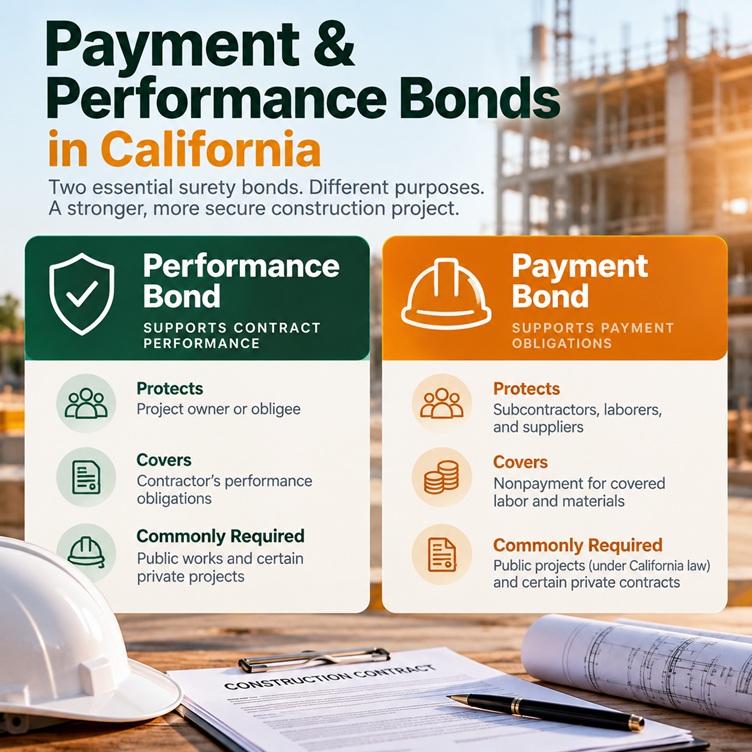
Payment and performance bonds help California contractors meet construction contract requirements and protect different parties involved in a project. A performance bond addresses covered contractor performance obligations, while a payment bond helps protect eligible subcontractors, laborers, and material suppliers against nonpayment. Both bonds may be required for public works projects and certain private construction contracts. Green State Insurance helps contractors understand bonding requirements, prepare application information, and request project-specific surety bond quotes.
Payment & Performance Bonds at a Glance
A quick comparison of the two construction surety bonds.
| Key Feature | Performance Bond | Payment Bond |
|---|---|---|
| Primary Purpose | Guarantees covered contract performance obligations | Protects against covered nonpayment obligations |
| Who Is Protected? | Project owner or obligee | Eligible subcontractors, laborers, and suppliers |
| When Is It Needed? | When required by the contract or applicable rules | When required by law or contract |
| Bond Amount | Determined by project requirements | Determined by legal and contractual requirements |
| Bond Cost | Depends on underwriting and project details | Depends on underwriting and project details |
| Who May Need It? | General contractors and specialty contractors | General contractors and specialty contractors |
| How to Apply | Submit project and underwriting information | Submit project and underwriting information |
Need Payment and Performance Bonds in California?
Contact Green State Insurance at
(949) 432-4805
to discuss your construction project and request a quote.
What Are Payment and Performance Bonds?
Payment and performance bonds are types of construction surety bonds commonly used to support contractual obligations. Although they are often required together, each serves a different purpose.
A performance bond provides financial protection to the project owner if the contractor fails to fulfill covered contractual obligations.
A payment bond helps protect eligible subcontractors, laborers, and material suppliers against nonpayment for covered work or materials.
These bonds typically involve three parties:
- Principal: The contractor responsible for fulfilling the bonded obligations.
- Obligee: The project owner or other party requiring the bond.
- Surety: The company issuing the bond and providing the specified guarantee.
Unlike ordinary liability insurance, surety bonds guarantee defined obligations. Depending on the circumstances and indemnity agreement, the contractor may be responsible for reimbursing the surety for amounts paid on valid claims.
What Is a Performance Bond?
A construction performance bond helps protect a project owner if a contractor does not perform according to the terms of a bonded contract.
Depending on the bond wording and circumstances, the surety may respond to a covered contractor default through arrangements such as financing completion, providing another contractor, or paying covered damages up to the bond’s applicable limit.
Performance bonds are frequently associated with public construction contracts, commercial projects, and larger construction agreements.
For additional information, read our guide to performance bonds in California.
What Is a Payment Bond?
A construction payment bond helps protect eligible parties who supply labor or materials for a bonded project.
If a contractor fails to pay a covered claimant, the payment bond may provide a claim mechanism, subject to applicable law, notice requirements, deadlines, and the bond’s terms.
Payment bonds are especially important on public construction projects, where ordinary mechanics lien remedies against public property generally are not available.
Performance Bond vs. Payment Bond: What’s the Difference?
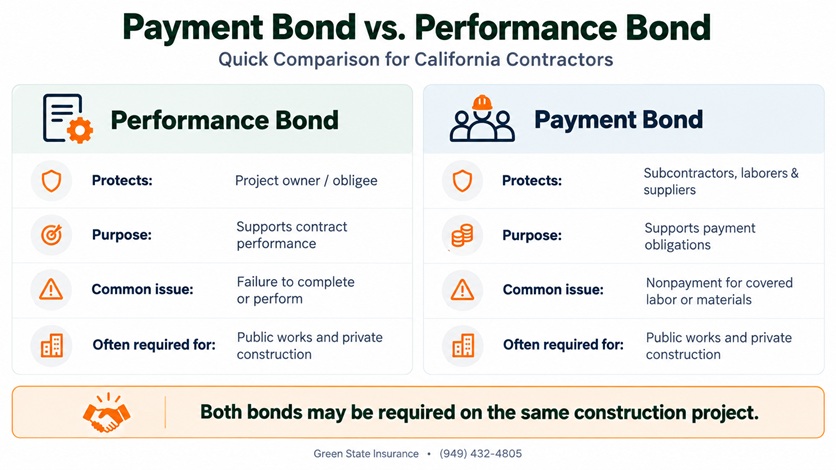
While both bonds support construction projects, they address different contractual risks.
| Feature | Performance Bond | Payment Bond |
|---|---|---|
| Primary purpose | Support contract performance | Support payment obligations |
| Main protection | Project owner or obligee | Eligible subcontractors, laborers, and suppliers |
| Common concern | Contractor default or failure to complete | Nonpayment for covered labor or materials |
| Typically required | Based on public contract rules or project terms | Based on applicable law and contract terms |
| Bond amount | Based on contract requirements | Based on legal and contractual requirements |
Both bonds may be required under the same construction contract, but one does not automatically replace the other.
For a detailed comparison, visit our guide: Performance Bond vs. Payment Bond.
When Are Payment and Performance Bonds Required in California?
Bond requirements depend on the type of project, the contracting authority, and the construction agreement.
Public Works Projects
California public construction contracts may require payment bonds, performance bonds, or both.
California Civil Code Section 9550 generally requires a payment bond for covered public works contracts exceeding $25,000, subject to statutory exceptions. State agency contracts and particular procurement programs may follow additional or different requirements.
Performance bond requirements should be confirmed in the applicable bid package, contract documents, and governing procurement rules.
Private Construction Projects
Private project owners, developers, lenders, and general contractors may require performance and payment bonds as a contractual condition.
These requirements can apply to commercial developments, industrial facilities, residential developments, and other privately funded construction projects.
Subcontractor Bonding Requirements
General contractors may also require subcontractors to provide performance or payment bonds for particular scopes of work.
The specific bond forms, amounts, and conditions should be reviewed before submitting an application.
Not sure which bonds your contract requires?
Green State Insurance can help you review the bonding information and determine the next steps for requesting a quote.
Who Needs Payment and Performance Bonds?
Payment and performance bonds may be requested from contractors involved in a variety of construction projects, including:
- General contractors
- Commercial construction contractors
- Electrical contractors
- Plumbing contractors
- HVAC contractors
- Concrete contractors
- Roofing contractors
- Framing and carpentry contractors
- Public works contractors
- Specialty trade subcontractors
Bonding requirements are determined by the project and contract, not simply by a contractor’s trade classification.
Whether your company is bidding on its first bonded project or managing multiple construction contracts, understanding the surety’s underwriting requirements is an important part of the process.
How Much Do Payment and Performance Bonds Cost in California?
The cost of payment and performance bonds varies based on the contractor, project, surety, and bond requirements.
A surety may evaluate factors such as:
Contract Value and Bond Amount
Larger contracts and higher bond amounts may require more extensive underwriting.
Financial Strength
Business financial statements, working capital, financial history, and other underwriting information may affect the available terms.
Contractor Experience
The surety may review the contractor’s experience with similar work, project size, and contract obligations.
Project Complexity
The type of construction, contract duration, technical challenges, and project risks may influence underwriting.
Bonding Capacity
Existing bonded projects and outstanding contractual commitments may affect a contractor’s ability to qualify for additional bonds.
Can Payment and Performance Bonds Be Quoted Together?
Yes. When a project requires both bonds, the surety may evaluate them as part of the same contract bonding request.
Pricing and documentation depend on the surety’s requirements and the specific project. A combined request does not automatically mean both bonds have a fixed or identical premium.
Request a Project-Specific Bond Quote
Contact Green State Insurance to discuss available options based on your construction contract.
How to Get a Payment and Performance Bond in California
Step 1: Share Your Project Requirements
Provide the contract information, required bond forms, bond amounts, project owner details, and anticipated project schedule.
If the project has already been awarded, include the award letter or available contract documents.
Step 2: Complete the Surety Application
Depending on the contract and requested bonding amount, additional information may be necessary.
This may include company financial statements, contractor experience, work-in-progress reports, references, or other underwriting documents.
Step 3: Review Available Bond Terms
The surety reviews the application and determines whether it can offer bonding, subject to its underwriting criteria.
The time required depends on the complexity of the application and the completeness of the submitted information.
Step 4: Finalize Bond Issuance
If approved, the required bond forms and execution requirements are confirmed.
The contractor should verify that the issued bonds meet the contract’s submission instructions and applicable deadlines.
Documents You May Need for a Bond Application
Preparing the correct information before applying can help reduce avoidable delays.
Commonly requested details include:
- Contractor’s legal business name and contact information
- CSLB license information, if applicable
- Project name and location
- Contract amount
- Required payment and performance bond amounts
- Project owner or obligee information
- Contract documents or notice of award
- Required bond forms
- Estimated start and completion dates
- Financial statements or additional underwriting records, when requested
Not every application requires the same documentation. Requirements vary by surety, contract size, and contractor qualifications.
Payment & Performance Bonds vs. Bid Bonds
Contractors sometimes need different types of bonds at different stages of a construction project.
A bid bond is commonly associated with the bidding process. It helps provide assurance that the bidder will meet specified obligations if selected for the contract.
Payment and performance bonds typically address obligations associated with carrying out the awarded contract.
For contractors preparing to submit a bid, learn more about our California Bid Bond services.
Are These Bonds the Same as a California Contractor License Bond?
No.
A California contractor license bond is associated with CSLB licensing requirements. Payment and performance bonds are generally connected to particular construction contracts.
Having an active contractor license bond does not automatically satisfy the bonding requirements for an awarded construction project.
Visit our California Contractor Surety Bond page to understand other bonding options and licensing-related requirements.
Why Choose Green State Insurance for Construction Bonds?
Construction projects come with deadlines, detailed contract requirements, and paperwork that needs to be handled carefully.
Green State Insurance focuses on helping California contractors navigate insurance and surety bond requests with practical guidance and clear communication.
Contractor-Focused Assistance
We work with construction businesses and understand the importance of reviewing contract-specific bonding requirements.
Guidance Through the Application Process
Our team can help identify information that may be needed for a surety application and explain the next steps.
Bonding Solutions for Different Project Needs
From bid bonds to payment and performance bonds, we help contractors explore appropriate bonding options for their projects.
Support for California Contractors
We assist construction businesses across California with contractor insurance and surety bond needs.
Have a contract requiring payment and performance bonds?
Contact Green State Insurance to discuss your bonding requirements.
Call (949) 432-4805
Frequently Asked Questions About Payment and Performance Bonds
Are payment and performance bonds required on all California construction projects?
No. Requirements depend on applicable law, the contracting agency, the project type, and the terms of the contract. Some public projects require payment bonds, while performance bonds and private-project bonding depend on the applicable requirements.
Can a contractor get a performance bond without a payment bond?
Yes, when the contract and surety allow it. However, many construction contracts require both bonds. Always review the specific contract documents.
How much does a $100,000 performance bond cost?
There is no universal fixed premium. Pricing depends on underwriting, the required bond amount, the contractor’s financial qualifications, and other project factors. A quote is needed to determine the actual cost.
What is the difference between a payment bond and a contractor license bond?
A payment bond relates to payment obligations on a particular bonded project. A contractor license bond supports certain obligations under contractor licensing laws. They serve different purposes.
Do small contractors qualify for payment and performance bonds?
Small contractors may qualify, depending on the project, underwriting requirements, financial information, and available surety programs.
How long does it take to obtain payment and performance bonds?
Timelines vary. Some straightforward applications may be processed relatively quickly, while larger or more complex contracts may require additional financial review and documentation. Issuance is subject to approval.
Can subcontractors be required to obtain performance bonds?
Yes. A general contractor may require a subcontractor to provide performance or payment bonds, subject to the applicable subcontract terms and legal requirements.
Does a performance bond guarantee the contractor will finish the project?
A performance bond provides protection under its terms if a covered default occurs. It does not mean every project delay or construction problem is automatically covered, and the surety’s response depends on the bond and contract.
Is a bid bond the same as a performance bond?
No. Bid bonds generally relate to bidding obligations, while performance bonds address performance obligations under an awarded construction contract.
Can I request payment and performance bond quotes together?
Yes. You can provide the project information and requested bond forms together so the applicable surety requirements can be evaluated.
Request a Payment & Performance Bond Quote in California
Every construction project has its own contract requirements. Whether you need a payment bond, a performance bond, or both, the first step is understanding the obligations and preparing the necessary application information.
Green State Insurance helps California contractors review their bonding needs and explore available surety options.
Call (949) 432-4805
Request Your Bond Quote Today
Bond availability, underwriting, pricing, and issuance are subject to surety approval and applicable requirements.
California Payment Bond Requirements Under Civil Code §9550
Under California Civil Code Section 9550, a direct contractor awarded a covered public works contract exceeding $25,000 is generally required to provide a payment bond before work begins. Certain state-entity contracts are governed by different requirements.
Contractors should verify the applicable bond requirements in their bid documents and construction contracts.
Federal Construction Bond Requirements
For covered federal construction contracts, FAR 28.102 establishes requirements for performance bonds, payment bonds, and alternative payment protections.
Under FAR 28.102-1, construction contracts exceeding $150,000 generally require both performance and payment bonds, subject to applicable exceptions. Federal projects follow federal bonding requirements, which should not be confused with California state or local public works rules.
FREQUENTLY ASKED QUESTIONS
Payment & Performance Bond FAQs
Find answers to common questions about payment bonds,
performance bonds, costs, and construction surety
requirements in California.
Are payment and performance bonds required in California?
the type of construction project, applicable laws,
and contractual terms. Under
California Civil Code Section 9550
,
a payment bond is generally required for covered public
works contracts exceeding $25,000, subject to statutory
exceptions. Performance bond requirements should be
verified through the applicable contract and procurement rules.
What is the difference between a payment bond and a performance bond?
related to the contractor’s performance under a
construction contract. A payment bond helps protect
eligible subcontractors, laborers, and material suppliers
against covered nonpayment. Both bonds may be required
for the same project, but they serve different purposes.
Read our
performance bond vs. payment bond comparison
for more details.
How much do payment and performance bonds cost in California?
contractor’s financial qualifications, project complexity,
work history, and surety underwriting. There is no
single fixed rate that applies to every construction
contractor. Green State Insurance can assist with
requesting a quote based on your specific project.
How long does it take to get a payment and performance bond?
bond amount, complexity of the project, and completeness
of the underwriting documentation. Some applications
may be reviewed relatively quickly, while larger
or more complex construction contracts can require
additional financial and project evaluation.
Bond issuance is subject to surety approval.
Can I apply for payment and performance bonds together?
payment and performance bonds, contractors can
commonly submit the project information together
for surety review. The specific application,
pricing, and documentation requirements depend
on the surety and construction contract.
What documents are needed for a construction performance bond?
business information, project details, contract
amount, required bond forms, and contract documents.
Depending on underwriting requirements, the surety
may also request financial statements, work-in-progress
reports, contractor experience, or additional records.
Requirements vary by surety and project.
Can small contractors qualify for payment and performance bonds?
bonding depending on their financial qualifications,
project experience, contract size, and underwriting
requirements. Available bonding options vary, and
approval is not guaranteed. Contractors can request
an evaluation based on their particular project needs.
Is a bid bond the same as a performance bond?
during the bidding process, while a performance bond
addresses covered performance obligations associated
with an awarded construction contract. Contractors
preparing to submit a proposal can learn more about
California bid bond requirements
and the application process.
Do subcontractors need payment and performance bonds?
or performance bonds when specified by the general
contractor or subcontract agreement. Requirements
depend on the project, scope of work, applicable
laws, and contractual conditions. Not every
subcontractor is automatically required to be bonded.
Where can I get payment and performance bonds in California?
with payment and performance bond inquiries,
project-specific bonding requirements, and
surety bond quote requests. Contact our team
at
(949) 432-4805
to discuss your project and the next steps.
All bonding options are subject to surety approval.
Still Have Questions About Construction Bonds?
Our team can help you review your project’s bonding
requirements and explore available surety options.