

Performance Bond California: A Complete Guide for Contractors
A performance bond in California can be an important requirement for contractors working on public projects, private construction contracts, and certain regulated activities.
Unlike contractor insurance, a performance bond is designed primarily to protect the project owner or other obligee if the contractor fails to perform the bonded contract according to its terms.
For contractors, understanding performance bond requirements before bidding or signing a contract can help prevent delays when a project owner, government agency, or general contractor requests bonding.
This guide explains how a performance bond California contractors may encounter works, when one may be required, what affects the cost and approval process, and how performance bonds differ from other contractor bonds and insurance policies.
Performance Bond California at a Glance
Need a performance bond for a California project? Here are the key details contractors should check before applying.
| What You Need to Know | Quick Answer | What to Do |
|---|---|---|
| What does it do? | Supports the contractor’s performance obligations under a bonded contract. | Review the contract and required bond form. |
| Who does it protect? | Primarily the project owner, agency, or other obligee requiring the bond. | Confirm the correct legal name of the obligee. |
| Is it always required? | No. Requirements depend on the project, contract, agency, law, or regulatory program. | Check the solicitation and contract requirements. |
| How much bond is needed? | There is no single California amount. The required bond amount is determined by the applicable project or requirement. | Verify the exact amount before requesting a bond. |
| What affects approval? | Project size, experience, financial strength, credit, workload, contract terms, and bonding capacity may be reviewed. | Prepare project, business, and financial information. |
| Same as a Payment Bond? | No. Performance Bonds address contract performance; Payment Bonds address certain payment obligations. | Compare Performance vs Payment Bond → |
| Same as a License Bond? | No. A Contractor License Bond serves a different purpose from a project-specific Performance Bond. | Review Contractor Bonds → |
| Does it replace insurance? | No. A Performance Bond does not replace contractor liability, Workers’ Comp, or project insurance. | Review Contractor Liability Insurance → |
Check Requirement
Get Bond Form
Submit Details
Underwriting
Bond Issued
Before applying for a Performance Bond in California, confirm the bond type, required amount, obligee, bond form, project details, and deadline. A Performance Bond supports contractual performance—it does not replace the insurance coverage required for your business or project.
What Is a Performance Bond?
A performance bond is a type of surety bond connected to a contract.
Its purpose is to provide financial assurance to the party requiring the bond that the contractor will perform its contractual obligations according to the bonded agreement.
A typical performance bond involves three parties:
Principal — The contractor or business required to obtain the bond.
Obligee — The project owner, government agency, general contractor, or other party requiring the bond.
Surety — The company issuing the bond and providing the financial guarantee subject to the bond terms.
This three-party structure is one of the most important differences between a surety bond and a traditional insurance policy.
How Does a Performance Bond Work in California?
Imagine a contractor is awarded a construction project and the contract requires a performance bond.
The contractor applies for the bond as the principal. The project owner is named as the obligee, and the surety evaluates whether it is willing to issue the requested bond.
If the contractor fulfills the bonded contract, the bond generally completes its purpose without a claim.
If the contractor is alleged to have defaulted on its contractual obligations, the obligee may make a claim under the performance bond.
The surety then evaluates the claim under the bond and contract terms.
Depending on the circumstances and applicable bond provisions, the response to a valid default may involve measures such as arranging for completion, supporting another contractor to finish the project, or addressing covered financial obligations up to the applicable bond amount.
The exact process depends on the bond form, underlying contract, facts surrounding the default, and applicable law.
When Is a Performance Bond Required in California?
There is no single rule requiring every California contractor to obtain a performance bond for every job.
Requirements can arise from several different sources.
Public Construction Projects
Government agencies may require performance bonds as part of public construction contracts.
The exact requirement can depend on the public entity, contract documents, procurement rules, project structure, and applicable law.
California’s Department of General Services describes a performance bond in the public-contracting context as security protecting the state against damages when a contractor fails to perform, and its acquisition glossary also discusses performance bonds in connection with public works contracts involving progress payments. California DGS
Contractors should therefore review the actual solicitation and contract instead of assuming that one universal bond requirement applies to every California public project.
Private Construction Projects
A performance bond can also be required on a private project.
A developer, property owner, lender, general contractor, or other contracting party may make bonding a condition of the contract even when a particular statewide statutory requirement does not apply.
That makes the contract itself an important part of determining whether a performance bond is necessary.
Federal Construction Projects in California
Federal construction projects have separate federal bonding requirements.
Under the current Federal Acquisition Regulation, performance and payment bonds are generally required for federal construction contracts exceeding $150,000, subject to specified exceptions. Acquisition.GOV
The contractor generally must provide required bonds before receiving a notice to proceed or beginning the work. Acquisition.GOV
These federal requirements can therefore apply to a contractor performing a federal construction project located in California.
California Performance Bonds Are Not Limited to Construction
The phrase performance bond California is often associated with contractors, but performance bond requirements can also exist in regulated industries.
A good California example is telecommunications.
The California Public Utilities Commission currently requires certain telephone corporations holding specified operating authority or registrations to maintain a continuous performance bond. CPUC states that the minimum bond amount is $25,000 per Utility ID Number and requires annual performance bond filings by March 31. California Public Utilities Commission
That requirement is specific to the regulated entities covered by the CPUC rules.
It should not be interpreted as a $25,000 performance bond requirement for California contractors generally.
This distinction matters because the required bond amount and bond form depend on why the bond is being required.
How Much Performance Bond Do You Need?
There is no universal performance bond amount that applies to every California contractor or project.
The required amount may be established by:
- The construction contract
- Project specifications
- A government solicitation
- Applicable law
- The public agency
- The project owner
- A regulatory authority
For certain contracts, the required performance bond can be tied to the contract value.
For example, federal rules establish performance and payment bonding requirements for covered federal construction contracts exceeding $150,000. Acquisition.GOV
The important practical rule is simple:
Do not assume the bond amount before reviewing the contract or solicitation.
When requesting a bond quote, provide the actual bond requirement and bond form whenever possible.
How Much Does a Performance Bond Cost in California?
The required bond amount and the premium paid for the bond are not the same thing.
For example, if a contract requires a performance bond based on a particular contract amount, that does not mean the contractor pays that entire amount as the premium.
Surety underwriting evaluates the risk associated with issuing the bond.
Pricing can vary significantly depending on the contractor and project.
Factors that may affect the cost and approval include:
- Required bond amount
- Contract value
- Type of work
- Contractor experience
- Financial strength
- Credit history
- Previous project performance
- Existing workload
- Bonding capacity
- Project duration
- Contract terms
- Surety underwriting requirements
Because these factors vary from one contractor to another, a generic online percentage should not be treated as a guaranteed California performance bond rate.
What Is Bonding Capacity?
Contractors seeking larger or multiple performance bonds may encounter the term bonding capacity.
Bonding capacity generally refers to the amount of bonded work a surety is willing to support based on its underwriting evaluation of the contractor.
The evaluation may consider both:
Single-project capacity — the size of an individual bonded project.
Aggregate capacity — the total amount of bonded work the contractor has underway.
A contractor with several unfinished projects may therefore be evaluated differently from a contractor requesting a similar bond with a lighter existing workload.
Bonding capacity can become increasingly important as contractors pursue larger public or private projects.
What Does a Surety Review?
Performance bonds can involve more underwriting than relatively simple license bonds.
Depending on the requested bond and project size, the surety may evaluate several areas.
Contractor Experience
The surety may want to understand whether the contractor has successfully completed similar work.
Project size, trade, complexity, location, and prior experience can all be relevant.
Financial Strength
For larger bond requests, financial information can become important.
The surety may evaluate whether the contractor appears financially capable of completing the project and managing its obligations.
Credit
Personal or business credit may be considered as part of underwriting, particularly depending on the size and structure of the bond request.
Credit, however, is not necessarily the only factor.
Existing Workload
A contractor may be financially capable of performing one project but become stretched across several simultaneous contracts.
The surety may therefore consider work currently in progress.
Contract Terms
The underlying construction contract matters because the performance bond supports obligations connected to that contract.
Unusual project terms or significant contractual risk can affect underwriting.
Documents You May Need for a Performance Bond
The documents requested depend on the surety, project, bond amount, and complexity of the application.
Contractors may be asked for information such as:
- Bond application
- Copy of the contract
- Bond form
- Project description
- Contract amount
- Contractor license information
- Business ownership information
- Work history
- Current work-in-progress information
- Financial statements
- Bank information
- Credit authorization
- Previous bonding history
Larger bond programs may involve more detailed underwriting than smaller or straightforward requests.
Providing accurate information at the beginning can help reduce delays in the review process.
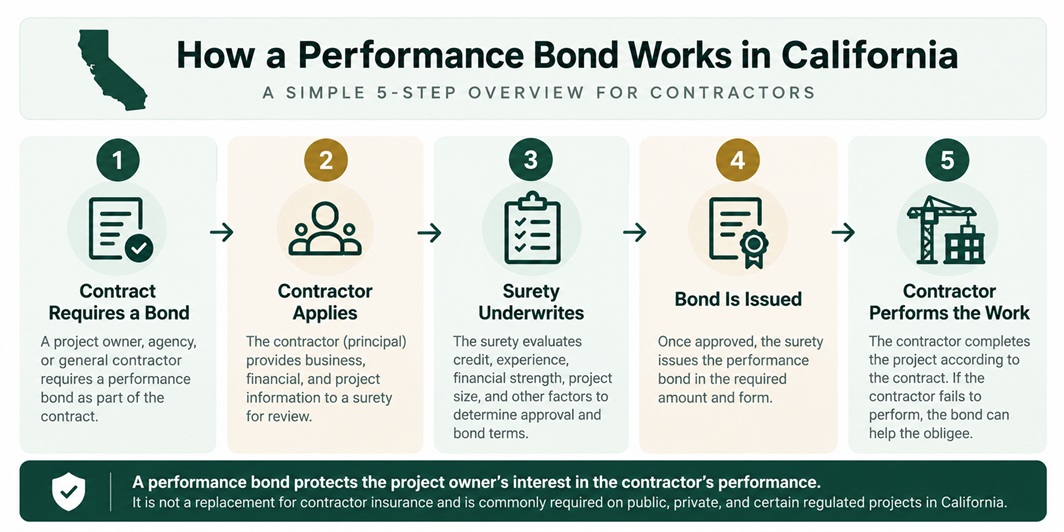
How to Get a Performance Bond in California
The process usually begins before the contractor needs to deliver the final bond.
1. Identify the Bond Requirement
Review the solicitation, contract, project specifications, or agency requirements.
Determine:
- Bond type
- Bond amount
- Obligee
- Required bond form
- Project value
- Submission deadline
2. Gather Your Business and Project Information
Prepare the documents needed to evaluate both the contractor and the specific project.
3. Submit the Bond Application
The application is provided for surety underwriting.
The complexity of this process can vary significantly based on the requested bond amount and contractor profile.
4. Complete Underwriting
The surety evaluates the application and determines whether it can support the bond and under what terms.
Additional information may be requested.
5. Review and Issue the Bond
Once approved and applicable requirements are satisfied, the performance bond can be issued in the required form.
Contractors should verify the obligee name, bond amount, project information, and other required details before submitting it.
Performance Bond vs Payment Bond
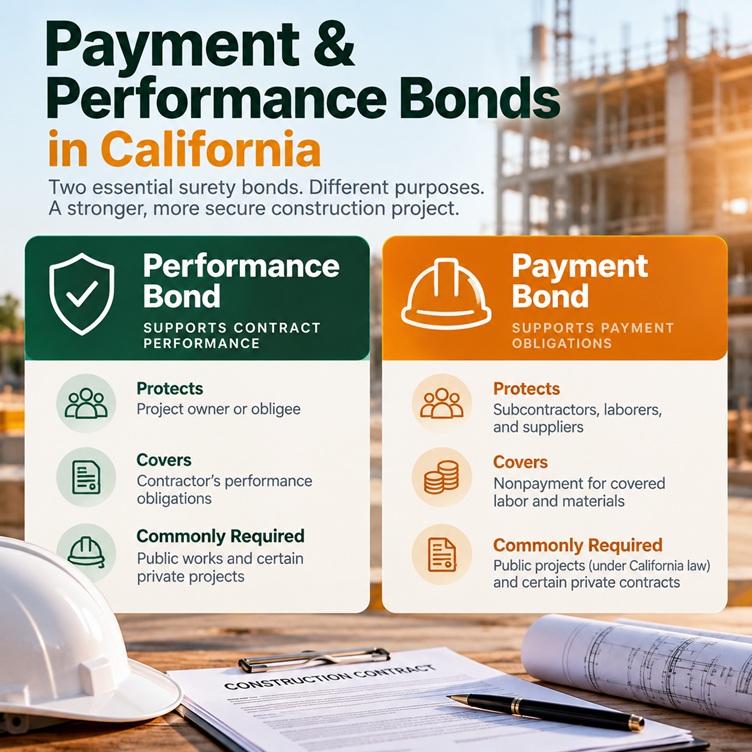
These two bonds are frequently required together, but they do not protect against the same problem.
A performance bond focuses on the contractor’s performance of the bonded contract.
A payment bond focuses on certain payment obligations involving labor, subcontractors, and suppliers.
For example:
If the contractor fails to complete the project according to the bonded contract, the performance bond may become relevant.
If the contractor completes work but fails to pay covered subcontractors or suppliers, the payment bond addresses a different exposure.
We have a separate guide explaining this distinction in detail:
Performance Bond vs Payment Bond: Key Differences Contractors Should Know
That article is the better resource when the primary question is which of those two bonds applies to a particular contractual obligation.
Contractors who need both types of bonds for an awarded construction project can explore our Payment & Performance Bonds in California services. Green State Insurance helps contractors review project bonding requirements, prepare application information, and request a quote based on their contract needs.
Performance Bond vs Bid Bond
A Bid Bond operates at an earlier stage of the contracting process.
It generally supports the contractor’s bid and provides assurance related to entering the contract and furnishing required post-award bonds if the bid is accepted, subject to the applicable bond terms.
A Performance Bond applies after contract award and focuses on contractual performance.
A simplified project sequence may look like this:
Bid Stage → Bid Bond
Contract Award → Performance Bond
Contract Award → Payment Bond
This is why contractors pursuing bonded projects may encounter multiple surety products during a single procurement process.
Contractors preparing to submit a construction bid can review our California bid bond page to learn about bid bond requirements, application details, and the information needed before a bid submission deadline.
Performance Bond vs Contractor License Bond
These are also very different bonds.
A California Contractor License Bond is connected to contractor licensing requirements.
A Performance Bond is typically connected to performance under a specific contract or other defined obligation.
A contractor can therefore have a contractor license bond and still need a separate performance bond for a particular project.
Green State provides additional information about California Contractor Bonds.
The presence of one bond should not automatically be interpreted as satisfying another bond requirement.
Performance Bond vs Contractor Insurance
A performance bond is not a replacement for contractor insurance.
The two products address fundamentally different risks.
Suppose a contractor fails to perform a bonded construction contract. That may create a performance bond issue.
Now suppose a third party alleges that the contractor caused bodily injury or property damage during operations. That is a different type of exposure and may involve general contractor insurance such as General Liability coverage.
Similarly, employee workplace injuries may involve Workers’ Compensation Insurance.
A construction project may also create property exposures that call for Builders Risk Insurance.
For this reason, contractors should evaluate bonding and insurance separately rather than assuming that a performance bond replaces contractor liability insurance.
What Happens if a Contractor Fails to Perform?
A performance bond claim is not necessarily an automatic payment simply because a dispute arises.
The surety will typically evaluate whether a valid claim or default exists under the bond and underlying contract.
The exact response depends on the circumstances and bond language.
Depending on the bond and situation, potential outcomes may involve:
- Supporting completion of the work
- Arranging for another contractor
- Addressing eligible costs or damages
- Other remedies provided under the bond
The obligee and contractor should follow applicable notice and claim procedures.
Contract disputes can be fact-specific, so the underlying contract and bond form matter.
Does the Contractor Have to Repay a Surety?
This is another important difference between surety bonds and traditional insurance.
Surety arrangements commonly involve indemnity obligations.
That means contractors and other indemnitors may ultimately be responsible for losses, costs, or expenses the surety incurs under the bond, subject to the applicable indemnity agreement and law.
A contractor should therefore not think of a performance bond as an insurance policy purchased to transfer its own contractual performance risk in the same way it might think about traditional business insurance.
Review the indemnity agreement and bond terms carefully.
Common Performance Bond Problems Contractors Should Avoid
Several issues can slow down bonding or create problems after a project is awarded.
Waiting Until the Last Minute
Bond underwriting can require documentation and additional review. Waiting until immediately before the submission deadline creates unnecessary pressure.
Requesting the Wrong Bond
Bid, Performance, Payment, and Contractor License Bonds have different purposes.
Confirm exactly which bond is required.
Using the Wrong Bond Amount
Use the amount specified by the contract, solicitation, agency, or other applicable requirement.
Submitting Incomplete Financial Information
For bond requests requiring financial underwriting, incomplete information can delay the process.
Ignoring Existing Workload
Your current bonded projects can matter when the surety evaluates additional capacity.
Assuming a Performance Bond Replaces Insurance
It does not.
Contractors should separately review liability, Workers’ Compensation, vehicle, property, and project-specific insurance exposures.
California Performance Bond Checklist
Before requesting a performance bond California contractors should have the basic project information ready.
Bond Requirement
Confirm that a Performance Bond—not a Bid Bond, Payment Bond, or Contractor License Bond—is being requested.
Bond Amount
Verify the exact amount required.
Obligee
Confirm the correct legal name of the party requiring the bond.
Bond Form
Obtain the required bond form from the owner, agency, or contract documents when applicable.
Contract
Have the underlying contract or relevant project documents available.
Project Details
Prepare the project value, scope, location, start date, and expected completion date.
Business Information
Have contractor licensing, ownership, and business information available.
Financial Information
Prepare requested financial documents if the surety requires financial underwriting.
Existing Workload
Be ready to provide information about projects already underway.
Insurance Requirements
Review the contract separately for General Liability, Workers’ Compensation, Builders Risk, Commercial Auto, and other insurance requirements.
Contractors who need both types of bonds for an awarded construction project can explore our Payment & Performance Bonds in California services. Green State Insurance helps contractors review project bonding requirements, prepare application information, and request a quote based on their contract needs.
Frequently Asked Questions About Performance Bonds in California
What is a performance bond in California?
A performance bond is a surety bond that supports a contractor’s or business’s performance of a specified contractual or regulatory obligation. In construction, it is commonly used to protect the project owner or other obligee if the contractor fails to perform the bonded contract according to its terms.
Are performance bonds required for every California contractor?
No. There is no universal performance bond requirement applying to every contractor and every California construction project. Requirements can arise from public procurement rules, private contracts, federal requirements, project specifications, or specialized regulations.
Are performance bonds required on federal construction projects in California?
Current federal acquisition rules generally require performance and payment bonds for federal construction contracts exceeding $150,000, subject to specified exceptions. Acquisition.GOV
How much does a California performance bond cost?
There is no universal premium. Cost and approval can depend on the bond amount, contract, project, contractor financial strength, credit, experience, existing workload, bonding capacity, and surety underwriting.
Is a performance bond the same as a payment bond?
No. A performance bond focuses on contractual performance, while a payment bond addresses certain payment obligations involving labor and materials. See our Performance Bond vs Payment Bond guide for a detailed comparison.
Is a performance bond the same as a contractor license bond?
No. A Contractor License Bond is associated with licensing requirements, while a Performance Bond is generally associated with performance of a specific contract or defined obligation.
Does a performance bond replace General Liability Insurance?
No. A performance bond and General Liability Insurance serve different purposes. Contractors should separately evaluate general liability insurance for contractors and other applicable insurance.
Who is protected by a performance bond?
The bond primarily protects the obligee—the project owner, agency, general contractor, or other party requiring the bond—according to the terms of the bond.
What information do I need to get a performance bond?
Requirements vary, but contractors may need the bond form, contract, project details, bond amount, business information, work history, financial information, and details about current projects.
Can a California business need a performance bond outside construction?
Yes. Certain regulated businesses can have separate performance bond requirements. For example, CPUC currently requires specified telephone corporations to maintain continuous performance bonds, with a minimum $25,000 amount per Utility ID Number. That is a telecommunications-specific requirement, not a general contractor requirement. California Public Utilities Commission
Get a Performance Bond in California
If a project owner, government agency, general contractor, or contract requires a performance bond in California, start by confirming the required bond type, amount, obligee, bond form, and submission deadline.
Green State Insurance can help contractors review bonding requirements and the commercial insurance coverage that may apply alongside the bond.
For contractors who need licensing-related bonding, review California Contractor Bonds.
If your project requires both Performance and Payment Bonds, read Performance Bond vs Payment Bond to understand the difference before applying.
Contractors can also review General Liability Insurance, Workers’ Compensation Insurance, and Builders Risk Insurance as part of their broader insurance program.
For additional bond and commercial coverage options, visit Green State Insurance Services or call (949) 432-4805.