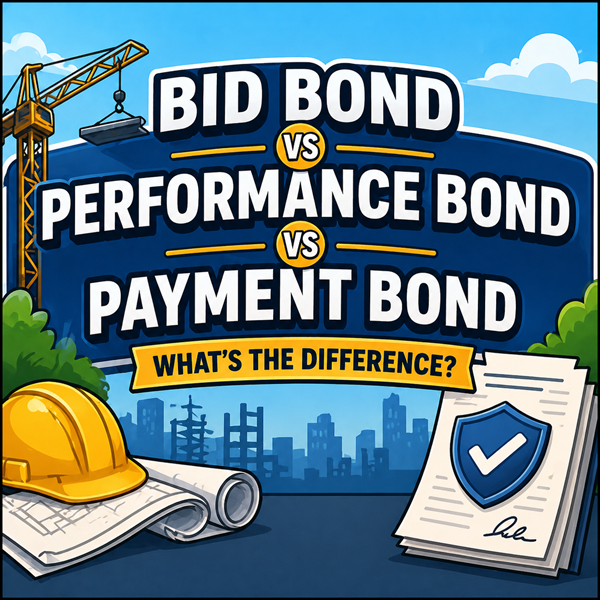

Performance Bond vs Payment Bond: Start With What Your Project Requires
Not sure which bond or insurance coverage you need? Start with the requirement
in your bid package, construction contract, or contractor license.
| Your Concern | What You May Need | What It Addresses | Green State Service |
|---|---|---|---|
| My contract requires assurance that the project will be completed. |
Performance Bond | The contractor’s performance obligations under the bonded construction contract. | Performance Bond Options → |
| My project requires protection for certain payment obligations. |
Payment Bond | Covered payment obligations involving eligible subcontractors, laborers, and suppliers. |
Payment Bond Options → |
| I need a bond to submit with my construction bid. |
Bid Bond | The bidding stage before the construction contract is awarded. | Bid Bond Options → |
| I need the bond associated with my California contractor license. |
Contractor’s Bond | Contractor licensing requirements rather than a specific project’s performance or payment obligations. |
Contractor Bond → |
| My contract also requires liability insurance. |
General Liability | Certain third-party bodily injury and property damage exposures, subject to policy terms. |
General Liability → |
| I have employees and need Workers’ Compensation coverage. |
Workers’ Compensation | Employee work-related injury and illness exposures. | Workers’ Compensation → |
| I need coverage for a building or materials during construction. |
Builders Risk | Certain property exposures involving the structure and materials during construction. |
Builders Risk → |
Quick Answer:
A Performance Bond addresses the contractor’s performance
obligations, while a Payment Bond addresses certain payment
obligations. Neither automatically replaces a Bid Bond,
Contractor’s Bond, or commercial insurance required for the project.
What Is a Performance Bond?
A Performance Bond is a contract surety bond associated with a contractor’s obligation to perform the construction contract. If the contractor defaults on covered contractual obligations, the bond may provide protection to the obligee, subject to the terms of the bond and underlying contract.
In simple terms, the Performance Bond focuses on whether the contractor fulfills the performance obligations covered by the bonded contract.
Simple Performance Bond Process
Performance Bond vs Payment Bond: What’s the Main Difference?
The easiest way to understand Performance Bond vs Payment Bond is to look at the main concern each bond addresses.
Did the contractor perform the contract?
This is primarily the Performance Bond side of the equation. It relates to covered performance obligations under the bonded contract.
Were covered project participants paid?
This is primarily the Payment Bond side. It relates to covered payment obligations involving eligible project participants.
A Simple Construction Project Example
A contractor wins a construction contract that requires both a Performance Bond and a Payment Bond.
If the contractor defaults on covered performance obligations, the
Performance Bond may become relevant.
If eligible subcontractors or suppliers have covered unpaid amounts, the
Payment Bond may become relevant.
Performance Problem ≠ Payment Problem
Performance and Payment Bonds may apply to the same construction project, but they address different obligations. Having one does not automatically mean the requirement for the other has been satisfied.
7 Key Differences Between Performance Bonds and Payment Bonds
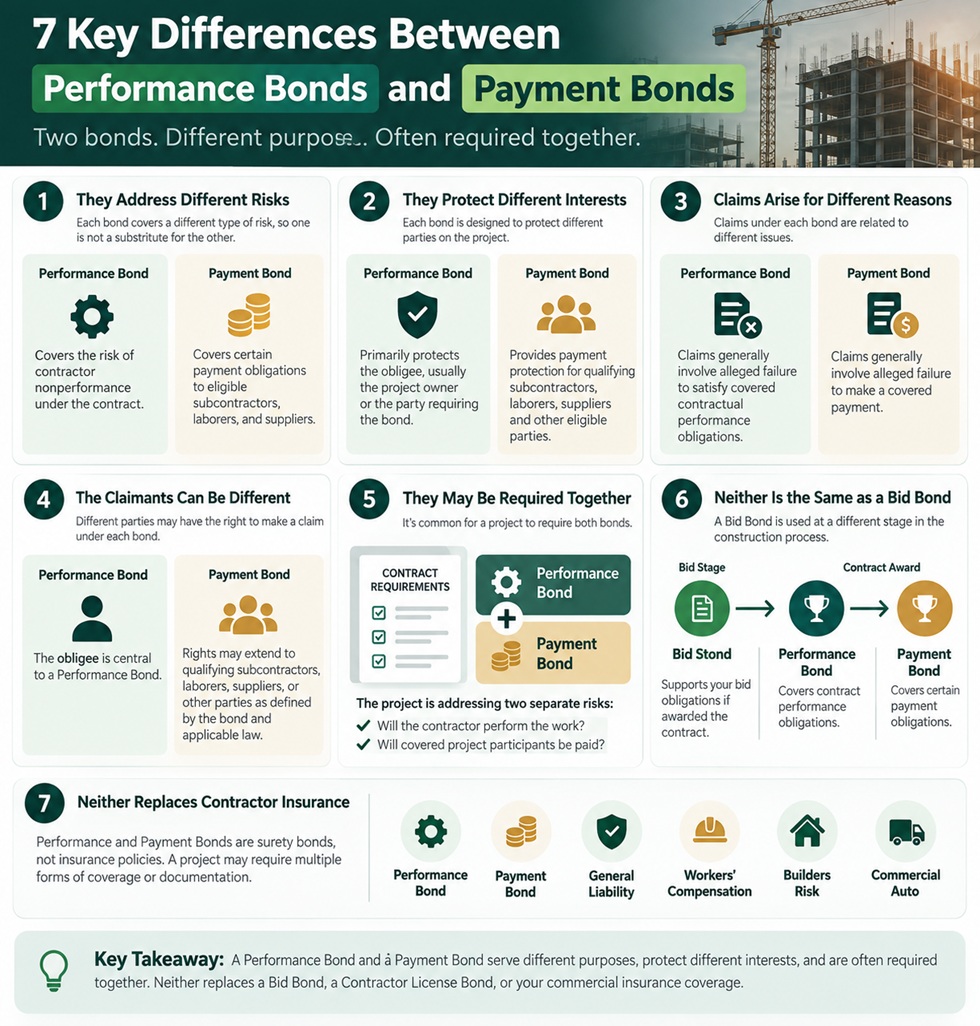
7 Key Differences Between Performance Bonds and Payment Bonds
Performance and Payment Bonds are often required together, but they address different obligations. Here are seven important differences contractors should understand.
1. They Address Different Risks
This is the most important difference. A Performance Bond addresses the risk of contractor nonperformance under the bonded contract, while a Payment Bond addresses covered payment obligations to eligible project participants.
Because they address different risks, one should not automatically be treated as a substitute for the other.
2. They Protect Different Interests
A Performance Bond primarily protects the interests of the obligee, usually the party requiring the contractor’s performance obligation to be bonded.
A Payment Bond is designed around payment protection for qualifying parties furnishing labor or materials under the applicable bond and law. The precise rights depend on the bond and project.
3. Claims Arise for Different Reasons
A Performance Bond claim generally involves an alleged failure to satisfy covered contractual performance obligations. A Payment Bond claim generally involves an alleged failure to make a covered payment.
Performance problem ≠ Payment problem
A construction project can potentially experience one without experiencing the other.
4. The Claimants Can Be Different
Because the bonds protect different obligations, the parties entitled to assert rights under them can also differ. The obligee is central to a Performance Bond.
Payment Bond rights may extend to qualifying subcontractors, laborers, suppliers, or other parties as defined by the bond and applicable law. Contractors should not assume that every party associated with a project automatically has the same rights under a Payment Bond.
5. They May Be Required Together
One reason contractors compare Performance Bond vs Payment Bond is that bid or contract documents may require both. This is not contradictory because the project is addressing two separate risks.
Performance Question
Will the contractor perform the work?
Payment Question
Will covered project participants be paid?
6. Neither Is the Same as a Bid Bond
A Bid Bond comes into the process at a different stage. It generally relates to the contractor’s bid obligations if awarded the contract.
BID STAGE
Bid Bond
CONTRACT AWARD
Performance Bond
CONTRACT AWARD
Payment Bond
7. Neither Replaces Contractor Insurance
A Performance Bond or Payment Bond should not be confused with commercial insurance. A construction project may require bonding and insurance coverage at the same time.
The Bottom Line
A Performance Bond focuses on covered contract performance obligations, while a Payment Bond focuses on covered payment obligations. They may be required together, but neither automatically replaces a Bid Bond, Contractor’s Bond, or commercial insurance required for the project.
Performance Bond vs Payment Bond Example
Suppose a general contractor is awarded a $2 million commercial construction project.
The contract requires both a Performance Bond and a Payment Bond.
Scenario A: Contractor Performance Problem
The contractor encounters serious problems and allegedly fails to perform covered contractual obligations.
The Performance Bond may become relevant because the issue concerns contract performance.
Scenario B: Payment Problem
The contractor performs construction work but an eligible subcontractor or supplier has a covered unpaid amount.
The Payment Bond may become relevant.
Scenario C: Both Problems Occur
A contractor default could potentially result in both performance and payment issues.
This is one reason Performance and Payment Bonds may be required together.
Do You Need Both a Performance Bond and Payment Bond?
Possibly.
It depends on the project.
You should not assume you need both bonds simply because you are a contractor. Likewise, you should not assume that obtaining one satisfies a requirement for the other.
Start with the documents requiring the bond.
Review:
- Who requires the bond?
- What type of bond is specified?
- What is the required bond amount?
- What bond form must be used?
- Who is the obligee?
- When must the bond be submitted?
- Are both Performance and Payment Bonds required?
Providing this information when requesting bonding can make it easier to identify the correct requirement.
When Are Performance and Payment Bonds Required?
Performance and Payment Bond requirements depend on the type of construction project and the specific contract. For federal construction contracts, current Federal Acquisition Regulation (FAR) rules generally require Performance and Payment Bonds for contracts exceeding $150,000, subject to applicable exceptions. State and local public works projects may have different bonding requirements under their own laws and contract terms, while private projects may require one or both bonds based on requirements established by the owner, lender, general contractor, or construction agreement. For contractors, the practical approach is not to assume that every project requires the same bonds. Instead, review the bid package, construction contract, required bond form, bond amount, and obligee information for each project to determine exactly what is required. In other words, the key question is not simply “Are Performance and Payment Bonds required?” but “Does this specific project require them?” For federal requirements, contractors can review FAR 28.102-1 — Performance and Payment Bonds.
Federal Construction Bonding Note
The Federal Acquisition Regulation (FAR) connects bid guarantees with later performance and payment bond requirements. FAR 28.101-1 states:
“Except as provided in paragraph (c) of this subsection, bid guarantees shall be required whenever a performance bond or a performance and payment bond is required.”
Performance Bond vs Contractor License Bond
A Performance Bond and a California Contractor’s Bond serve different purposes and should not be treated as interchangeable. A Contractor’s Bond is associated with California contractor licensing requirements, while a Performance Bond is tied to a contractor’s performance obligations under a specific bonded construction contract. This means having a California Contractor’s Bond does not automatically satisfy a project’s Performance Bond requirement, and obtaining a Performance Bond for a particular project does not replace applicable contractor licensing bond requirements. Contractors should review both their licensing requirements and individual project documents to determine which bonds they need. Pasted text
Payment Bond vs Contractor License Bond
A Payment Bond is also different from a California Contractor’s Bond. The Contractor’s Bond relates to contractor licensing, while a Payment Bond addresses covered payment obligations associated with a specific construction project, which may involve eligible subcontractors, laborers, suppliers, or other qualifying parties. As a result, a contractor may need both a Contractor’s Bond and a Payment Bond at the same time. Having one does not automatically satisfy the requirement for the other, so contractors should check their licensing obligations separately from the bonding requirements contained in the project’s bid package or construction contract.
Where Does a Bid Bond Fit In?
A Bid Bond generally comes earlier in the construction procurement process than a Performance Bond or Payment Bond. When a project requires a Bid Bond, the contractor typically provides it as part of the bidding process. The purpose is tied to the contractor’s obligations during the bid stage, before the construction contract has been formally awarded. This makes the Bid Bond different from Performance and Payment Bonds, which generally become relevant after a contractor has been selected for the project.
If the contractor is awarded the contract, the bonding requirements may then move to the next stage. Depending on the project and contract documents, the contractor may be required to provide a Performance Bond to address covered obligations related to performing the construction contract. A Payment Bond may also be required to address covered payment obligations involving eligible subcontractors, laborers, suppliers, or other qualifying project participants.
A simplified construction bonding sequence can therefore be viewed as Bid Bond → Contract Award → Performance Bond + Payment Bond. However, this does not mean every project requires all three bonds. The specific requirements depend on the project, applicable requirements, and the language contained in the bid package or construction contract.
Understanding where the Bid Bond fits also helps clarify the Performance Bond vs Payment Bond comparison. A Bid Bond primarily belongs to the bidding stage, while Performance and Payment Bonds address different obligations after the contract is awarded. Contractors should review each bond requirement separately rather than assuming that obtaining one type of bond automatically satisfies the others.
For example, a contractor may submit a Bid Bond when competing for a construction project and later discover, after receiving the award, that the contract also requires both Performance and Payment Bonds. In that situation, the three bonds are connected to the same project but serve different purposes at different stages. Reviewing the bond forms, required amounts, obligee information, deadlines, and contract documents early can help the contractor understand what needs to be provided as the project moves from bidding to contract award and construction.
How Much Do Performance and Payment Bonds Cost?
There is no single price that applies to every contractor or every project.
The required bond amount and underwriting can depend on the project and applicant.
Depending on the bond and surety, underwriting may consider information such as:
- Contract amount
- Scope of work
- Contractor experience
- Business financial information
- Personal financial information when applicable
- Credit
- Work history
- Current backlog
- Prior bonded projects
- Project schedule
- Bond form
- Other underwriting information
Larger or more complex bond requests may involve more extensive underwriting.
For that reason, contractors should avoid assuming that another company’s bond premium will predict their own cost.
What Information Do You Need to Get a Performance or Payment Bond?
The required information varies based on the project, bond amount, and underwriting requirements.
A contractor may be asked to provide:
| Information | Why It May Be Needed |
|---|---|
| Contractor/business information | Identifies the applicant |
| Project owner / obligee | Identifies who requires the bond |
| Contract amount | Helps establish project and bond size |
| Project description | Explains the scope of work |
| Bond form | Shows the exact required wording |
| Contract documents | Helps review contractual obligations |
| Project schedule | Provides project timing |
| Financial information | May be needed for underwriting |
| Work history | Helps demonstrate relevant experience |
| Current backlog | Helps evaluate existing commitments |
The most useful starting point is often the actual bond requirement or bond form provided with the project documents.
Don’t Confuse Performance and Payment Bonds With Contractor Insurance
Performance and Payment Bonds are surety products. They do not replace the commercial insurance coverage a contractor may need for business operations or a specific construction project.
A contractor could satisfy a project’s bonding requirements and still be required to carry coverage such as General Liability or Workers’ Compensation. Depending on the project, Builders Risk may also need to be considered.
General Liability
General Liability can address certain third-party bodily injury and property damage exposures, subject to the policy’s terms, conditions, and exclusions.
Workers’ Compensation
Workers’ Compensation addresses work-related employee injuries and illnesses. It is separate from Performance and Payment Bonds and should be reviewed based on your business and applicable requirements.
Builders Risk
Builders Risk addresses certain property exposures involving buildings, structures, and materials during construction. It serves a different purpose from a Performance Bond or Payment Bond.
A Performance Bond addresses contract performance, while a Payment Bond addresses certain payment obligations. Neither automatically replaces General Liability, Workers’ Compensation, Builders Risk, or other insurance required by your business or construction contract.
How Green State Insurance Helps Contractors
Construction projects can involve multiple requirements at the same time.
You may be asked for a:
Bid Bond
Performance Bond
Payment Bond
Contractor License Bond
Certificate of Insurance
General Liability policy
Workers’ Compensation policy
Instead of treating each request as if it means the same thing, start with the actual contract, bid package, or licensing requirement.
Green State Insurance can help California contractors review their bonding and commercial insurance needs based on the specific requirement they have received.
Need a Performance Bond or Payment Bond?
If your bid package or construction contract requires bonding, first determine exactly what is being requested.
Green State Insurance can help contractors review requirements for Performance Bonds, Payment Bonds, Bid Bonds, and other contractor bonding needs, along with related commercial insurance requirements.
Have the bond form or contract requirement available? That’s the best place to start.
Call Green State Insurance:
(949) 432-4805
Green State Insurance — Contractor Bonds & Commercial Insurance
Frequently Asked Questions About Performance Bond vs Payment Bond
Quick answers to common questions about Performance Bonds, Payment Bonds, project requirements, and contractor bonding.
What is the main difference between a Performance Bond and a Payment Bond?
A Performance Bond relates to the contractor’s performance obligations under a bonded contract. A Payment Bond relates to covered payment obligations involving eligible parties such as subcontractors, laborers, and suppliers.
Are Performance Bonds and Payment Bonds the same thing?
No. Although they are frequently required together, they address different obligations and should not be treated as interchangeable.
Can I get a Performance Bond without a Payment Bond?
That depends on the project requirements and underwriting. Some projects require both, while another requirement may call for a specific bond. Review the contract or bid documents.
Who does a Performance Bond protect?
A Performance Bond primarily protects the obligee against covered contractor performance defaults according to the terms of the bond and contract.
Who does a Payment Bond protect?
Payment Bonds can provide rights to eligible subcontractors, laborers, suppliers, and other qualifying claimants depending on the bond and applicable law.
Are Performance and Payment Bonds required on every construction project?
No. Requirements depend on applicable laws, the type and value of the project, the owner, and the construction contract.
Is a Performance Bond the same as contractor insurance?
No. A Performance Bond is a surety bond. It does not replace commercial insurance such as
General Liability
or
Workers’ Compensation.
Is a Payment Bond the same as a California Contractor’s Bond?
No. A Payment Bond is project-specific, while the California
Contractor’s Bond
relates to contractor licensing requirements.
Do I need a Bid Bond if I already have Performance and Payment Bonds?
They serve different purposes and occur at different stages. If a bid package requires a Bid Bond, having other bonds does not automatically satisfy that requirement.
What should I send when requesting a Performance or Payment Bond?
Start with the project name, contract amount, obligee, scope of work, required bond amount, and—most importantly—the bond form or requirement supplied with the bid or contract documents.
Need a Performance Bond or Payment Bond?
Have your bid package, bond form, or contract requirement ready. Green State Insurance can help you review your contractor bonding and related insurance requirements.