
Car Dealership Insurance Requirements in California: What Coverage Do You Need?
Running a car dealership comes with risks that many other businesses do not face. Vehicles are constantly moving on and off the lot, customers take cars for test drives, employees handle valuable inventory, and a single accident or property loss can become expensive quickly.
Understanding car dealership insurance requirements can help California dealers identify which coverages may be required by law and which insurance options may be important based on the dealership’s operations.
There is no single insurance policy that automatically covers every dealership risk. A dealer may need a combination of auto-related liability coverage, Workers’ Compensation, property or inventory protection, General Liability, and other specialized coverages.
Dealers should also understand an important distinction:
Dealer insurance and an Auto Dealer Bond are not the same thing.
A dealership may need both depending on its license type and operations.
Car Dealership Insurance Requirements at a Glance
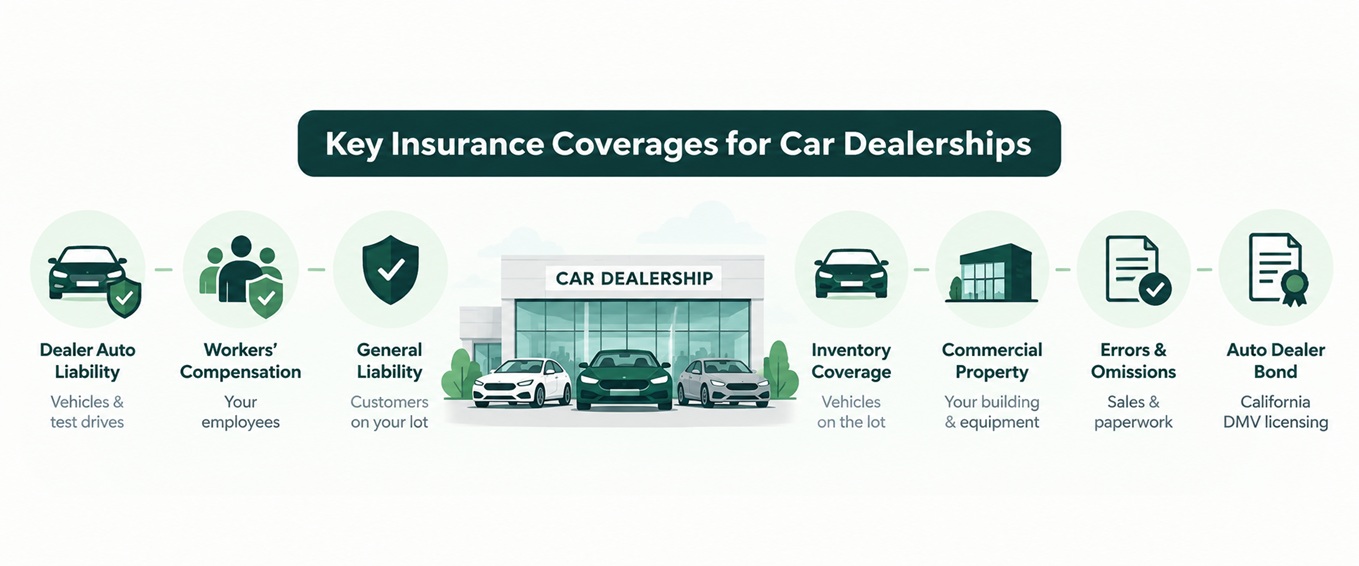
Start with the risks your dealership actually has. This quick overview shows the coverage commonly worth reviewing based on your vehicles, employees, inventory, property and licensing needs.
Car dealership insurance is not a single policy. Auto-related liability, Workers’ Compensation, General Liability, inventory protection, property coverage and an Auto Dealer Bond address different exposures. The right combination depends on how your dealership operates.
1. Auto Liability and Dealer Vehicle Coverage
Vehicles are at the center of dealership operations, which makes auto-related liability one of the first exposures a dealer should review.
California requires financial responsibility for vehicles operated or parked on California roads. The California DMV currently lists minimum liability limits of $30,000 for injury or death to one person, $60,000 for injury or death to more than one person, and $15,000 for property damage, while noting that additional requirements can apply to commercial or fleet vehicles. DMV California
A dealership’s situation is more complicated than simply insuring one personal vehicle.
Depending on the operation, vehicles may be driven by:
- Owners
- Employees
- Salespeople
- Customers during test drives
- Other authorized drivers
That means the dealership should review how its policy handles vehicles owned by the business, inventory vehicles, permitted drivers and test-drive exposures.
Dealer101 also identifies lot inventory and unaccompanied test drives as important dealership insurance considerations. Dealer 101®
2. General Liability Insurance for Car Dealerships
A dealership is also a physical business where customers, vendors and other visitors may be present.
General Liability insurance may help with certain covered claims involving third-party bodily injury or property damage.
For example, consider a customer who slips and is injured inside the dealership or a situation where business operations cause damage to someone else’s property.
These risks are different from accidents involving dealership vehicles.
That distinction matters.
General Liability should not automatically be treated as a replacement for the auto-related coverage a dealership may need.
Dealers should review both their premises/business liability exposures and their vehicle-related exposures when building an insurance program.
3. Workers’ Compensation Insurance
If your dealership has employees, Workers’ Compensation is a particularly important requirement.
California requires employers with one or more employees to provide Workers’ Compensation benefits. CalDIR
At a dealership, employees may include:
- Sales staff
- Office employees
- Lot attendants
- Detailers
- Drivers
- Service technicians
- Parts employees
- Managers
Workplace injuries can happen in offices, on the sales lot, inside service areas or while employees are performing other job duties.
Workers’ Compensation can provide benefits for covered work-related injuries or illnesses, including medical care and certain disability benefits. CalDIR
The dealership should make sure its payroll, employee classifications and business operations are accurately represented when applying for or renewing coverage.
4. Dealership Inventory and Physical Damage Coverage
One of the largest assets of many dealerships is the inventory sitting on the lot.
A dealer may have hundreds of thousands—or potentially millions—of dollars tied up in vehicles.
That creates risks from events such as:
- Theft
- Vandalism
- Fire
- Weather events
- Collision or physical damage
- Other covered causes of loss
Dealer101 specifically identifies lot inventory as an area dealers should consider insuring.
The appropriate protection depends heavily on how much inventory the dealership carries, where vehicles are stored and the terms and exclusions of the policy.
Dealers should not assume that ordinary business property insurance automatically provides the protection needed for vehicle inventory.
5. Commercial Property Insurance
Vehicles are not the dealership’s only physical assets.
The business may also depend on:
- Office equipment
- Computers
- Furniture
- Signs
- Tools
- Service equipment
- Parts
- Buildings or improvements
Commercial Property insurance may help protect covered business property against specified causes of loss.
For dealerships with service departments, repair equipment and specialized machinery can represent a significant investment.
Travelers includes property and equipment breakdown among the insurance categories it offers for auto and truck dealerships. Travelers
The appropriate property coverage will depend on whether the dealership owns or leases its location and what property is actually exposed to loss.
6. Errors and Omissions Insurance
Not every dealership claim involves a car accident or physical damage.
Administrative and transactional mistakes can also create financial risk.
Depending on the dealership and policy, Errors & Omissions coverage may be relevant to certain claims involving errors in business transactions or documentation.
Dealer101 identifies Errors & Omissions, including certain dealership transaction exposures, as an insurance consideration, while Travelers also includes Auto Errors & Omissions in its dealer insurance offering.
Dealers should discuss their specific sales, financing and administrative operations when determining whether E&O coverage is appropriate.
7. Cyber Liability for Dealerships
Modern dealerships collect and process significant amounts of information.
That may include customer contact information, financing information and other business records.
Dealerships also increasingly rely on:
- Dealer management systems
- Online lead forms
- Customer databases
- Online financing applications
- Digital sales systems
A cyber incident can therefore create risks that traditional property or liability policies may not fully address.
Cyber or Internet Liability coverage may be worth reviewing as part of a broader dealership insurance program. Travelers, for example, includes Internet Liability among the coverages available for auto and truck dealerships.
8. Umbrella or Excess Liability Coverage
Some dealerships may also consider limits beyond their underlying liability policies.
Umbrella or Excess Liability coverage can potentially provide additional limits over certain underlying policies, subject to policy terms.
This can be particularly relevant when a dealership has significant vehicle activity, customer traffic, employees or other higher-value exposures.
Travelers includes Umbrella/Excess Liability among its dealership coverage categories.
Whether this coverage makes sense depends on the dealership’s underlying policies, limits and overall risk profile.
Is an Auto Dealer Bond the Same as Dealership Insurance?
No.
This is one of the most important distinctions for California dealers to understand.
An Auto Dealer Bond is a surety bond, while dealership insurance is designed to address covered risks and losses associated with operating the business.
A surety bond generally involves three parties:
Principal: the dealer that needs the bond
Surety: the company issuing the bond
Obligee/protected parties: the party requiring the bond and parties protected under its terms
With a surety bond, if a valid claim is paid by the surety, the dealer may be responsible for reimbursing the surety.
Insurance works differently and is designed around covered losses under the terms, limits, exclusions and conditions of the policy.
So:
Dealer Bond ≠ General Liability
Dealer Bond ≠ Workers’ Compensation
Dealer Bond ≠ Dealer Auto Coverage
A dealership may need both insurance and bonding.
Green State’s existing Auto Dealer Bond content also makes this distinction between the licensing bond and insurance coverage. Pasted markdown
California Auto Dealer Bond Requirements
California vehicle dealers should also review the bonding requirements associated with their specific DMV license type.
The exact bond form and amount can vary depending on the dealer category.
For example, California DMV licensing materials distinguish among different dealer types and application requirements. DMV California
For many standard California vehicle dealers, a $50,000 Auto Dealer Bond may apply, while certain motorcycle, ATV or qualifying wholesale-only dealer situations may involve different bond forms or amounts.
The important point is not simply to purchase “a dealer bond.”
The bond should correspond to the correct dealer license category and DMV requirement.
Need a California Auto Dealer Bond?
Green State Insurance can help dealers review their bonding needs and request the appropriate bond option.
California Auto Dealer Bond:
https://www.greenstateins.com/california-auto-dealer-bond/
What Insurance Does a Used Car Dealership Need?
Used car dealerships can have many of the same exposures as new-car dealerships.
The appropriate insurance program depends on the actual business, but a used dealership may need to review:
Dealer Auto / Auto Liability
For vehicle-related liability and dealership driving exposures.
Workers’ Compensation
When the dealership has employees.
General Liability
For certain covered third-party bodily injury and property damage exposures arising from business operations.
Inventory / Physical Damage Coverage
For covered losses involving vehicles held for sale.
Commercial Property
For covered buildings, equipment and other business property.
Errors & Omissions
For certain covered errors arising from dealership transactions or administrative activities.
Cyber Liability
For certain data, network and privacy-related risks.
Auto Dealer Bond
For applicable California DMV dealer licensing requirements.
Not every dealership will need the exact same combination or limits.
A small independent used-car lot and a large dealership with a service department, dozens of employees and significant inventory can have very different insurance needs.
Car Dealership Insurance Requirements Depend on Your Operations
One of the biggest mistakes a dealership can make is choosing insurance based only on the business label “car dealer.”
Insurance underwriting usually goes deeper than that.
Factors that can affect the coverage needed and the premium may include:
| Factor | Why It Matters |
|---|---|
| Number of vehicles | Changes the dealership’s inventory and vehicle exposure |
| Inventory value | Affects the amount of property at risk |
| Number of employees | Affects Workers’ Compensation and workplace exposure |
| Payroll | Can affect Workers’ Compensation pricing |
| Test-drive activity | Creates additional vehicle exposure |
| Service or repair operations | Adds risks beyond vehicle sales |
| Dealership location | Can affect property and other exposures |
| Claims history | May influence underwriting and pricing |
| Coverage limits | Higher limits can affect premium |
| Deductibles | Can affect both premium and out-of-pocket exposure |
Travelers similarly notes that dealer insurance pricing can depend on dealership size, location, risks, coverage amounts and deductibles.
How Much Does Car Dealership Insurance Cost?
There is no single price that applies to every dealership.
A dealership with a small used-vehicle inventory and few employees may have a very different insurance profile from a large dealership with:
- High-value inventory
- A service department
- Multiple drivers
- Numerous employees
- Large premises
- Frequent test drives
Premiums can also vary based on limits, deductibles, claims history and the specific coverages selected.
For that reason, a useful dealership insurance quote starts with accurate business information rather than a generic average price.
Car Dealership Insurance Checklist
Before requesting a quote or renewing coverage, gather the information an insurance professional may need to understand your dealership’s actual exposures. Use this checklist to make your car dealership insurance requirements review more accurate and efficient.
1. Define Your Dealership Operations
Start with exactly what your business does. Identify whether you sell new or used vehicles, operate as a wholesale dealer, sell motorcycles or other vehicle types, and whether you have a service or repair department.
2. Calculate Your Vehicle Inventory
Know approximately how many vehicles you normally keep in inventory and their estimated total value. Also consider whether inventory levels change significantly during the year.
3. Identify Who Drives Dealership Vehicles
List the people who may operate dealership vehicles, including owners, employees, sales staff and customers during test drives. Be prepared to explain how vehicles are used and whether test drives are accompanied or unaccompanied.
4. Prepare Employee and Payroll Information
Confirm your number of employees, estimated payroll and primary job duties. Separate roles such as sales staff, office employees, lot attendants, detailers, drivers and service technicians when applicable.
5. Disclose Additional Services
Insurance needs can change when a dealership does more than sell vehicles. Identify additional operations such as:
- Vehicle repair or maintenance
- Detailing
- Towing
- Vehicle storage
- Parts sales
- Delivery or vehicle transport
These activities can introduce exposures that may not exist at a sales-only dealership.
6. Review Your Property and Equipment
Make a basic inventory of the physical property used by the dealership, including buildings, office equipment, signs, tools, service equipment, computers and other valuable business property.
If you lease your location, also review any insurance requirements included in the lease.
7. Confirm Your California Auto Dealer Bond
Insurance and bonding serve different purposes. Confirm the bond form and amount associated with your specific California dealer license rather than assuming every dealer has the same requirement.
If you need help with your licensing bond, review Green State Insurance’s California Auto Dealer Bond options.
Final Check Before Requesting a Quote
Before contacting an insurance provider, make sure you can answer these questions:
What type of dealership do you operate?
How many vehicles do you typically carry?
What is the approximate value of your inventory?
Who drives dealership vehicles?
How many employees do you have and what do they do?
Do you provide repairs, detailing, towing or other services?
What property and equipment need protection?
What dealer bond applies to your license?
The goal is not to purchase as many policies as possible. It is to accurately identify your dealership’s vehicle, employee, customer, inventory, property and licensing exposures so you can review coverage that matches how the business actually operates.
Dealer Bond vs. Dealer Insurance: Quick Comparison
| Auto Dealer Bond | Dealership Insurance | |
|---|---|---|
| Main Purpose | Helps satisfy applicable licensing/bond obligations | Addresses covered business risks and losses |
| Protects | Primarily parties protected under the bond | Depends on the insurance policy |
| Claim Repayment | Dealer may have to reimburse surety for a valid paid claim | Generally not structured like surety reimbursement |
| DMV Licensing | May be required depending on dealer license | Separate from the dealer surety bond |
| Replaces Insurance? | No | No — insurance does not replace a required bond |
Understanding this difference is important when reviewing car dealership insurance requirements. Having a bond does not automatically mean the dealership’s business risks are insured.
Review Your Dealership Insurance and Bonding Needs
Understanding car dealership insurance requirements starts with looking at how your dealership actually operates.
A dealership with employees, customer test drives, vehicle inventory and a physical location can have several different exposures. No single policy or bond should automatically be assumed to address all of them.
Green State Insurance can help California dealerships review their business insurance and bonding needs, including applicable liability coverage, Workers’ Compensation and Auto Dealer Bonds.
Explore Green State Insurance Services:
https://www.greenstateins.com/our-services/
California Auto Dealer Bond:
https://www.greenstateins.com/california-auto-dealer-bond/
Workers’ Compensation:
https://www.greenstateins.com/workers-compensation/
General Liability:
https://www.greenstateins.com/general-liability/
Phone: (949) 432-4805
Frequently Asked Questions About Car Dealership Insurance Requirements
Common questions about insurance, Workers’ Compensation, dealer bonds, vehicle coverage, inventory and other risks California car dealerships should review.
What insurance does a car dealership need in California?
The answer depends on the dealership’s operations. Dealers may need to review auto liability or dealer auto coverage, Workers’ Compensation, General Liability, inventory protection, Commercial Property, Errors & Omissions and other specialized coverages. Applicable bonding requirements should be reviewed separately.
Is Workers’ Compensation required for a California car dealership?
California employers with one or more employees generally must provide Workers’ Compensation benefits.
Does an Auto Dealer Bond count as insurance?
No. An Auto Dealer Bond is a surety bond and serves a different purpose from dealership insurance. A dealer may need both.
Does General Liability cover dealership vehicles?
General Liability should not be assumed to cover the dealership’s auto exposures. Dealers should review appropriate auto-related coverage for vehicles used in their operations.
Do used car dealerships need insurance?
Used car dealerships face many of the same liability, vehicle, employee, property and inventory risks as other dealerships. The appropriate policies and limits depend on the dealership’s actual operations.
Does dealership insurance cover test drives?
Coverage depends on the policy and circumstances. Because test drives create a significant dealership auto exposure, dealers should specifically verify how customer test drives and permitted drivers are handled under their coverage.
Is dealership inventory automatically covered?
Do not assume it is. Dealers should verify how vehicles held for sale are covered, the applicable limits and what causes of loss are included or excluded.
How much does dealership insurance cost?
Cost depends on factors such as dealership size, inventory, employees, location, operations, claims history, selected coverages, limits and deductibles.